Giải đề IELTS Cambridge 21 – Test 4: Listening Part 4 Music therapy for surgical patients

Cùng IZONE luyện tập giải đề IELTS Cambridge 21 Test 4 Listening Part 4 Music therapy for surgical patients và tham khảo phần giải thích đáp án chi tiết trong bài viết này nhé!
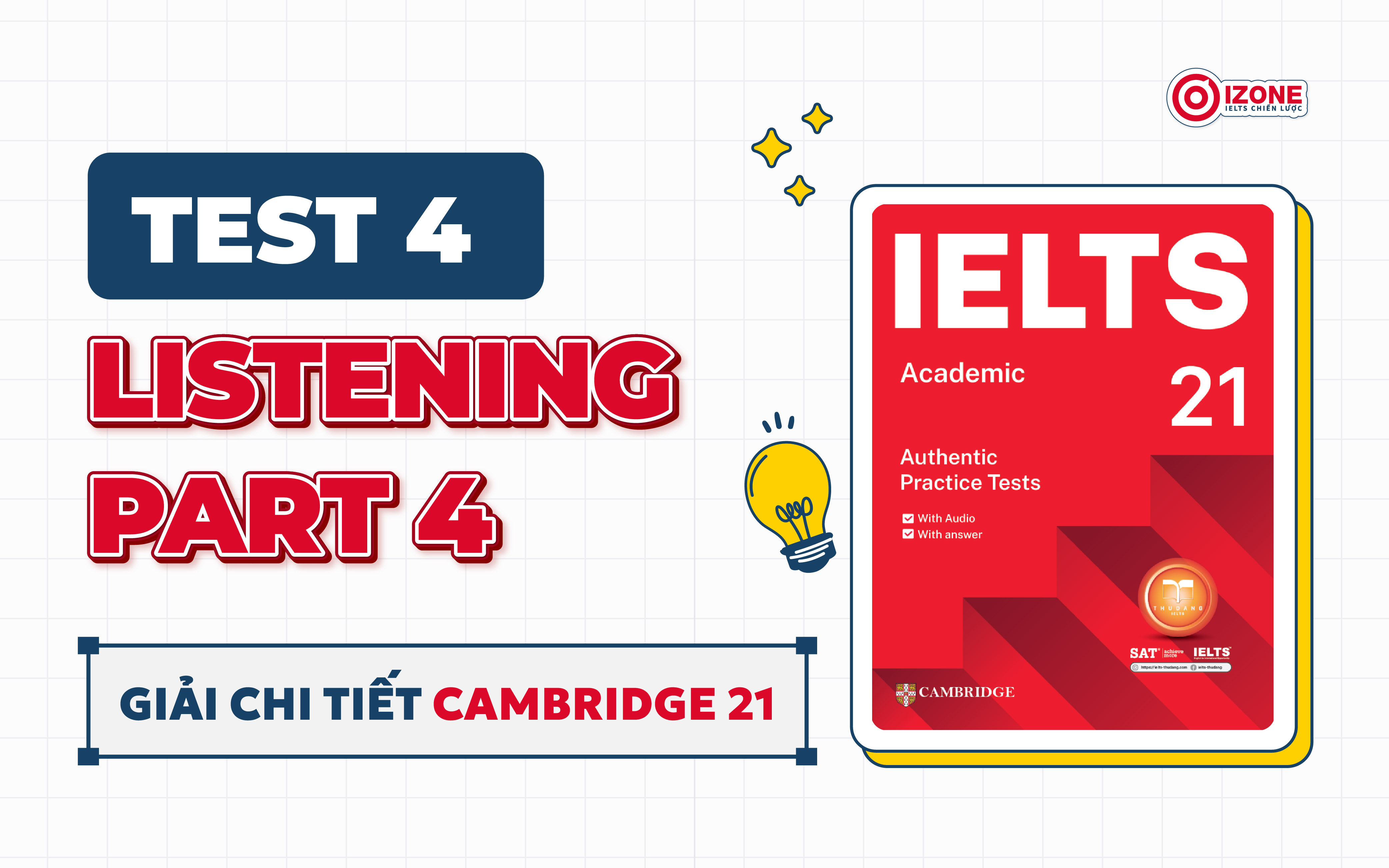
Bài nghe IELTS Cambridge 21 Test 4 Listening Part 4 Music therapy for surgical patients
Music therapy for surgical patients Background
Recent research
|
Luyện tập Cam 21 với giao diện chuẩn thi máy IDP/BC tại Website Luyện tập Listening và Reading của IZONE:
Trải nghiệm ngay Web Luyện tập IZONE để tiến bộ hơn mỗi ngày! |

Audiotranscripts IELTS Cambridge 21 Test 4 Listening Part 4 Music therapy for surgical patients
Part 4. You will hear part of a lecture to medical students about playing music to patients who are in hospital for surgery. First, you have some time to look at questions 31 to 40.
Now listen carefully and answer questions 31 to 40.
Today’s lecture is about studies that look at how music therapy can be used to help patients who undergo surgery.
Now, most people undergo a surgical procedure at some point in their lives, and more than 51 million operations are performed annually in the USA. But there’s no escaping the fact that most patients feel uncomfortable following surgery. They may have difficulty mobilizing, and even sitting up in bed can feel too much. They may also be negatively affected by having their routine disrupted, you know, like if they can’t do the things they normally do, or have to devote a lot of time to appointments, such as physiotherapy to aid their recovery.
Currently, the main strategy for improving recovery is medication to control pain, and this can be administered to patients in the short, medium, or longer term, depending on the extent of their surgery. But music is still not an everyday part of the post-surgical phase, despite a wealth of relevant studies supporting its potential in recovery.
Earlier this year, a research team set out to assess all the available evidence so that they could highlight the potential for music in surgical recovery. They identified nearly a hundred trials involving a total of 7,000 patients who were played recorded music as part of their post-operative care. The researchers then looked at what impact the music had on the patients.
They discovered that patients who had been played music reported feeling happier and more satisfied in the post-operative phase, and the length of their stay was shorter than for patients who had not listened to any music.
The researchers also explored the patients’ choice of music, and their findings showed that a wide variety of music styles was evident. However, a common factor was that the chosen music had a calming quality. Some of the patients listened to music with headphones, but it was quiet enough not to prevent them from being able to communicate with nurses and other staff.
More often though, the mode of delivery was by what are known as music pillows. These broadcast sound that is only audible to the person lying on them. The research involved testing music before, during, or after operations, or a combination. Some patients listened to the music just once a day, while others had several episodes a day.
When asked to report their experience of listening to music, surgical patients said that either they had no feelings of anxiety at any point, or those feelings were only slight. Patients who hadn’t listened to music, on the other hand, reported higher levels of dissatisfaction.
This feedback from all of the patients was then cross-checked against their medical notes. And in every case, those who were given music to listen to didn’t need as much medication to ease their pain as those patients who weren’t played music.
The type of music, patient choice, and timing—before, during, or after the surgery—didn’t make much difference. And it even worked when patients were played music under general anesthetic, although the positive effects were greater when patients were awake.
All the evidence suggests that music has a positive effect on post-operative patients, but it’s not entirely clear how or why this is the case. A lot of people listen to music in daily life as a way to relax and forget their problems, but the researchers came to the conclusion that it worked on patients by distraction. I suppose it was something familiar and gave them something they could control.
The researchers say there is now sufficient research to demonstrate that music should be available to all patients undergoing operations. They say patients should be able to choose what they’d like to listen to. And if they prefer, recordings taken from nature can be just as good as music.
Surgical teams may prefer patients to listen to music before the procedure, or as soon as they arrive back onto the ward. Clearly, there’s more to learn about this area, and the team now plan to focus their next research on the most appropriate volume to play the music at, and I look forward to reading the results of their study. It will be interesting to see that if it’s…
That is the end of part 4. You now have one minute to check your answers to part 4.
Đáp án & Giải chi tiết IELTS Cambridge 21 Test 4 Listening Part 4 Music therapy for surgical patients
Question 31-40 Dạng Note Completion/ Table Completion/ Diagram Completion (Chú ý sửa lại tên tương ứng với dạng bài) Cách làm: Bước 1: Đọc lướt các chỗ trống cần điền đáp án. Khoanh tròn giới hạn từ cần điền Bước 2: Đoán nhanh xem liệu loại từ cần điền vào chỗ trống là loại từ gì (danh từ, động từ, tính từ hay trạng từ) và xác định dạng từ (tên quốc gia, tên người, con số ….) Bước 3: Xác định những từ khóa trong câu chứa chỗ trống cần điền. Bước 4: Nghe và lựa chọn đáp án | |
Câu 31: Surgery impacts patients because they may experience discomfort or unwelcome changes to their ______. Từ cần điền là danh từ vì đứng sau tính từ sở hữu their. Nội dung bài: Đề cập đến việc phẫu thuật ảnh hưởng đến bệnh nhân vì họ cũng có thể bị ảnh hưởng tiêu cực khi thói quen sinh hoạt hằng ngày của họ bị xáo trộn, chẳng hạn như khi họ không thể làm những việc mà họ vẫn thường làm. => Đáp án là routine | Speaker: Now, most people undergo a surgical procedure at some point in their lives. And more than fifty-one million operations are performed annually in the USA. But there’s no escaping the fact that most patients feel uncomfortable following surgery. They may have difficulty mobilising, and even sitting up in bed can feel too much. They may also be negatively affected by having their routine disturbed, you know, like if they can’t do the things they normally do…” |
Câu 32: A study reviewed data from about 100 __________________ and found that listening to music:
Từ cần điền là danh từ số nhiều vì đứng sau about 100. => Đáp án là trials | Speaker: Earlier this year, a research team set out to assess all the available evidence so that they could highlight the potential for music in surgical recovery. They identified nearly a hundred trials involving a total of seven thousand patients who were played recorded music as part of their post-operative care. |
Câu 33: The patients in the study all listened to music with a ______ effect Từ cần điền là tính từ vì bổ nghĩa cho danh từ effect. Nội dung bài: Điểm chung là loại nhạc được lựa chọn đều có đặc tính giúp tạo cảm giác thư giãn và bình tĩnh. => Đáp án là calming | Speaker: The researchers also explored the patients‘ choice of music, and their findings showed that a wide variety of music styles was evident. However, a common factor was that the chosen music had a calming quality. |
Câu 34: The music was mostly played through music __________________.
Nội dung bài: Tuy nhiên, phổ biến hơn cả, âm nhạc được truyền tải thông qua một thiết bị gọi là “gối âm nhạc” (music pillows). => Đáp án là: pillows | Speaker: More often though, the mode of delivery was by what are known as music pillows.” |
Câu 35: Patients reported an absence or low levels of __________________.
Nội dung bài: Khi được yêu cầu chia sẻ trải nghiệm nghe nhạc của mình, các bệnh nhân phẫu thuật cho biết rằng hoặc là họ hoàn toàn không cảm thấy lo âu vào bất kỳ thời điểm nào, hoặc nếu có thì cảm giác lo âu chỉ ở mức rất nhẹ. => Đáp án là: anxiety | “When asked to report their experience of listening to music, surgical patients said that either they had no feelings of anxiety at any point, or those feelings were only slight.” |
Câu 36: Medical records confirmed that patients who were played music in hospital needed less __________________ than those who weren’t played music.
Nội dung bài: Những bệnh nhân được nghe nhạc không cần dùng nhiều thuốc giảm đau như những bệnh nhân không được nghe nhạc. => Đáp án là: medication | Speaker: Those who were given music to listen to didn’t need as much medication to ease their pain as those patients who weren’t played music. |
Câu 37: The best results were achieved when patients were played music while they were __________________.
Nội dung bài: Phương pháp này thậm chí vẫn có hiệu quả ngay cả khi bệnh nhân được nghe nhạc trong lúc đang được gây mê toàn thân, mặc dù hiệu quả tích cực rõ rệt hơn khi bệnh nhân còn tỉnh. => Đáp án là: awake | Speaker: It even worked when patients were played music under general anesthetic, although the positive effects were greater when patients were awake. |
Câu 38: The study concluded that playing music was effective because it served as a __________________.
Nội dung bài: Các nhà nghiên cứu đi đến kết luận rằng phương pháp này có tác dụng đối với bệnh nhân nhờ cơ chế đánh lạc hướng sự chú ý. => Đáp án là: distraction | Speaker: The researchers came to the conclusion that it worked on patients by distraction. |
Câu 39: The researchers recommend playing either music or sounds from __________________ to all surgical patients.
Nội dung bài: Các nhà nghiên cứu cho rằng bệnh nhân nên được tự lựa chọn những gì họ muốn nghe; và nếu họ thích, các bản ghi âm âm thanh từ thiên nhiên cũng có thể mang lại hiệu quả tốt như âm nhạc. => Đáp án là: nature | Speaker: They say patients should be able to choose what they’d like to listen to, and if they prefer, recordings taken from nature can be just as good as music. |
Câu 40: A future study will investigate the best __________________ for the music.
Nội dung bài: Nhóm nghiên cứu hiện dự định tập trung nghiên cứu tiếp theo vào việc xác định mức âm lượng phù hợp nhất để phát nhạc. => Đáp án là: volume | Speaker: … the team now plan to focus their next research on the most appropriate volume to play the music at. |