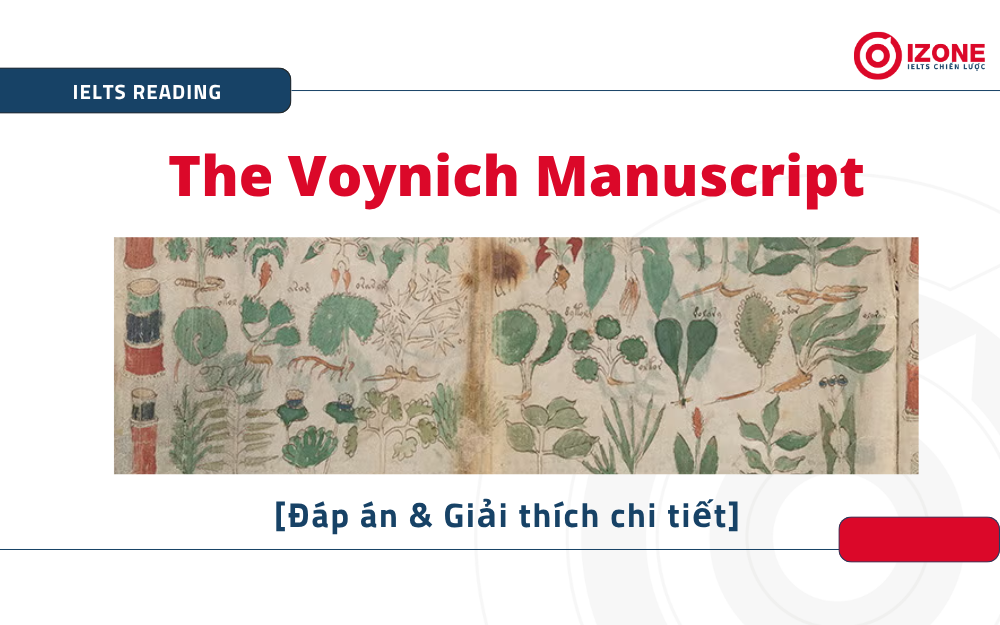
[Giải đáp án chi tiết] The Voynich Manuscript IELTS Reading
Cùng IZONE luyện tập với bài đọc The Voynich Manuscript IELTS Reading và tham khảo phần giải thích đáp án chi tiết nhé!
Bài đọc The Voynich Manuscript IELTS Reading
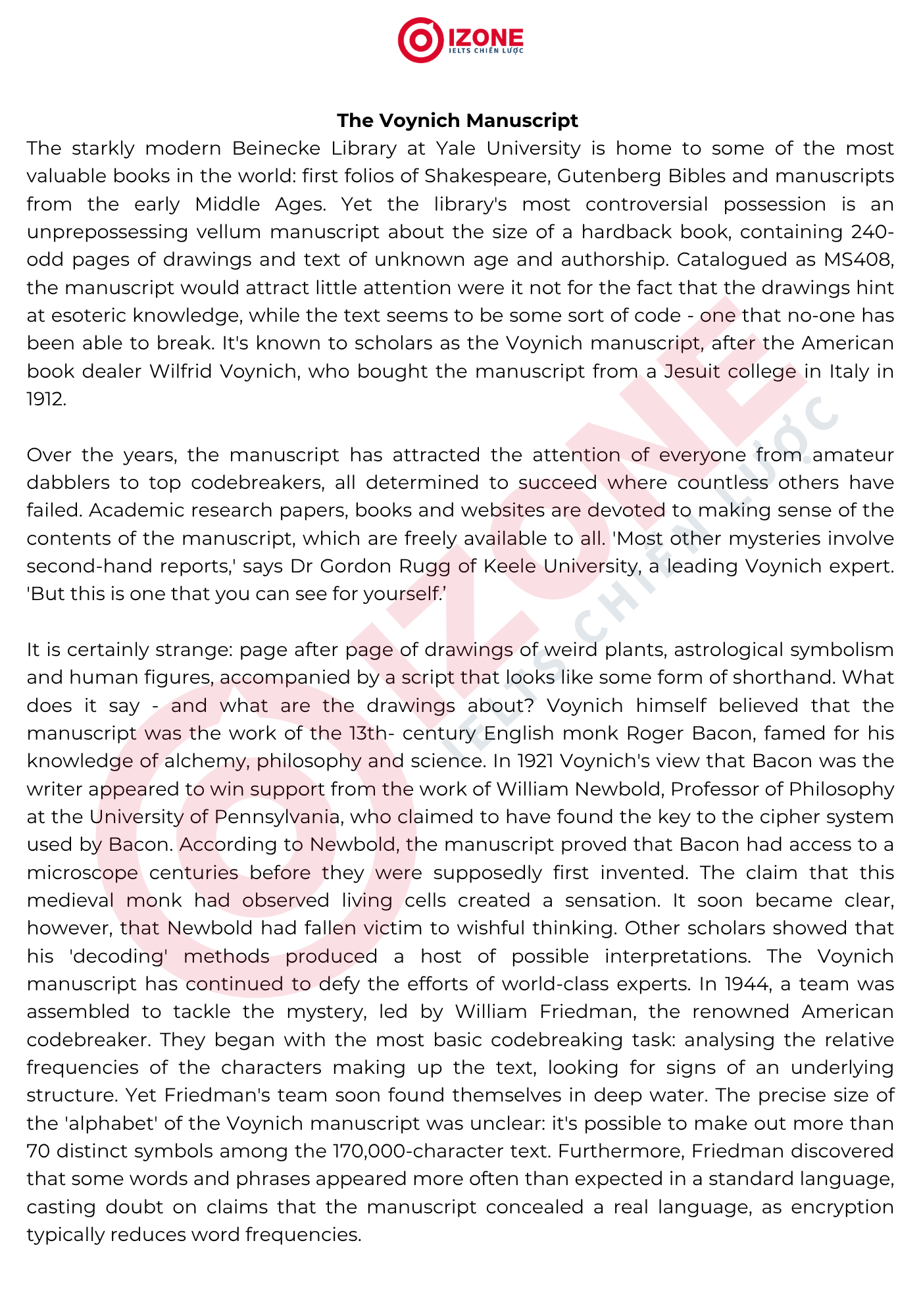
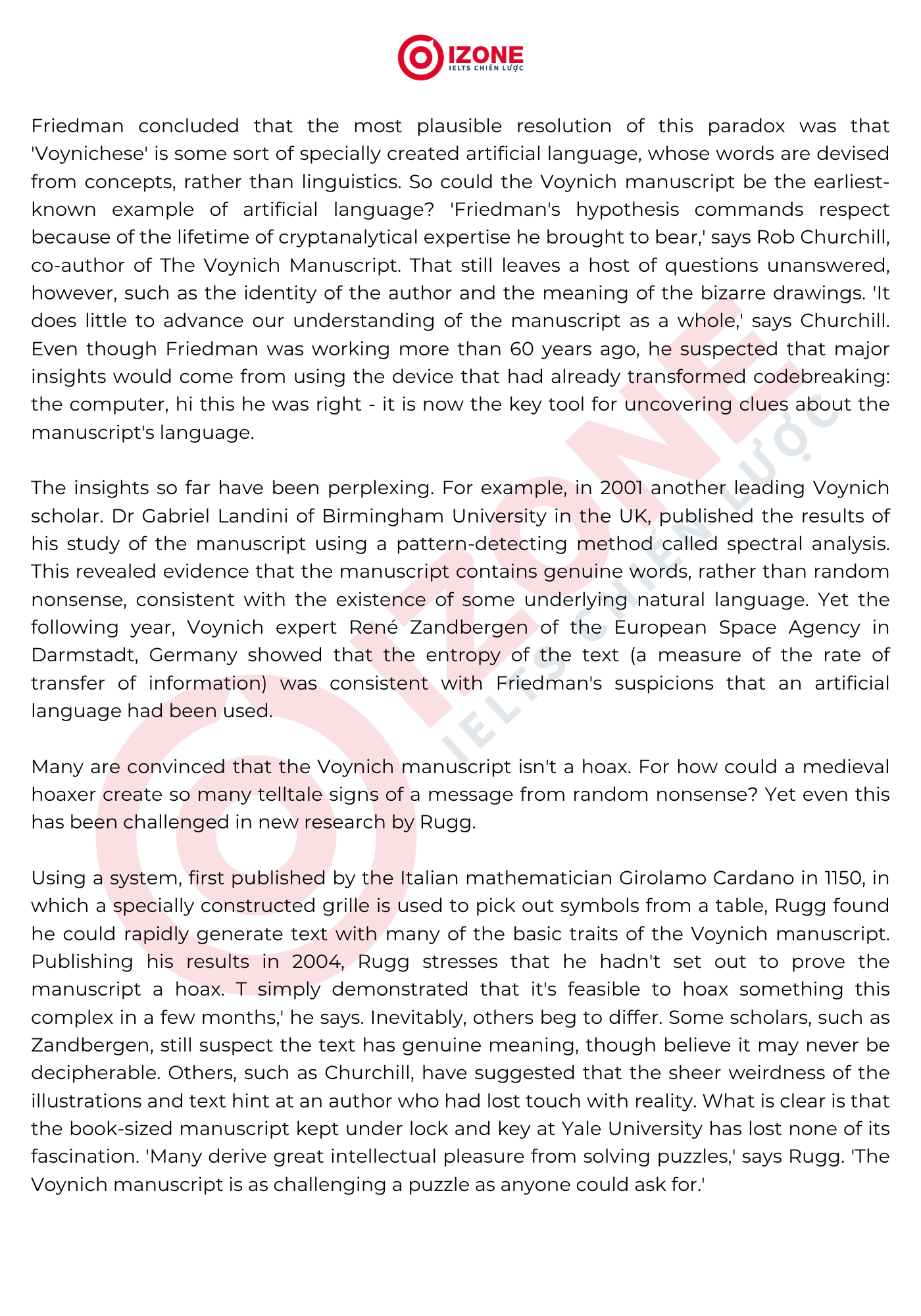
Questions 27-30: Do the following statements agree with the information given in Reading Passage 3?
In boxes 27 - 30 on your answer sheet, write
TRUE if the statement agrees with the information in the passage,
FALSE if it contradicts the information
NOT GIVEN if there is no information on this.
Questions 31-34:
Look at the following statements (Questions 31-34) and the list of people below. Match each statement with the correct person, A-H. Write the correct letter, A-H, in boxes 31-34 on your answer sheet.
List of People:
A Gordon Rugg
B Roger Bacon
C William Newbold
D William Friedman
E Rob Churchill
F Gabriel Landini
G Ren Zandbergen
H Girolamo Cardano
Questions 35-39: Complete the sentences with NO MORE THAN TWO WORDS from the passage.
Voynich Researchers William Newbold believed that the author of the Voynich manuscript had been able to look at cells through a 35 Other researchers later demonstrated that there were flaws in his argument. William Friedman concluded that the manuscript was mitten in an artificial language that was based on 36 He couldn't find out the meaning of this language but he believed that the 37 would continue to bring advances in code breaking. Dr Gabriel Landini used a system known as 38 in his research, and claims to have demonstrated the presence of genuine words. Dr Gordon Rugg's system involved a grille that made it possible to quickly select symbols that appeared in a 39 Rugg's conclusion was that the manuscript lacked genuine meaning.
Question 40: Choose the correct letter A, B, C, or D.
The writer’s main aim in this passage is to:
Điểm số của bạn là % - đúng / câu
Đáp án và giải thích chi tiết The Voynich Manuscript IELTS Reading with answer
Đáp án The Voynich Manuscript IELTS Reading
| 27. TRUE | 34. C |
| 28. NOT GIVEN | 35. microscope |
| 29. TRUE | 36. concepts |
| 30. FALSE | 37. computer |
| 31. D | 38. Spectral analysis |
| 32. A | 39. table |
| 33. E | 40. C |
Giải thích đáp án chi tiết The Voynich Manuscript IELTS Reading with answer
|
Question 27 – 30: Dạng TRUE/FALSE/NOT GIVEN & YES/NO/NOT GIVEN Cách làm:
Chọn đáp án bằng cách lần lượt trả lời 2 câu hỏi:
|
|
|
27. It is uncertain when the Voynich manuscript was written.
Đoạn văn nói rõ bản thảo có “unknown age”, tức là không xác định được thời điểm được viết. Đáp án TRUE |
Yet the library’s most controversial possession is an unprepossessing vellum manuscript about the size of a hardback book, containing 240-odd pages of drawings and text of unknown age and authorship. Catalogued as MS408, the manuscript would attract little attention were it not for the fact that the drawings hint at esoteric knowledge, while the text seems to be some sort of code – one that no-one has been able to break. It’s known to scholars as the Voynich manuscript, |
|
28. Wilfrid Voynich donated the manuscript to the Beinecke Library.
Văn bản chỉ nói Voynich mua bản thảo, không đề cập ông có tặng nó cho thư viện hay không. Đáp án NOT GIVEN |
It’s known to scholars as the Voynich manuscript, after the American book dealer Wilfrid Voynich, who bought the manuscript from a Jesuit college in Italy in 1912. |
|
29. Interest in the Voynich manuscript extends beyond that of academics and professional code breakers.
Đoạn văn cho thấy cả người không chuyên (amateur dabblers) cũng quan tâm. Đáp án TRUE |
Over the years, the manuscript has attracted the attention of everyone from amateur dabblers to top codebreakers |
|
30. The text of the Voynich manuscript contains just under 70 symbols.
Đáp án FALSE |
The precise size of the ‘alphabet’ of the Voynich manuscript was unclear: it’s possible to make out more than 70 distinct symbols |
|
Questions 31-34: Dạng Matching Names Cách làm:
Note: Một số tên riêng có thể nối với nhiều hơn 1 đáp án |
|
|
31. The number of times some words occur make it unlikely that the manuscript is based on an authentic language. William Friedman chỉ ra rằng số lần lặp lại của từ khiến người ta nghi ngờ đây là ngôn ngữ thật. Đáp án D- William Friedman |
Friedman discovered that some words and phrases appeared more often than expected in a standard language, casting doubt on claims that the manuscript concealed a real language, as encryption typically reduces word frequencies. |
|
32. Unlike some other similar objects of fascination, people can gain direct access to the Voynich manuscript. Gordon Rugg cho rằng khác với các bí ẩn khác, bản thảo này ai cũng có thể tận mắt xem. Đáp án A – Gordon Rugg |
‘Most other mysteries involve second-hand reports,’ says Dr Gordon Rugg of Keele University, a leading Voynich expert. ‘But this is one that you can see for yourself.’ |
|
33. The person who wrote the manuscript may not have been entirely sane. Rob Churchill gợi ý rằng người viết bản thảo có thể không tỉnh táo. Đáp án E – Rob Churchill |
such as Churchill, have suggested that the sheer weirdness of the illustrations and text hint at an author who had lost touch with reality. |
|
34. It is likely that the author of the manuscript is the same person as suggested by Wilfrid Voynich. William Newbold ủng hộ quan điểm của Voynich rằng tác giả là Roger Bacon. Đáp án C – William Newbold |
Voynich himself believed that the manuscript was the work of the 13th- century English monk Roger Bacon, famed for his knowledge of alchemy, philosophy and science. In 1921 Voynich’s view that Bacon was the writer appeared to win support from the work of William Newbold |
|
Questions 35-39: Dạng Summary Completion without a wordlist Cách làm:
|
|
|
William Newbold believed that the author of the Voynich manuscript had been able to look at cells through a 35…………. Từ cần điền là một danh từ, sau mạo từ “a” nên là danh từ số ít. Newbold cho rằng Bacon dùng kính hiển vi để quan sát tế bào. Đáp án microscope |
According to Newbold, the manuscript proved that Bacon had access to a microscope centuries before they were supposedly first invented. The claim that this medieval monk had observed living cells |
|
William Friedman concluded that the manuscript was written in an artificial language that was based on 36………….. Từ cần điền là danh từ Friedman cho rằng ngôn ngữ trong bản thảo là ngôn ngữ nhân tạo dựa trên khái niệm. Đáp án là concepts |
Friedman concluded that the most plausible resolution of this paradox was that ‘Voynichese’ is some sort of specially created artificial language, whose words are devised from concepts, rather than linguistics. |
|
He couldn’t find out the meaning of this language but he believed that the 37……………..would continue to bring advances in code breaking. Từ cần điền là danh từ Friedman tin rằng máy tính sẽ giúp giải mã ngôn ngữ. Đáp án là computer |
Even though Friedman was working more than 60 years ago, he suspected that major insights would come from using the device that had already transformed codebreaking: the computer, |
|
Dr Gabriel Landini used a system known as 38……………….in his research, and claims to have demonstrated the presence of genuine words. Từ cần điền là danh từ Landini sử dụng phương pháp phân tích mẫu. Đáp án là spectral analysis |
Dr Gabriel Landini of Birmingham University in the UK, published the results of his study of the manuscript using a pattern-detecting method called spectral analysis. |
|
Dr Gordon Rugg’s system involved a grille that made it possible to quickly select symbols that appeared in a 39…………………..Rugg’s conclusion was that the manuscript lacked genuine meaning. Từ cần điền là danh từ Hệ thống của Rugg chọn ký hiệu từ một bảng. Đáp án là table |
Using a system, first published by the Italian mathematician Girolamo Cardano in 1150, in which a specially constructed grille is used to pick out symbols from a table, Rugg found he could rapidly generate text with many of the basic traits of the Voynich manuscript. |
|
Questions 40: Dạng MCQ Cách làm:
Chứng minh các đáp án ĐÚNG/SAI bằng cách lần lượt trả lời 2 câu hỏi:
|
|
|
40. The writer’s main aim in this passage is to: Tác giả không tập trung vào việc giải thích nội dung bản thảo (A) hay xác định chính xác tác giả của nó (B). Đồng thời không hề đề cập gì tới độ phủ sóng truyền thông của các nghiên cứu (D). Thay vào đó, bài đọc trình bày một cách có hệ thống, đầy đủ và liên tục về các nỗ lực giải mã bản thảo Voynich qua các thời kỳ và bởi nhiều nhà nghiên cứu khác nhau. Đáp án là C – describe the numerous attempts to decode the manuscript. |
Over the years, the manuscript has attracted the attention of everyone from amateur dabblers to top codebreakers Voynich himself believed…”, “Newbold claimed to have found the key…”, “Friedman discovered…”, “Landini used a pattern-detecting method…” “Rugg stresses that he hadn’t set out to prove the manuscript a hoax. ‘I simply demonstrated…’” “The insights so far have been perplexing.” “The Voynich manuscript is as challenging a puzzle as anyone could ask for.” |
Bài viết trên đã cung cấp đáp án cũng như giải thích chi tiết bài đọc The Voynich Manuscript IELTS Reading. Bạn có thể khám phá thêm nhiều bài luyện tập IELTS Reading khác tại chuyên mục Reading 6.0 – 8.0 của IZONE.
Thử sức với Marketing and Mind Control – IELTS Reading
Giải đáp án What is speed reading, and why do we need it IELTS Reading