Đáp án Astronaut ice cream, anyone?
Lời giải chi tiết Astronaut ice cream, anyone?
Trên đây là lời giải chi tiết cho bài đọc IELTS Reading Astronaut ice cream, anyone?. Đừng quên liên hệ với IZONE để được tư vấn nhé!
|
Questions 1 – 5: Dạng Flowchart Completion Cách làm: Bước 1: Khoanh tròn giới hạn từ được điền Bước 2: Nghiên cứu Diagram/ Table/ Flowchart và xác định loại từ cho mỗi chỗ trống Bước 3: Skim bài text để tìm ra những đoạn liên quan chứa đáp án Bước 4: Scan đoạn văn và điền đáp án đúng, chú ý giới hạn từ |
|
|
Câu 1: easy _______ of food items Cụ thể: Trong bài đọc, đoạn văn thứ ba giải thích rằng việc loại bỏ nước làm cho thực phẩm nhẹ hơn nhiều và do đó làm cho việc vận chuyển ít khó khăn hơn. => Đáp án là: transportation |
Removing this makes the food much lighter and therefore makes transportation less difficult. |
|
Câu 2: long-term storage of _______ and biological samples Cụ thể: Đoạn văn thứ tư nói rằng quy trình này cũng được dùng để bảo quản các loại vật liệu khác, chẳng hạn như dược phẩm. => Đáp án là: pharmaceuticals |
The process is also used to preserve other sorts of material, such as pharmaceuticals. … Similarly, research scientists may use freeze-drying to preserve biological samples for long periods of time. |
|
Câu 3: preservation of precious _______ Cụ thể: Đoạn văn thứ tư kết thúc bằng câu: Ngay cả những bản thảo có giá trị bị hư hại do nước cũng đã được cứu bằng quy trình này. => Đáp án là: manuscripts |
Even valuable manuscripts that had been water damaged have been saved by using this process. |
|
Câu 4: is based on process of _______ Cụ thể: Đoạn văn thứ sáu giải thích hiện tượng nước chuyển trực tiếp từ thể rắn (băng) sang thể khí (hơi). Câu văn nêu rõ: Điều này được gọi là ‘sự thăng hoa’…. => Đáp án là: sublimation |
This is possible because in freeze-drying, solid water – ice – is converted directly into water vapour, missing out the liquid phase entirely. This is called ‘sublimation’… |
|
Câu 5: …is more efficient than _______ Cụ thể: Đoạn văn thứ năm bắt đầu bằng việc so sánh: Sấy thăng hoa khác với sấy khô đơn giản vì nó có thể loại bỏ gần như toàn bộ nước…. =>Đáp án là: simple drying (techniques) |
Freeze-drying is different from simple drying because it is able to remove almost all the water from materials, whereas simple drying techniques can only remove 90-95%. |
|
Questions 6 – 9: Dạng Diagram Completion Cách làm: Bước 1: Khoanh tròn giới hạn từ được điền Bước 2: Nghiên cứu Diagram/ Table/ Flowchart và xác định loại từ cho mỗi chỗ trống Bước 3: Skim bài text để tìm ra những đoạn liên quan chứa đáp án Bước 4: Scan đoạn văn và điền đáp án đúng, chú ý giới hạn từ |
|
|
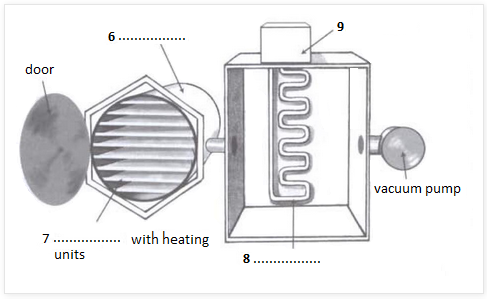
Câu 6: Cụ thể: Số 6 chỉ vào bộ phận lớn hình lục giác nơi thực phẩm được đặt vào. Đoạn văn mô tả máy móc có câu: Vật liệu cần bảo quản được đặt trong một buồng sấy thăng hoa…. =>Đáp án là: (freeze-drying) chamber |
The material to be preserved is placed in a freeze-drying chamber which is connected to a freezing coil and refrigerator compressor. |
|
Câu 7: ______ with heating unit Cụ thể: Số 7 chỉ vào các khay nằm ngang bên trong buồng sấy. Đoạn văn mô tả quá trình làm nóng có câu: Các bộ phận làm nóng cung cấp một lượng nhiệt nhỏ cho các kệ trong buồng…. =>Đáp án là: shelves |
The heating units apply a small amount of heat to the shelves in the chamber, causing the ice to change phase. |
|
Câu 8: Cụ thể: Số 8 chỉ vào bộ phận hình ziczac, uốn lượn bên trong hộp bên phải. Đoạn văn mô tả hơi nước thoát ra khỏi buồng sấy và …chảy qua cuộn dây làm lạnh. Hơi nước ngưng tụ trên cuộn dây làm lạnh dưới dạng băng rắn…. =>Đáp án là: freezing coil |
…the ice turns directly into water vapour, which leaves the freeze-drying chamber, and flows past the freezing coil. |
|
Câu 9: Cụ thể: Số 9 chỉ vào khối hộp nằm trên cùng của bộ phận bên phải. Đoạn văn mô tả cấu tạo máy có câu:…buồng được kết nối với một cuộn dây làm lạnh và máy nén tủ lạnh. Khi buồng được niêm phong, máy nén sẽ hạ nhiệt độ bên trong nó. =>Đáp án là: refrigerator compressor |
The material to be preserved is placed in a freeze-drying chamber which is connected to a freezing coil and refrigerator compressor. |
|
Questions 10 – 13: Dạng Summary Completion without a wordlist Cách làm: Bước 1: Đọc kĩ câu hỏi và gạch chân từ khóa, khoanh tròn giới hạn từ Bước 2: Xác định từ loại và loại thông tin cần điền trong chỗ trống (VD: noun – a person) Bước 3: Scan từ khóa đã xác định trong đoạn văn Bước 4: Điền vào chỗ trống, kiểm tra lại giới hạn từ & ngữ pháp |
|
|
Câu 10: Freeze-drying prevents food from going bad by stopping the activity of microorganisms or ______ Cụ thể: Đoạn văn thứ hai giải thích rằng vi sinh vật như vi khuẩn gây hỏng không thể tồn tại nếu không có nó. Tương tự, các enzyme tự nhiên trong thực phẩm không thể gây chín nếu không có nước…. =>Đáp án là: enzymes |
…the microorganisms such as bacteria that cause spoiling cannot survive without it. Similarly, the enzymes which occur naturally in food cannot cause ripening without water… |
|
Câu 11: Its advantages are that the food tastes and feels the same as the original because both the ______ and structure are preserved. Cụ thể: Đoạn tóm tắt nói về ưu điểm của sấy thăng hoa là giữ được hương vị và cảm giác ban đầu vì cả thành phần và “structure” (cấu trúc) đều được bảo toàn. =>Đáp án là: composition |
In addition, the composition and structure of the material is not significantly changed, so materials can be revitalised without compromising the quality of the original. |
|
Câu 12: The process is carried out slowly in order to ensure that ______ does not take place. Cụ thể: Đoạn tóm tắt nói rằng quá trình được thực hiện chậm để đảm bảo sự quá nhiệt không xảy ra. =>Đáp án là: overheating |
This time is necessary to avoid overheating, which might affect the structure of the material. |
|
Câu 13: The people of one ancient mountain civilisation were able to use this method of food preservation because the conditions needed were present at ______ Cụ thể: Đoạn tóm tắt đề cập đến một nền văn minh miền núi cổ đại. Vì ở độ cao lớn trên núi nên họ có thể sử dụng phương thức bảo quản thực phẩm này =>Đáp án là: high altitudes |
The ancient Incas of Peru used mountain peaks along the Andes as natural food preservers. The extremely cold temperatures and low pressure at those high altitudes prevented food from spoiling in the same basic way as a modern freeze-drying machine and a freezer. |


Tham khảo: [Giải thích đáp án chi tiết] Communicating styles and conflict IELTS Reading