Giải chi tiết Living Dunes IELTS Reading Answers
Thực hành luyện tập với bài đọc Living Dunes IELTS Reading và tham khảo phần giải thích đáp án chi tiết từ IZONE nhé!
Bài đọc Living Dunes IELTS Reading
Questions 27-33
Reading passage 3 has seven paragraphs, A-G.
Choose the correct heading for paragraphs A-G from the list of headings below.
Write the correct number, i-x, in boxes 27-33 on your answer sheet.
List of Headings
i Shaping and reforming
ii Causes of desertification
iii Need combination of specific conditions
iv Potential threat to industry and communication
v An old superstition demystified
vi Differences and similarities
vii A continuous cycling process
viii Habitat for rare species
ix Replicating the process in laboratory
x Commonest type of dune
Questions 34-36
Complete the sentences below.
Choose ONE WORD ONLY from the passage for each answer.
Write your answers in boxes 34-36 on your answer sheet.
34 dune is said to have long ridges that can extend hundreds of miles.
35 According to Bagnold, an is needed to stop the sand from moving before a dune can form.
36 Stéphane Douady believes the singing of dunes is not a spiritual phenomenon, but purely .
Questions 37-40
Complete the summary below.
Choose ONE WORD ONLY from the passage for each answer.
Write your answers in boxes 37-40 on your answer sheet.
There are many different types of dunes, two of which are most commonly found in deserts throughout the world, the linear dune and the 37 dune, sometimes also known as the crescentic dune. It’s been long known that in some places dunes can even sing and the answer lies in the sand itself. To produce singing sand in lab, all the sands must have similar 38 . And scientists have discovered that the size of the sand can affect the 39 of the sound. But the function of the varnish composed by a mixture of 40 still remains puzzling.
Điểm số của bạn là % - đúng / câu
Đáp án và giải thích chi tiết Living Dunes IELTS Reading Answers
| 27 iv | 34 linear |
| 28 x | 35 obstacle |
| 29 iii | 36 acoustic |
| 30 vii | 37 barchan |
| 31 i | 38 shape |
| 32 v | 39 tone |
| 33 ix | 40 minerals |
Giải thích đáp án chi tiết Living Dunes IELTS Reading Answers
|
Questions 27 – 33: Dạng Matching heading Cách làm:
|
|
|
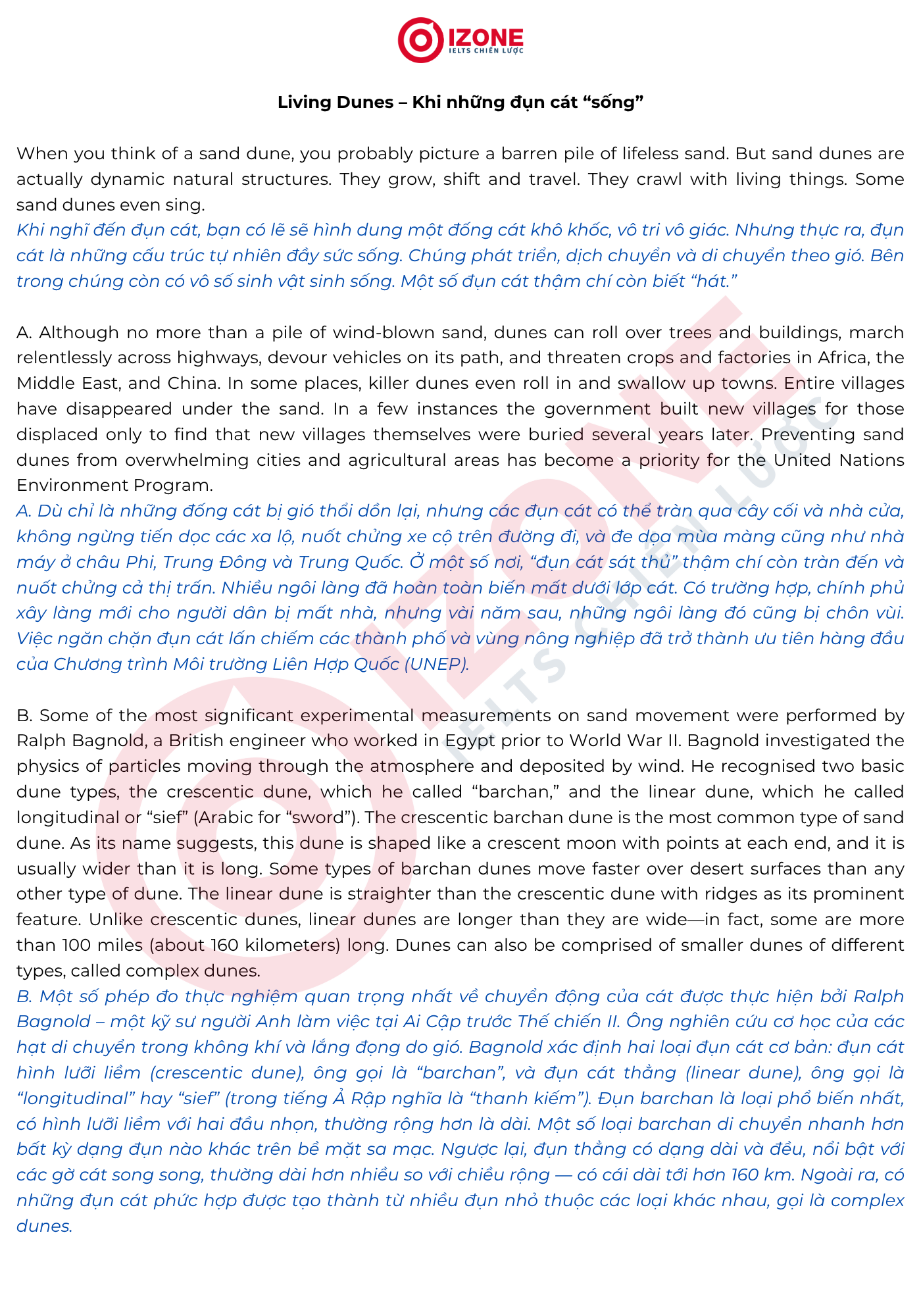
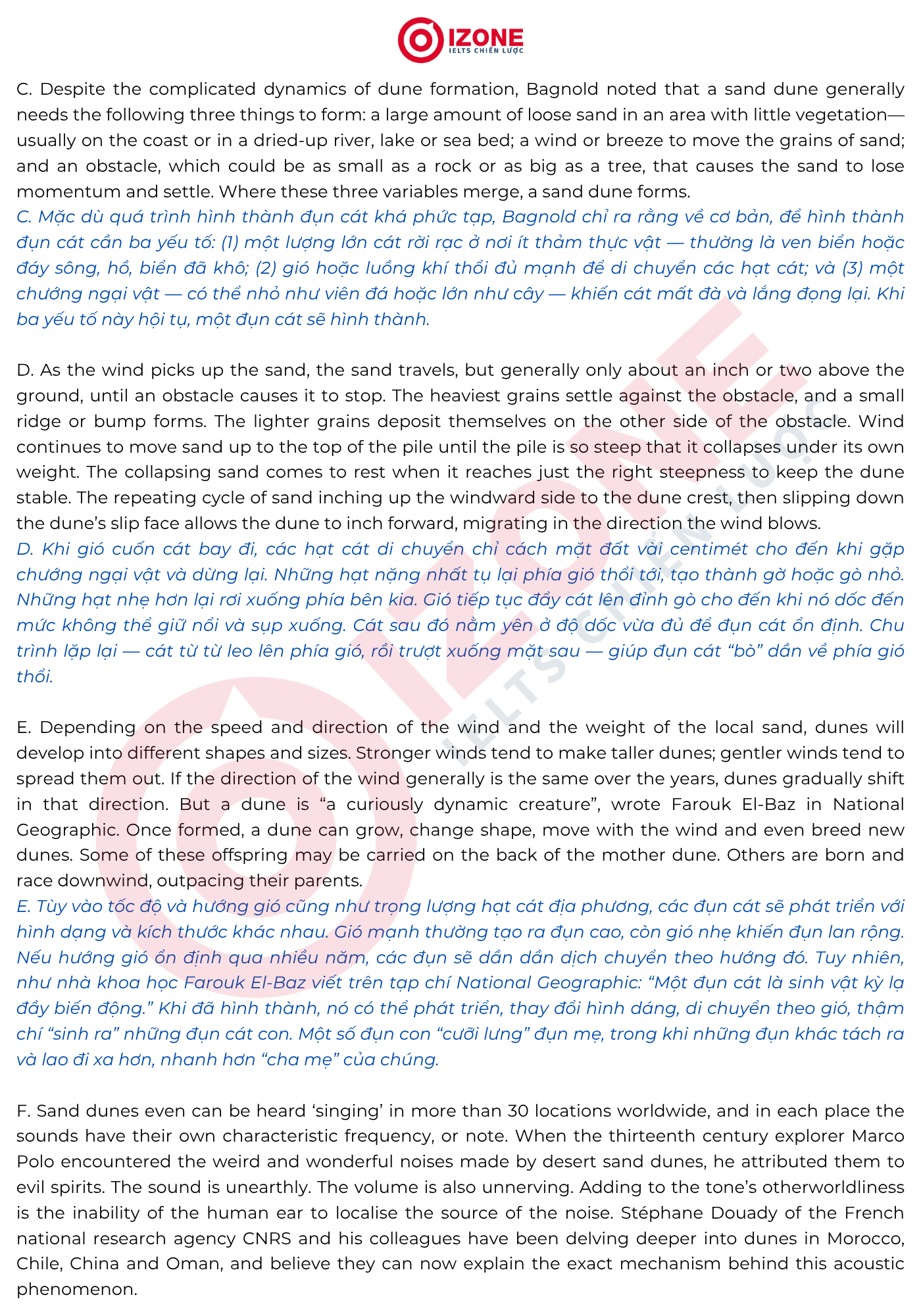
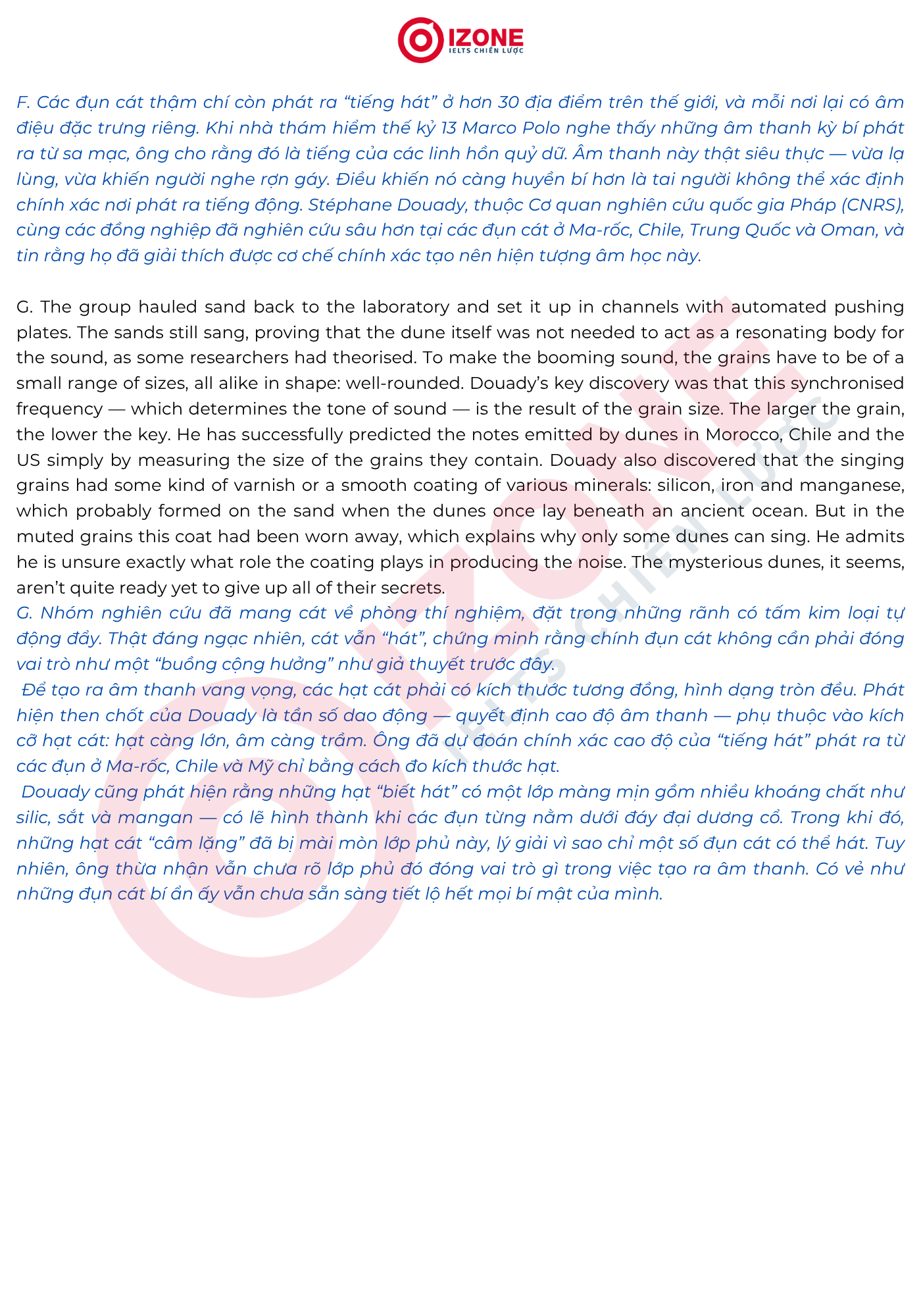
27. Heading iv. Potential threat to industry and communication Đoạn A mô tả các cơn bão cát có thể nuốt chửng nhà cửa, xe cộ, và ảnh hưởng nặng đến nông nghiệp, nhà máy – đây là mối đe doạ tiềm tàng đối với công nghiệp và giao thông. |
Paragraph A: Although no more than a pile of wind-blown sand, dunes can roll over trees and buildings, march relentlessly across highways, devour vehicles on its path, and threaten crops and factories in Africa, the Middle East, and China. |
|
28. Heading x. Commonest type of dune Đoạn B nói về hai loại cát chính do Bagnold phân loại và nhấn mạnh rằng barchan (crescentic dune) là loại phổ biến nhất. |
Paragraph B: He recognised two basic dune types, the crescentic dune, which he called “barchan,” and the linear dune, which he called longitudinal or “sief ’ (Arabic for “sword”). The crescentic barchan dune is the most common type of sand dune. |
|
29. Heading iii. Need combination of specific conditions Đoạn C nói rõ 3 điều kiện cần thiết để hình thành cồn cát: lượng cát lớn, gió, và vật cản – đó là sự kết hợp điều kiện đặc thù. |
Paragraph C: Bagnold noted that a sand dune generally needs the following three things to form: a large amount of loose sand in an area with little vegetation—usually on the coast or in a dried-up river, lake or sea bed; a wind or breeze to move the grains of sand; and an obstacle, which could be as small as a rock or as big as a tree, that causes the sand to lose momentum and settle. Where these three variables merge, a sand dune forms. |
|
30. Heading vii. A continuous cycling process Đoạn D mô tả chu kỳ liên tục cát trượt lên rồi đổ xuống theo hướng gió thổi – chính là một chu trình lặp đi lặp lại. |
Paragraph D: The repeating cycle of sand inching up the windward side to the dune crest, then slipping down the dune’s slip face allows the dune to inch forward, migrating in the direction the wind blows. |
|
31. Heading i. Shaping and reforming Đoạn E giải thích cách hình dáng cồn cát thay đổi theo gió, và thậm chí có thể sinh ra cồn cát mới – tức là quá trình tạo hình và tái tạo. |
Paragraph E: Once formed, a dune can grow, change shape, move with the wind and even breed new dunes. |
|
32. Heading v. An old superstition demystified Đoạn F nói về âm thanh cát hát từng được cho là do linh hồn (mê tín), nhưng nay được khoa học giải thích – tức là một mê tín xưa đã được làm sáng tỏ. |
Paragraph F: When the thirteenth century explorer Marco Polo encountered the weird and wonderful noises made by desert sand dunes, he attributed them to evil spirits. The sound is unearthly. The volume is also unnerving. Adding to the tone’s otherworldliness is the inability of the human ear to localise the source of the noise. […] and believe they can now explain the exact mechanism behind this acoustic phenomenon. |
|
33. Heading ix. Replicating the process in laboratory Đoạn G nói về việc nhóm nghiên cứu tái hiện tiếng hát của cát trong phòng thí nghiệm – tức là mô phỏng lại quy trình trong phòng lab. |
Paragraph G: The group hauled sand back to the laboratory and set it up in channels with automated pushing plates. The sands still sang, proving that the dune itself was not needed to act as a resonating body for the sound, as some researchers had theorised. |
|
Questions 34 – 36: Dạng Sentence Completion Cách làm
|
|
|
34 ________ dune is said to have long ridges that can extend hundreds of miles. Từ cần điền là tính từ vì đứng trước danh từ. Câu hỏi mô tả cồn cát có sống dài hàng trăm dặm, đây là đặc điểm nổi bật của linear dune như nêu trong đoạn B. Đáp án là linear. |
Đoạn B: Unlike crescentic dunes, linear dunes are longer than they are wide—in fact, some are more than 100 miles (about 160 kilometers) long |
|
35 According to Bagnold, an ________ is needed to stop the sand from moving before a dune can form. Từ cần điền là danh từ. Bagnold nói rõ một trong ba điều kiện cần thiết là vật cản – “obstacle” – giúp cát ngừng di chuyển và tích tụ lại. Đáp án là obstacle. |
Đoạn C: Bagnold noted that a sand dune generally needs the following three things to form: a large amount of loose sand in an area with little vegetation—usually on the coast or in a dried-up river, lake or sea bed; a wind or breeze to move the grains of sand; and an obstacle, which could be as small as a rock or as big as a tree, that causes the sand to lose momentum and settle. Where these three variables merge, a sand dune forms. |
|
36 Stéphane Douady believes the singing of dunes is not a spiritual phenomenon, but purely ________. Từ cần điền là tính từ. Douady bác bỏ mê tín (linh hồn) và chứng minh hiện tượng là âm thanh tự nhiên – tức là mang tính acoustic (âm học). Đáp án là acoustic. |
Đoạn F: Stéphane Douady of the French national research agency CNRS and his colleagues have been delving deeper into dunes in Morocco, Chile, China and Oman, and believe they can now explain the exact mechanism behind this acoustic phenomenon. |
|
Questions 37 – 40: Dạng Summary Completion without a wordlist Cách làm:
|
|
|
There are many different types of dunes, two of which are most commonly found in deserts throughout the world, the linear dune and the 37 ________ dune, sometimes also known as the crescentic dune. Từ cần điền là danh từ đứng sau mạo từ “the”. Trong đoạn B, barchan là tên gọi khác của crescentic dune – loại phổ biến thứ hai sau linear dune. Đáp án là barchan. |
Đoạn B: He recognised two basic dune types, the crescentic dune, which he called “barchan,” and the linear dune, which he called longitudinal or “sief ’ (Arabic for “sword”). The crescentic barchan dune is the most common type of sand dune. |
|
To produce singing sand in lab, all the sands must have similar 38 ________. Từ cần điền là danh từ. Trong đoạn G, cát phải có hình dạng tương đồng và tròn trịa để tạo ra âm thanh – tức là giống nhau về shape. Đáp án là shape. |
Đoạn G: To make the booming sound, the grains have to be of a small range of sizes, all alike in shape: well-rounded. |
|
And scientists have discovered that the size of the sand can affect the 39 ________ of the sound. Kích thước hạt cát quyết định cao độ âm thanh phát ra – chính là tone. Đáp án là tone. |
Đoạn G: Douady’s key discovery was that this synchronised frequency — which determines the tone of sound — is the result of the grain size. |
|
But the function of the varnish composed by a mixture of 40 ________ still remains puzzling. Lớp phủ bên ngoài hạt cát có thành phần là khoáng chất như silicon, sắt, mangan – tức là minerals. Đáp án là minerals. |
Đoạn G: Douady also discovered that the singing grains had some kind of varnish or a smooth coating of various minerals: silicon, iron and manganese, which probably formed on the sand when the dunes once lay beneath an ancient ocean. |
Bài viết trên IZONE đã cung cấp phần giải thích đáp án chi tiết cho bài đọc Living Dunes IELTS Reading Answers. Mời bạn tiếp tục thực hành với các bài luyện tập tại chuyên mục IELTS Reading cùng IZONE.
Thử sức với: Giải chi tiết Sydney Opera IELTS Reading