Giải chi tiết The history of the poster IELTS Reading
Cùng IZONE luyện tập và tham khảo phần giải thích đáp án chi tiết cho bài đọc The history of the poster IELTS Reading trong bài viết này nhé!
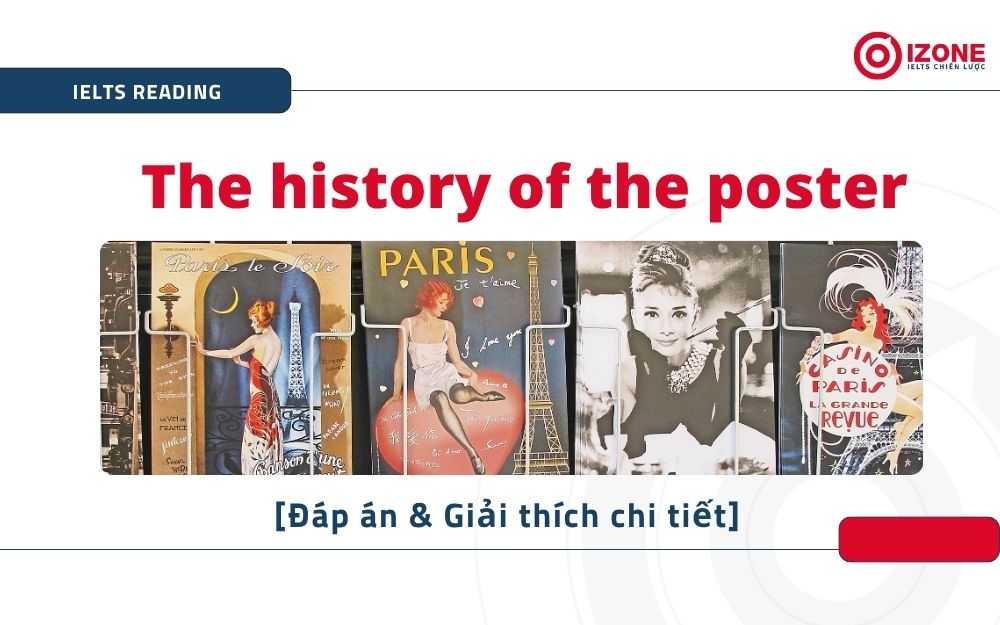
Bài đọc The history of the poster IELTS Reading
The history of the poster
The appearance of the poster has changed continuously over the past two centuries.
The first posters were known as ‘broadsides’ and were used for public and commercial announcements. Printed on one side only using metal type, they were quickly and crudely produced in large quantities. As they were meant to be read at a distance, they required large lettering.
There were a number of negative aspects of large metal type. It was expensive, required a large amount of storage space and was extremely heavy. If a printer did have a collection of large metal type, it was likely that there were not enough letters. So printers did their best by mixing and matching styles.
Commercial pressure for large type was answered with the invention of a system for wood type production. In 1827, Darius Wells invented a special wood drill – the lateral router – capable of cutting letters on wood blocks. The router was used in combination with William Leavenworth’s pantograph (1834) to create decorative wooden letters of all shapes and sizes. The first posters began to appear, but they had little colour and design; often wooden type was mixed with metal type in a conglomeration of styles.
A major development in poster design was the application of lithography, invented by Alois Senefelder in 1796, which allowed artists to hand-draw letters, opening the field of type design to endless styles. The method involved drawing with a greasy crayon onto finely surfaced Bavarian limestone and offsetting that image onto paper. This direct process captured the artist’s true intention; however, the final printed image was in reverse. The images and lettering needed to be drawn backwards, often reflected in a mirror or traced on transfer paper.
As a result of this technical difficulty, the invention of the lithographic process had little impact on posters until the 1860s, when Jules Cheret came up with his ‘three-stone lithographic process’. This gave artists the opportunity to experiment with a wide spectrum of colours.
Although the process was difficult, the result was remarkable, with nuances of colour impossible in other media even to this day. The ability to mix words and images in such an attractive and economical format finally made the lithographic poster a powerful innovation.
Starting in the 1870s, posters became the main vehicle for advertising prior to the magazine era and the dominant means of mass communication in the rapidly growing cities of Europe and America. Yet in the streets of Paris, Milan and Berlin, these artistic prints were so popular that they were stolen off walls almost as soon as they were hung. Cheret, later known as ‘the father of the modern poster’, organised the first exhibition of posters in 1884 and two years later published the first book on poster art. He quickly took advantage of the public interest by arranging for artists to create posters, at a reduced size, that were suitable for in-home display.
Thanks to Cheret, the poster slowly took hold in other countries in the 1890s and came to celebrate each society’s unique cultural institutions: the cafe in France, the opera and fashion in Italy, festivals in Spain, literature in Holland and trade fairs in Germany. The first poster shows were held in Great Britain and Italy in 1894, Germany in 1896 and Russia in 1897. The most important poster show ever, to many observers, was held in Reims, France, in 1896 and featured an unbelievable 1,690 posters arranged by country.
In the early 20th century, the poster continued to play a large communication role and to go through a range of styles. By the 1950s, however, it had begun to share the spotlight with other media, mainly radio and print. By this time, most posters were printed using the mass production technique of photo offset, which resulted in the familiar dot pattern seen in newspapers and magazines. In addition, the use of photography in posters, begun in Russia in the twenties, started to become as common as illustration.
In the late fifties, a new graphic style that had a strong reliance on typographic elements in black and white appeared. The new style came to be known as the International Typographic Style. It made use of a mathematical grid, strict graphic rules and black-and-white photography to provide a clear and logical structure. It became the predominant style in the world in the 1970s and continues to exert its influence today.
It was perfectly suited to the increasingly international post-war marketplace, where there was a strong demand for clarity. This meant that the accessibility of words and symbols had to be taken into account. Corporations wanted international identification, and events such as the Olympics called for universal solutions, which the Typographic Style could provide.
However, the International Typographic Style began to lose its energy in the late 1970s. Many criticised it for being cold, formal and dogmatic.
A young teacher in Basel, Wolfgang Weingart, experimented with the offset printing process to produce posters that appeared complex and chaotic, playful and spontaneous – all in stark contrast to what had gone before. Weingart’s liberation of typography was an important foundation for several new styles. These ranged from Memphis and Retro to the advances now being made in computer graphics.
Questions 15-19
Complete the table below.
Choose NO MORE THAN THREE WORDS from the passage for each answer.
| Features | Problems | |
| Metal type | • produced large print | • cost, weight and 15 difficulties• mixed styles |
| Wood type | • Darius's wood drill used in connection with another 16 .• produced a range of letters | • lacked both 17 • mixed type |
| Lithography | • letters drawn by hand• design tool - a 18 | • had to use a mirror or 19 to achieve correct image |
Questions 20-23
Complete the flow chart below.
Write NO MORE THAN THREE WORDS from the passage for each answer
Questions 24-27
Do the following statements agree with the information in the reading passage?
In boxes 24–27 on your answer sheet, write:
TRUE if the statement agrees with the information
FALSE if the statement contradicts the information
NOT GIVEN if there is no information on this
Điểm số của bạn là % - đúng / câu
Đáp án bài đọc The history of the poster IELTS Reading answers
| 15. storage | 22. exhibition |
| 16. invention | 23. unique cultural institutions |
| 17. colour and design | 24. F |
| 18. greasy crayon | 25. T |
| 19. transfer paper | 26. T |
| 20. words and images | 27. NG |
| 21. mass communication |
Giải thích đáp án chi tiết The history of the poster IELTS Reading answers
Questions 15 -19: Dạng Diagram/ Table/ Flowchart Completion Cách làm Bước 1: Đọc kĩ câu hỏi và gạch chân từ khóa, khoanh tròn giới hạn từ Bước 2: Xác định từ loại và loại thông tin cần điền trong chỗ trống (VD: noun – a person) Bước 3: Scan từ khóa đã xác định trong đoạn văn Bước 4: Điền vào chỗ trống, kiểm tra lại giới hạn từ & ngữ pháp | |
cost, weight and 15 ………. difficulties Trong đoạn nói về nhược điểm của metal type, tác giả nêu rõ kim loại in chữ lớn rất đắt, rất nặng và cần rất nhiều không gian lưu trữ. Vì vậy đáp án là storage. | It was expensive, required a large amount of storage space and was extremely heavy. |
Darius’s wood drill used in connection with another 16 ………. Máy khoan gỗ của Darius Wells được sử dụng kết hợp với phát minh khác của William Leavenworth là pantograph. Từ phù hợp trong bài là invention. | Commercial pressure for large type was answered with the invention of a system for wood type production. In 1827, Darius Wells invented a special wood drill – the lateral router – capable of cutting letters on wood blocks. The router was used in combination with William Leavenworth’s pantograph (1834) to create decorative wooden letters of all shapes and sizes. |
lacked both 17 ………. Những poster đầu tiên sử dụng wood type có rất ít màu sắc và thiết kế. Vì vậy đáp án là “colour and design”. | The first posters began to appear, but they had little colour and design; often wooden type was mixed with morganised the first exhibition of posters in 1884 and two years later published the first book on poster art. etal type in a conglomeration of styles. |
• design tool – a 18 ………. Trong kỹ thuật lithography, nghệ sĩ vẽ bằng một loại bút sáp dầu (greasy crayon) lên đá vôi. Đây chính là công cụ thiết kế được nhắc đến. Đáp án là greasy crayon | The method involved drawing with a greasy crayon onto finely surfaced Bavarian limestone and offsetting that image onto paper. |
had to use a mirror or 19 ………. to achieve correct image Do hình in cuối cùng bị đảo ngược nên nghệ sĩ phải vẽ ngược bằng gương hoặc dùng giấy chuyển hình (transfer paper). Đáp án là transfer paper | The images and lettering needed to be drawn backwards, often reflected in a mirror or traced on transfer paper. |
Questions 20-23: Dạng Diagram/ Table/ Flowchart Completion Cách làm Bước 1: Đọc kĩ câu hỏi và gạch chân từ khóa, khoanh tròn giới hạn từ Bước 2: Xác định từ loại và loại thông tin cần điền trong chỗ trống (VD: noun – a person) Bước 3: Scan từ khóa đã xác định trong đoạn văn Bước 4: Điền vào chỗ trống, kiểm tra lại giới hạn từ & ngữ pháp | |
20. combination of both _____ on coloured posters Kỹ thuật three-stone lithographic process cho phép kết hợp chữ và hình ảnh trên các poster màu sắc hấp dẫn. Đáp án là words and images | The ability to mix words and images in such an attractive and economical format finally made the lithographic poster a powerful innovation. |
21. posters used for advertising and _____ in Europe Từ những năm 1870, poster không chỉ dùng để quảng cáo mà còn là phương tiện truyền thông đại chúng chủ đạo. Đáp án là mass communication | Starting in the 1870s, posters became the main vehicle for advertising prior to the magazine era and the dominant means of mass communication in the rapidly growing cities of Europe and America. |
22. Cheret’s poster _____ and book on poster art Năm 1884 Cheret tổ chức triển lãm poster đầu tiên, sau đó xuất bản cuốn sách đầu tiên về nghệ thuật poster. Đáp án là exhibition | Cheret, later known as ‘the father of the modern poster’, organised the first exhibition of posters in 1884 and two years later published the first book on poster art. |
23. posters represent _____ around the world Ở các quốc gia khác nhau, poster phản ánh những đặc trưng văn hóa riêng của từng xã hội. Đáp án là unique cultural institutions | Thanks to Cheret, the poster slowly took hold in other countries in the 1890s and came to celebrate each society’s unique cultural institutions: the cafe in France, the opera and fashion in Italy, festivals in Spain, literature in Holland and trade fairs in Germany. |
Questions 24-27: Dạng TRUE/FALSE/NOT GIVEN & YES/NO/NOT GIVEN Cách làm:
Chọn đáp án bằng cách lần lượt trả lời 2 câu hỏi:
| |
24. By the 1950s photographs were more widely seen than artists’ illustrations on posters.
Bài đọc chỉ nói rằng đến thập niên 1950, ảnh chụp bắt đầu trở nên phổ biến như tranh minh họa. Không có thông tin nói ảnh phổ biến hơn tranh minh họa. Vì vậy phát biểu này trái với nội dung bài. Đáp án là FALSE | In addition, the use of photography in posters, begun in Russia in the twenties, started to become as common as illustration. |
25. Features of the Typographic Style can be seen in modern-day posters.
Bài đọc nói phong cách này vẫn tiếp tục ảnh hưởng đến ngày nay. Điều đó cho thấy các đặc điểm của nó vẫn xuất hiện trên poster hiện đại. Đáp án là TRUE | It became the predominant style in the world in the 1970s and continues to exert its influence today. |
26. The Typographic Style met a global need at a particular time in history.
Sau chiến tranh thế giới, thị trường ngày càng mang tính quốc tế và cần sự rõ ràng trong giao tiếp. Typographic Style đáp ứng đúng nhu cầu toàn cầu này. Đáp án là TRUE | It was perfectly suited to the increasingly international post-war marketplace, where there was a strong demand for clarity. |
27. Weingart got many of his ideas from his students in Basel.
Bài chỉ nói Weingart là một giáo viên trẻ ở Basel và ông đã thử nghiệm các kỹ thuật in offset. Không có thông tin nào cho biết ông lấy ý tưởng từ học sinh của mình. Đáp án là NOT GIVEN | A young teacher in Basel, Wolfgang Weingart, experimented with the offset printing process to produce posters that appeared complex and chaotic, playful and spontaneous – all in stark contrast to what had gone before. |
Trên đây là phần giải thích đáp án chi tiết cho bài đọc The history of the poster IELTS Reading. Rèn luyện kỹ năng Reading tại chuyên mục IELTS Reading hoặc tìm hiểu các kỹ năng làm IELTS Reading tại Series Kỹ năng làm bài IELTS Reading của IZONE.