[Giải thích đáp án] Advantages of public transport IELTS Reading
Luyện tập giải Advantages of public transport IELTS Reading và tham khảo phần giải thích đáp án chi tiết trong bài viết dưới đây cùng IZONE.
Bài đọc Advantages of public transport IELTS Reading chi tiết
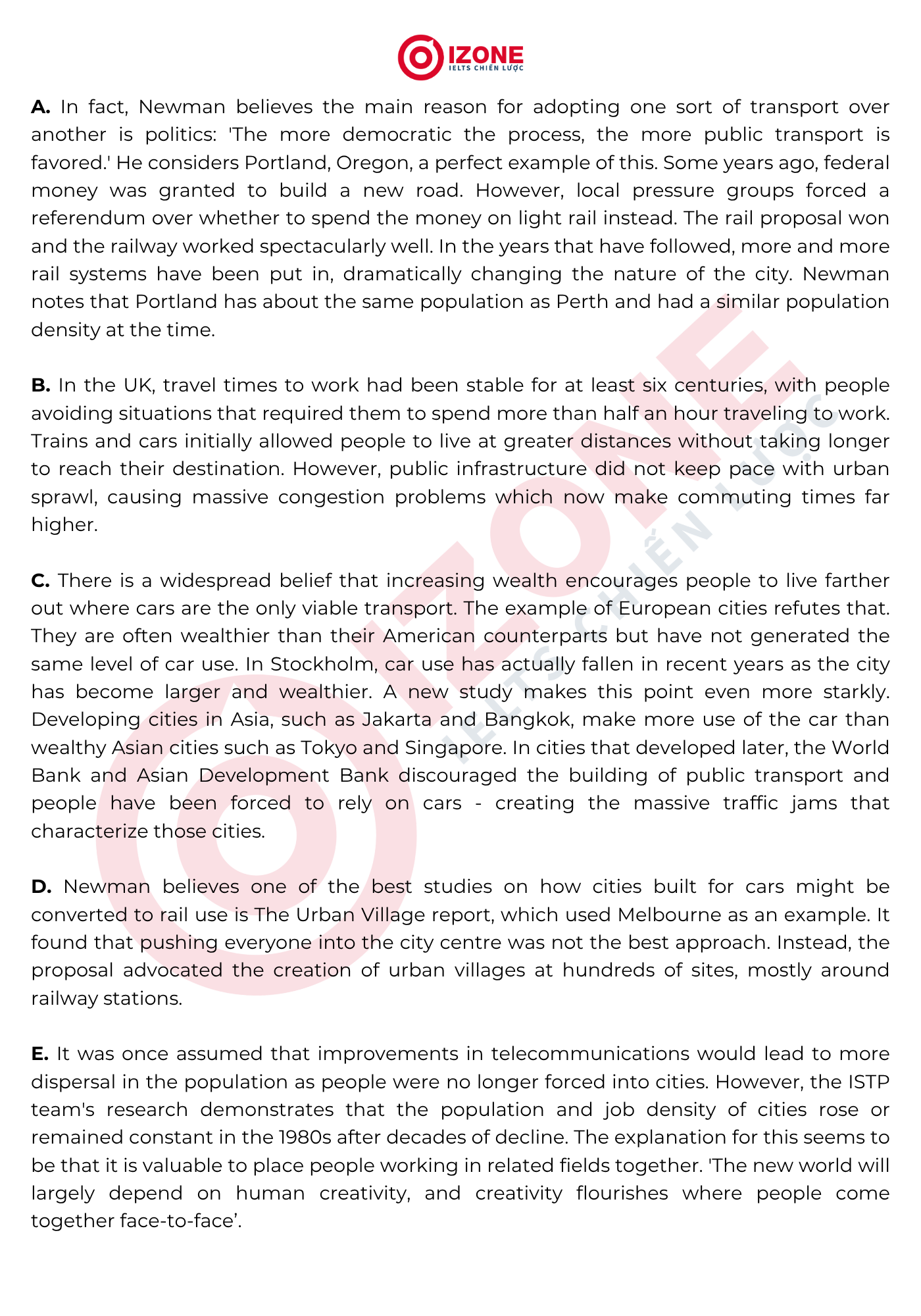
Questions 1-5
Reading Passage has five marked paragraphs, A-E.
Choose the correct heading for each paragraph from the list of headings below.
Write the correct number, i-viii, in boxes 1-5 on your answer sheet.
List of Heading:
i. Avoiding an overcrowded center
ii. A successful exercise in people power
iii. The benefits of working together in cities
iv. Higher incomes need not mean more cars
v. Economic arguments fail to persuade
vi. The impact of telecommunications on population distribution
vii. Increases in traveling time
viii. Responding to arguments against public transport
Questions 6-10
Do the following statements agree with the information given in Reading Passage 95?
In boxes 6-10 on your answer sheet, write
TRUE if the statement agrees with the information
FALSE if the statement contradicts the information
NOT GIVEN if there is no information on this
Questions 11-13
Look at the following cities (Questions 11-13) and the list of descriptions below.
Match each city with the correct description, A-F.
Write the correct letter, A-F, in boxes 11-13 on your answer sheet.
List of Descriptions
A. successfully uses a light rail transport system in hilly environment
B. successful public transport system despite cold winters
C. profitably moved from road to light rail transport system
D. hilly and inappropriate for rail transport system
E. heavily dependent on cars despite widespread poverty
F. inefficient due to a limited public transport system
Điểm số của bạn là % - đúng / câu
Đáp án bài đọc Advantages of public transport IELTS Reading
| 1. ii | 8. NOT GIVEN |
| 2. vii | 9. FALSE |
| 3. iv | 10. TRUE |
| 4.i | 11. F |
| 5.iii | 12. D |
| 6. FALSE | 13. C |
| 7. TRUE |
Giải chi tiết IELTS Reading Advantages of public transport
|
Questions 1- 5: Dạng Matching heading Cách làm:
|
|
|
1. Heading ii. A successful exercise in people power Đoạn A mô tả về việc người dân Portland gây áp lực khiến chính quyền tổ chức trưng cầu dân ý về việc sử dụng tiền vào đường ray thay vì đường bộ. Cuối cùng, đề xuất đường sắt thắng và hệ thống hoạt động hiệu quả. Đây là một ví dụ rõ ràng về quyền lực của người dân. |
Đoạn A: However, local pressure groups forced a referendum over whether to spend the money on light rail instead. The rail proposal won and the railway worked spectacularly well |
|
2. Heading vii. Increases in traveling time Đoạn này nói về việc thời gian di chuyển đến nơi làm việc đã ổn định trong nhiều thế kỷ, nhưng do hạ tầng không theo kịp sự phát triển, ùn tắc khiến thời gian đi lại tăng. |
Đoạn B: However, public infrastructure did not keep pace with urban sprawl, causing massive congestion problems which now make commuting times far higher. |
|
3. Heading iv. Higher incomes need not mean more cars Đoạn này cho rằng các thành phố châu Âu giàu có hơn nhưng không có mức độ sử dụng ô tô cao hơn, và thành phố châu Á giàu thì ít sử dụng ô tô hơn các nước đang phát triển. |
Đoạn C: The example of European cities refutes that. They are often wealthier than their American counterparts but have not generated the same level of car use. In Stockholm, car use has actually fallen in recent years as the city has become larger and wealthier. |
|
4. Heading i. Avoiding an overcrowded center Đoạn D nói rằng thay vì đẩy mọi người vào trung tâm thành phố, đề xuất là tạo ra các “làng đô thị” quanh các ga tàu để tránh tình trạng quá tải trung tâm. |
Đoạn D: It found that pushing everyone into the city centre was not the best approach. Instead, the proposal advocated the creation of urban villages at hundreds of sites, mostly around railway stations. |
|
5. Heading iii. The benefits of working together in cities Nghiên cứu cho thấy việc tập trung dân cư và công việc tại thành phố giúp sáng tạo phát triển, trái ngược với giả định rằng công nghệ viễn thông sẽ phân tán dân số. |
Đoạn E: The new world will largely depend on human creativity, and creativity flourishes where people come together face-to-face |
|
Questions 6-10: Dạng TRUE/FALSE/NOT GIVEN Cách làm:
Chọn đáp án bằng cách lần lượt trả lời 2 câu hỏi:
|
|
|
6. The ISTP study examined public and private systems in every city in the world.
Đề bài nói rằng nghiên cứu kiểm tra các hệ thống ở mọi thành phố trên thế giới. Trong đoạn văn chỉ đề cập đến 37 thành phố được nghiên cứu. Đáp án là FALSE |
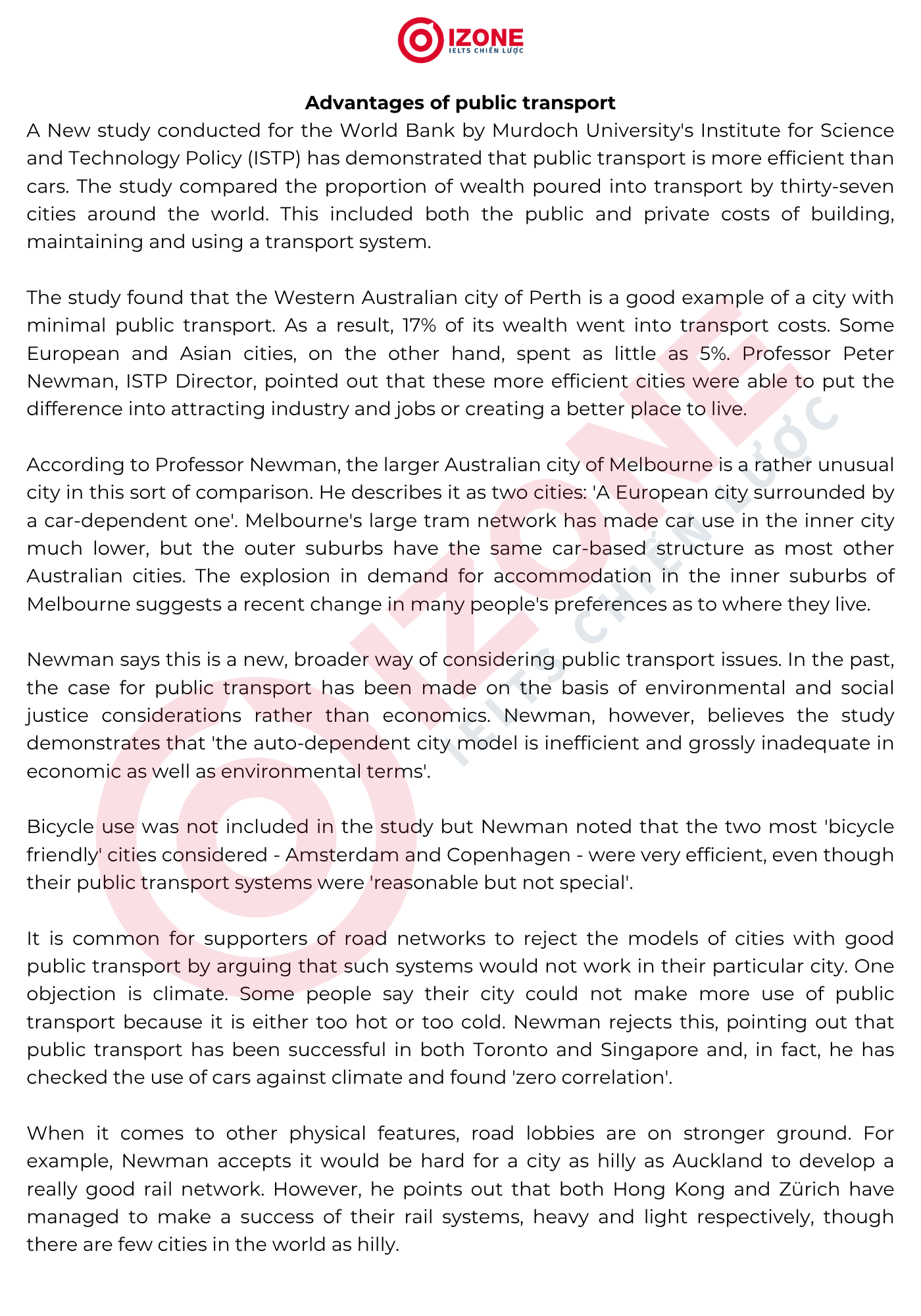
The study compared the proportion of wealth poured into transport by thirty-seven cities around the world. |
|
7. Efficient cities can improve the quality of life for their inhabitants.
Đoạn văn nói rằng các thành phố hiệu quả có thể dùng phần tiết kiệm để tạo ra nơi sống tốt hơn. Đáp án là TRUE |
more efficient cities were able to put the difference into attracting industry and jobs or creating a better place to live. |
|
8. An inner-city tram network is dangerous for car drivers.
Không có thông tin nào nói rằng mạng lưới xe điện nội đô nguy hiểm với người lái ô tô. Đáp án là NOT GIVEN |
|
|
9. In Melbourne, people prefer to live in the outer suburbs.
Đoạn văn cho thấy có sự gia tăng nhu cầu sống ở vùng nội thành Melbourne, tức là không phải người dân thích sống ở ngoại ô. Đáp án là FALSE |
The explosion in demand for accommodation in the inner suburbs of Melbourne suggests a recent change in many people’s preferences |
|
10. Cities with high levels of bicycle usage can be efficient even when public transport is only averagely good.
Newman cho rằng Amsterdam và Copenhagen dùng xe đạp nhiều và vẫn rất hiệu quả, dù hệ thống giao thông công cộng chỉ ở mức trung bình. Đáp án là TRUE |
Bicycle use was not included in the study but Newman noted that the two most ‘bicycle friendly‘ cities considered – Amsterdam and Copenhagen – were very efficient, even though their public transport systems were ‘reasonable but not special |
|
Questions 11-13: Dạng Matching information Cách làm:
Note: Một số tên riêng có thể nối với nhiều hơn 1 đáp án |
|
|
11. Perth Perth có hệ thống giao thông công cộng hạn chế và chi tiêu tới 17% tài sản vào giao thông, cho thấy sự kém hiệu quả. Đáp án là F. inefficient due to a limited public transport system |
The study found that the Western Australian city of Perth is a good example of a city with minimal public transport. As a result, 17% of its wealth went into transport costs. |
|
12. Auckland Newman nói rằng Auckland có địa hình đồi dốc nên khó phát triển mạng lưới đường sắt tốt. Đáp án là D. hilly and inappropriate for rail transport system |
When it comes to other physical features, road lobbies are on stronger ground. For example, Newman accepts it would be hard for a city as hilly as Auckland to develop a really good rail network |
|
13. Portland Portland ban đầu định dùng tiền cho đường bộ nhưng người dân ủng hộ đường sắt, và hệ thống hoạt động rất hiệu quả. Đáp án là C. profitably moved from road to light rail transport system |
He considers Portland, Oregon, a perfect example of this. Some years ago, federal money was granted to build a new road. However, local pressure groups forced a referendum over whether to spend the money on light rail instead. The rail proposal won and the railway worked spectacularly well. |
Thử sức với A Workaholic Economy – Giải đề IELTS Reading chi tiết