Giải chi tiết IELTS Reading: Angelo mosso’s pioneering work in the study of human physiology
Cùng IZONE giải chi tiết đề IELTS Reading: Angelo mosso’s pioneering work in the study of human physiology để luyện tập nâng cao kỹ năng làm bài nhé!
Bài đọc Angelo mosso’s pioneering work in the study of human physiology
A. Scientists in the late nineteenth century were beginning to investigate the functions of blood circulation, trying to tease out the reasons for variations in pulse and pressure and to understand the delivery of energy to the functioning parts of our bodies. Angelo Mosso (1846–1910) was one such pioneer, an Italian physiologist who progressed to become a professor of both pharmacology and physiology at the University of Turin. As was true of many of his enlightened, well-educated contemporaries, Mosso was concerned about the effect of the Industrial Revolution on the poorer working classes. Hard physical labour and an excessively long working day shortened lives, created conditions conducive to accidents, and crippled the children who were forced into such work at a very early age. One of his most influential contributions to society came from his work and writings on fatigue.
B. Early experimenters in any field find themselves having to construct previously unknown equipment to investigate fields of study as yet unexplored. Mosso had reviewed the work of fellow scientists who had worked on isolated muscles, such as those extracted from frogs, and who had observed movement and fatigue when these were stimulated electrically. He found two major issues with their methodolgy: there was a lack of evidence both that the findings would be relevant to the human body and that the dynamometers used to measure the strength of movement could give accurate results. He therefore became determined to construct an instrument to measure human muscular effort and record the effects of fatigue with greater precision.
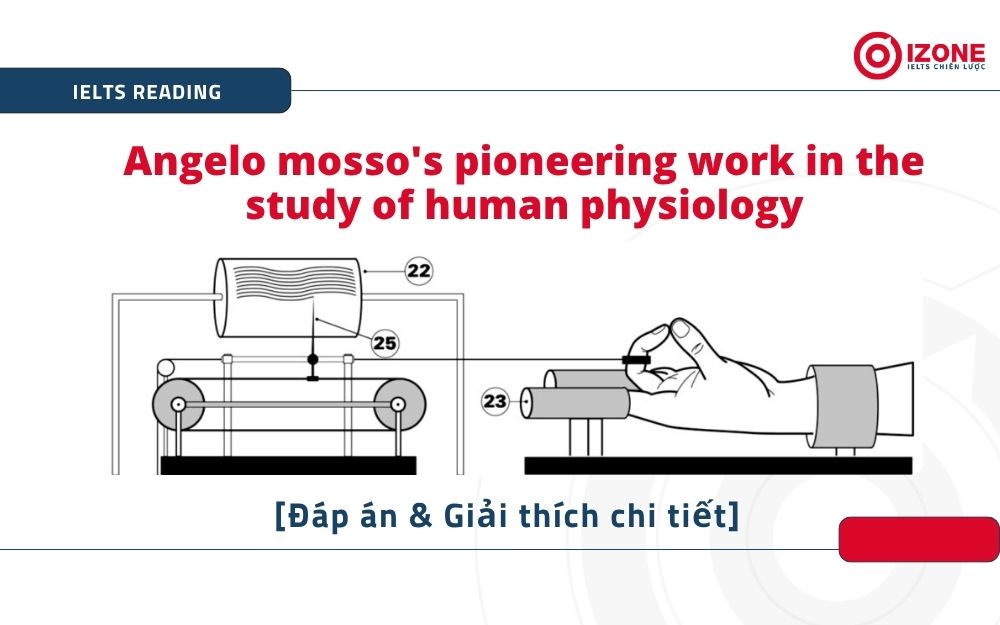
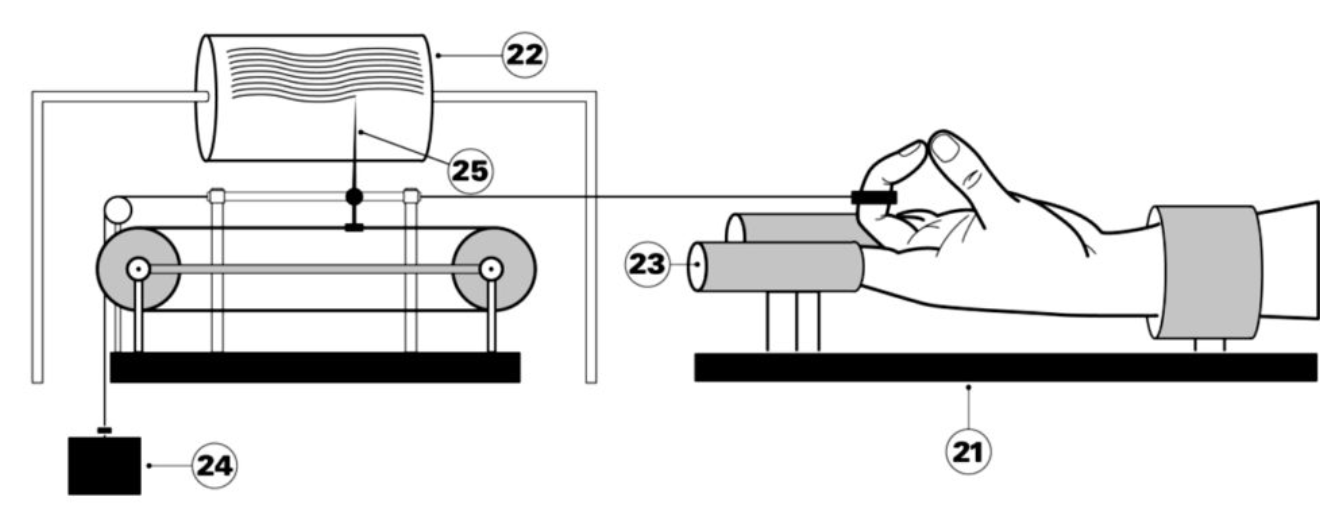
C. His device was named an ergograph, meaning “work recorder”. To modern eyes, it seems remarkably simple, but such is true of many inventions when viewed with hindsight. It allowed the measurement of the work done by a finger as it was repetitively curled up and straightened. There were basically two parts. One held the hand in position, palm up, by strapping down the arm to a wooden base; this was important to prevent any unintentional movement of the hand while the experiment was taking place. The other part was a recording device that drew the movements of the finger vertically on a paper cylinder which revolved by tiny increments as the experiment proceeded. The index and ring fingers of the hand were each inserted into a brass tube to hold them still. The middle finger was encircled with a leather ring tied to a wire which was connected to a weight after passing through a pulley. The finger had to raise and lower the weight, with the length and speed of these flexions recorded on the paper by a stylus. In this way, he not only learned the fatigue profiles of his subjects but could observe a relationship between performance, tiredness and the emotional state of his subjects.
D. Mosso’s interest in the interaction between psychology and physiology led to another machine and further groundbreaking research. He was intrigued to observe the pulsing of circulating blood in patients who had suffered traumatic damage to the skull, or cranium. In these patients, a lack of bone covering the brain allowed the strength of the heart’s pumping to be seen beneath the skin. He carried out experiments to see whether certain intellectual activities, such as reading or solving a problem, or emotional responses, such as to a sudden noise, would affect the supply of blood to the brain. He detected some changes in blood supply, and then wanted to find out if the same would be true of individuals with no cranial damage.
E. His solution was to design another instrument to measure brain activity in uninjured subjects. He designed a wooden tabletop for the human subject to lie on, which was placed over another table, balanced on a fulcrum (rather like a seesaw) that would allow the subject to tilt, with head a little higher than feet, or vice versa. Heavy weights beneath the table maintained the stability of the whole unit as the intention was to measure very tiny variations in the balance of the person. Once the upper table was adjusted to be perfectly horizontal, only the breathing created a slight regular oscillation. This breathing and pulses measured in the hands and feet were also recorded.
F. Once all was in equilibrium, Mosso would ring a bell, while out of sight of the subject. His hypothesis was that this aural stimulus would have to be interpreted by the brain, and that an increased blood flow would result in a slight head-down tilt of the table. Mosso followed the bell-ringing with a wide range of intellectual stimuli, such as reading from a newspaper, a novel, or a university text. He was no doubt well satisfied to observe that the tilting of the table increased proportionately to the difficulty of the subject matter and the intellectual requirements of the task. Mosso’s experiments indicated a direct link between mental effort and an increased volume of blood in the brain. This research was one of the first attempts to ‘image’ the brain, which is now performed by technology such as MRI (magnetic resonance imaging), commonly used in making medical diagnoses today.
Questions 14-19
Reading Passage 2 has six paragraphs, A–F.
Choose the correct heading for paragraphs A–F from the list of headings below.
Write the correct number, i–ix, in boxes 14–19 on your answer sheet.
List of Headings
i A finely balanced measuring machine
ii Head injuries are a window into the brain
iii Measuring changes in body weight
iv Measuring fatigue through finger movements
v Reasons for the development of the ergograph
vi Effects of fatigue on young factory workers
vii Reasons behind early physiological research
viii Estimating the difficulty of reading tasks
ix Mosso’s theory supported by experimental results
Question 20
Choose the correct letter, A, B, C or D.
Write the correct letter in box 20 on your answer sheet.
The text suggests that Mosso undertook his original research because he wanted to
Questions 21–25
Label the diagram below.
Choose NO MORE THAN TWO WORDS from the passage for each answer.
Write your answers in boxes 21–25 on your answer sheet.
The Ergograph
(21)
(22)
(23)
(24)
(25)
Question 26
Choose the correct letter, A, B, C or D.
Write the correct letter in box 26 on your answer sheet.
What is the writer’s overall purpose in writing this article?
Điểm số của bạn là % - đúng / câu
14. vii | 21. wooden base |
15. v | 22. paper cylinder |
16. iv | 23. brass tube |
17. ii | 24. (a / the) weight |
18. i | 25. (a / the) stylus |
19. ix | 26. A |
20. B |
Lời giải chi tiết Angelo mosso’s pioneering work in the study of human physiology
Questions 14 – 19: Dạng Matching Headings Cách làm: Bước 1: Đọc list các tiêu đề và gạch chân organizing words & content words Bước 2: Skim từng đoạn văn và nắm được ý chính cả đoạn Bước 3: Chọn ra tiêu đề phù hợp với đoạn văn Bước 4: Kiểm tra lại những tiêu đề thừa, các distractors trong list đề bài cho | |
Câu 14: Paragraph A Đoạn A giới thiệu bối cảnh của các nghiên cứu khoa học vào cuối thế kỷ 19. Đoạn văn nêu rõ các nhà khoa học đang điều tra chức năng của tuần hoàn máu, cố gắng tìm ra lý do cho sự thay đổi của mạch và huyết áp. Đoạn văn cũng đề cập đến mối quan tâm của Mosso về ảnh hưởng của Cách mạng Công nghiệp đối với tầng lớp lao động nghèo hơn. Đây chính là những lý do và động lực thúc đẩy các nghiên cứu sinh lý học thời đó. => Đáp án là vii Reasons behind early physiological research | Scientists in the late nineteenth century were beginning to investigate the functions of blood circulation, trying to tease out the reasons for variations in pulse and pressure and to understand the delivery of energy to the functioning parts of our bodies… Mosso was concerned about the effect of the Industrial Revolution on the poorer working classes. Hard physical labour and an excessively long working day shortened lives, created conditions conducive to accidents, and crippled the children… |
Câu 15: Paragraph B Đoạn B trình bày những vấn đề mà Mosso nhận thấy trong các phương pháp nghiên cứu trước đó. Ông chỉ ra hai vấn đề lớn với phương pháp luận của họ, bao gồm việc thiếu bằng chứng liên quan đến cơ thể người và các thiết bị đo lường không chính xác. Chính vì những lý do này mà ông quyết tâm chế tạo một công cụ để đo lường nỗ lực cơ bắp của con người với độ chính xác cao hơn. => Đáp án là v Reasons for the development of the ergograph | He found two major issues with their methodolgy: there was a lack of evidence both that the findings would be relevant to the human body and that the dynamometers used to measure the strength of movement could give accurate results. He therefore became determined to construct an instrument to measure human muscular effort and record the effects of fatigue with greater precision. |
Câu 16: Paragraph C Toàn bộ đoạn C tập trung mô tả chi tiết về máy ergo graph và cách nó hoạt động. Đoạn văn miêu tả cách thiết bị này cho phép đo lường công thực hiện bởi một ngón tay khi nó co duỗi lặp đi lặp lại. Cách hoạt động này chính xác là “đo lường sự mệt mỏi qua chuyển động ngón tay”. => Đáp án là iv Measuring fatigue through finger movements | His device was named an ergograph, meaning “work recorder”… It allowed the measurement of the work done by a finger as it was repetitively curled up and straightened… The middle finger… had to raise and lower the weight, with the length and speed of these flexions recorded on the paper… |
Câu 17: Paragraph D Đoạn D mô tả cách Mosso quan sát được sự lưu thông máu trong não của những bệnh nhân bị tổn thương hộp sọ. Chính nhờ việc thiếu xương che não mà ông có thể thấy được nhịp đập của tim bên dưới da. Điều này cho phép ông có một cái nhìn trực tiếp vào hoạt động sinh lý của não, giống như một “cửa sổ”. Quan sát này đã khơi nguồn cho các thí nghiệm tiếp theo của ông về mối liên hệ giữa hoạt động trí tuệ và lưu lượng máu đến não. => Đáp án là ii Head injuries are a window into the brain | He was intrigued to observe the pulsing of circulating blood in patients who had suffered traumatic damage to the skull, or cranium. In these patients, a lack of bone covering the brain allowed the strength of the heart’s pumping to be seen beneath the skin. He carried out experiments to see whether certain intellectual activities… would affect the supply of blood to the brain. |
Câu 18: Paragraph E Đoạn E mô tả cỗ máy thứ hai của Mosso. Các chi tiết như được cân bằng trên một điểm tựa và mục đích là để đo lường những thay đổi rất nhỏ trong sự cân bằng của người đó cho thấy đây là một cỗ máy được thiết kế để đo lường dựa trên sự cân bằng cực kỳ nhạy và tinh vi. => Đáp án là i A finely balanced measuring machine | His solution was to design another instrument… a wooden tabletop for the human subject to lie on, which was placed over another table, balanced on a fulcrum (rather like a seesaw) that would allow the subject to tilt… the intention was to measure very tiny variations in the balance of the person. |
Câu 19: Paragraph F Đoạn F mô tả quá trình thí nghiệm và kết quả. Giả thuyết của Mosso là một kích thích sẽ làm tăng lưu lượng máu đến não và khiến bàn nghiêng về phía đầu. Kết quả đã xác nhận điều này: độ nghiêng của bàn tăng tương ứng với độ khó của chủ đề. Điều này cho thấy các kết quả thí nghiệm đã ủng hộ giả thuyết của ông. => Đáp án là ix Mosso’s theory supported by experimental results | His hypothesis was that this aural stimulus would have to be interpreted by the brain, and that an increased blood flow would result in a slight head-down tilt of the table… He was no doubt well satisfied to observe that the tilting of the table increased proportionately to the difficulty of the subject matter… Mosso’s experiments indicated a direct link between mental effort and an increased volume of blood in the brain. |
Questions 20: Dạng Multiple Choice Questions Cách làm: Bước 1: Đọc câu hỏi và gạch chân từ khóa Bước 2: Scan từ khóa trong đoạn văn Bước 3: Tìm ra hiện tượng paraphrase Bước 4: Chọn đáp án đúng, double check bằng cách chứng minh các đáp án còn lại sai Chứng minh các đáp án ĐÚNG/SAI bằng cách lần lượt trả lời 2 câu hỏi: Câu 1: Các thông tin trong câu hỏi ĐỀU TÌM ĐƯỢC NỘI DUNG TƯƠNG ỨNG trong bài đọc hay không? *Nội dung tương ứng là những nội dung cùng chỉ về 1 điều, mang cùng 1 chức năng trong câu. Ví dụ: Anh ấy đến nơi lúc 8h vs. Sau 9h anh ấy mới tới => “lúc 8h” và “sau 9h” đều nêu thời điểm anh ta tới nơi => 2 thông tin này dù khác về nội dung những vẫn được coi là tương ứng với nhau (đều chỉ mặt thời gian) Nếu không ⇒ Đáp án SAI Nếu có: Xét tiếp sang câu hỏi số 2 Câu 2: Có thông tin nào trong câu hỏi bị TRÁI NGƯỢC/SAI LỆCH với nội dung bài đọc hay không? Nếu không ⇒ Đáp án ĐÚNG Nếu có ⇒ Đáp án SAI | |
Câu 20: The text suggests that Mosso undertook his original research because he wanted to Cụ thể: Đoạn B nói rõ rằng Mosso nhận thấy các thiết bị đo lường hiện có không thể cho kết quả chính xác. Do đó, ông quyết tâm hế tạo một công cụ với độ chính xác cao hơn => Đáp án là: B. make a more accurate measuring device | ..he found two major issues with their methodology… the dynamometers used to measure the strength of movement could give accurate results. He therefore became determined to construct an instrument to measure human muscular effort and record the effects of fatigue with greater precision. |
A. support previous researchers’ results Đoạn văn nói rằng ông tìm thấy hai vấn đề lớn với phương pháp luận của họ, tức là ông đang phê bình chứ không phải ủng hộ. | |
C. rebuild an existing machine Đoạn văn nói ông quyết tâm chế tạo một công cụ, ngụ ý tạo ra một cái mới, không phải xây dựng lại cái cũ. | |
D. study the movement of frog muscle Ông đã xem xét các công trình nghiên cứu về cơ ếch nhưng nhận thấy chúng thiếu bằng chứng liên quan đến cơ thể người. Nghiên cứu của ông là về con người. | |
Questions 21 – 26: Dạng Diagram Completion Cách làm: Bước 1: Khoanh tròn giới hạn từ được điền Bước 2: Nghiên cứu Diagram/ Table/ Flowchart và xác định loại từ cho mỗi chỗ trống Bước 3: Skim bài text để tìm ra những đoạn liên quan chứa đáp án Bước 4: Scan đoạn văn và điền đáp án đúng, chú ý giới hạn từ | |
Câu 21:
Từ cần điền là danh từ Số (21) trong sơ đồ là bộ phận phẳng, nằm bên dưới và đỡ toàn bộ phần cánh tay. Đoạn C mô tả một phần của thiết bị là nó giữ bàn tay ở vị trí bằng cách buộc cánh tay xuống một cái đế gỗ. Do đó, (21) chính là cái đế gỗ. => Đáp án là wooden base | One held the hand in position, palm up, by strapping down the arm to a wooden base; this was important to prevent any unintentional movement of the hand… |
Câu 22:
Từ cần điền là danh từ Số (22) là một vật hình trụ có các đường vẽ ghi lại kết quả. Đoạn C mô tả một thiết bị ghi vẽ lại các chuyển động theo chiều dọc trên một trục giấy hình trụ. Điều này khớp chính xác với hình ảnh của (22). => Đáp án là paper cylinder | …a recording device that drew the movements of the finger vertically on a paper cylinder which revolved by tiny increments as the experiment proceeded. |
Câu 23:
Từ cần điền là danh từ Số (23) chỉ hai cái ống dùng để cố định ngón trỏ và ngón đeo nhẫn (các ngón không tham gia kéo). Đoạn C nói rõ rằng Ngón trỏ và ngón đeo nhẫn… mỗi ngón được đút vào một cái ống đồng để giữ chúng yên. => Đáp án là brass tube | The index and ring fingers of the hand were each inserted into a brass tube to hold them still. |
Câu 24:
Từ cần điền là danh từ Thí nghiệm yêu cầu ngón giữa co duỗi để tạo ra công. Để đo lường công này, ngón tay phải kéo một vật có trọng lượng. Đoạn C mô tả ngón giữa được buộc vào một sợi dây được nối với một quả cân. Số (24) trong sơ đồ chính là vật nặng (quả cân) đó, tạo ra lực cản mà ngón tay phải nâng lên hạ xuống. => Đáp án là (a / the) weight | The middle finger was encircled with a leather ring tied to a wire which was connected to a weight after passing through a pulley. |
Câu 25:
Từ cần điền là danh từ Số (25) là vật nhọn ở đầu cần, tiếp xúc trực tiếp với trục giấy (22) để vẽ lại chuyển động. Đoạn C giải thích rằng tốc độ và độ dài của các chuyển động co duỗi ngón tay được ghi lại trên giấy bởi một cái bút ghi. => Đáp án là (a / the) stylus | …with the length and speed of these flexions recorded on the paper by a stylus. |
Questions 26: Dạng Multiple Choice Questions Cách làm: Bước 1: Đọc câu hỏi và gạch chân từ khóa Bước 2: Scan từ khóa trong đoạn văn Bước 3: Tìm ra hiện tượng paraphrase Bước 4: Chọn đáp án đúng, double check bằng cách chứng minh các đáp án còn lại sai Chứng minh các đáp án ĐÚNG/SAI bằng cách lần lượt trả lời 2 câu hỏi: Câu 1: Các thông tin trong câu hỏi ĐỀU TÌM ĐƯỢC NỘI DUNG TƯƠNG ỨNG trong bài đọc hay không? *Nội dung tương ứng là những nội dung cùng chỉ về 1 điều, mang cùng 1 chức năng trong câu. Ví dụ: Anh ấy đến nơi lúc 8h vs. Sau 9h anh ấy mới tới => “lúc 8h” và “sau 9h” đều nêu thời điểm anh ta tới nơi => 2 thông tin này dù khác về nội dung những vẫn được coi là tương ứng với nhau (đều chỉ mặt thời gian) Nếu không ⇒ Đáp án SAI Nếu có: Xét tiếp sang câu hỏi số 2 Câu 2: Có thông tin nào trong câu hỏi bị TRÁI NGƯỢC/SAI LỆCH với nội dung bài đọc hay không? Nếu không ⇒ Đáp án ĐÚNG Nếu có ⇒ Đáp án SAI | |
Câu 26: What is the writer’s overall purpose in writing this article? Cụ thể: Toàn bộ bài đọc là một bài tường thuật về công việc của Angelo Mosso. Nó bắt đầu bằng việc giới thiệu bối cảnh, sau đó mô tả hai thí nghiệm chính của ông, bao gồm lý do, thiết bị và kết quả. Đây chính xác là việc “mô tả nghiên cứu” của ông. => Đáp án là: A. to describe Mosso’s early research into human physiology | |
B. to argue that Angelo Mosso was an original designer Mặc dù bài viết cho thấy ông là người độc đáo, nhưng đây không phải là mục đích chính. Mục đích chính là trình bày nghiên cứu của ông, chứ không phải chỉ để ca ngợi kỹ năng thiết kế của ông. | |
C. to discuss differences between Mosso and other early researchers Sự khác biệt này chỉ được đề cập ngắn gọn trong đoạn B. Phần còn lại của bài viết tập trung hoàn toàn vào Mosso, vì vậy đây không phải là mục đích tổng thể. | |
D. to link Mosso’s experiments to modern brain imaging technology Liên kết này chỉ được nhắc đến ở câu cuối cùng của bài viết như một nhận xét kết luận. Nó không phải là mục đích chính của toàn bộ bài báo. | |


Trên đây là lời giải chi tiết cho bài đọc IELTS Reading: Angelo mosso’s pioneering work in the study of human physiology. Hy vọng bài viết này giúp ích cho các bạn.