Đáp án & Giải chi tiết Brand Loyalty Runs Deep IELTS Reading
Cùng IZONE luyện tập với Brand Loyalty Runs Deep IELTS Reading và tham khảo phần giải thích đáp án chi tiết từ IZONE trong bài viết này nhé!

Bài đọc Brand Loyalty Runs Deep IELTS Reading
We have given the Brand Loyalty runs deep Reading reading passage. Read the passage and answer all the questions (14-26). Check your answers with Brand Loyalty runs deep Reading Answers with location.
- At almost any supermarket in Sydney, Australia, food from all over the world fills the shelves. Perhaps you fancy some Tick Tock Rooibos tea made in South Africa or Maharaja’s Choice Rogan Josh sauce from India. Alongside local Foster’s beer, Chinese Tsingtao and Indonesian Bintang are both to be found. For homesick Britons, the confectionary aisle is stocked with Mars Bars and Bountys, while for pining Poles sweets manufactured by firms like Wawel or Solidarposc are available. Restaurants in Sydney range from Afghan to Zambian, catering to different ethnic groups as well as the rest of the curious general public.
- All of this variety results from population movement and changes in global trade, and, to a lesser extent, reduced production and transportation costs. While Australia can claim around 40% of its population as the first generation, other countries, like Switzerland, may have fewer international migrants, but still, have people who move from city to city in search of work. Even since the 1990s, taxes or tariffs on imported goods have decreased dramatically. The World Trade Organisation, for example, has promulgated the idea of zero tariffs, which has been adopted into legislation by many member states. It is estimated that within a century, agriculture worldwide has increased its efficiency five-fold. Faster and better-integrated road and rail services, containerization, and the ubiquitous airplane have sped up transport immeasurably.
- Even with this rise in the availability of non-local products, recent studies suggest that supermarkets should do more to increase their number to match more closely the proportion of shoppers from those countries or regions. Thus, if 10% of a supermarket’s customers originate in Vietnam, there ought to be 10% of Vietnamese products in the store. If Americans from southern states dominate in one northern neighborhood, southern brands should also be conspicuous. Admittedly, there are already specialist shops that cater to minority groups, but minorities do frequent supermarkets.
- Two separate studies by Americans Bart Bronnenberg and David Atkin have found that brand loyalty (choosing Maharaja’s Choice over Patak’s, or Cadbury’s over Nestlé) is not only determined by advertising but also by a consumer’s past. If a product is featured in a person’s early life in one place, then, as a migrant, he or she is likely to buy that same product even though it is more expensive than an otherwise identical locally-produced one.
- In the US context, between 2006 and 2008, Bronnenberg analyzed data from 38,000 families who had bought 238 different kinds of packaged goods. Although the same brands could be found across America, there were clear differences in what people purchased. In general, there were two leading brands in each kind of packaged good, but there were smaller brands that assumed a greater proportion of consumers’ purchases than was statistically likely. One explanation for this is that 16% of people surveyed came from interstate, and these people preferred products from their home states. Over time, they did buy more products from their adopted state, but, surprisingly, it took two decades for their brand loyalty to halve. Even people who had moved interstate 50 years previously maintained a preference for home-state brands. It seems the habits of food buying change more slowly than we think.
- Bronnenberg’s findings were confirmed by Atkin’s in India although there was something more unexpected that Atkin discovered. Firstly, during the period of his survey, the cost of all consumables rose considerably in India. As a result, families reduced their spending on food, and their calorific intake fell accordingly. It is also worth noting that although India is one country, states impose tariffs or taxes on products from other Indian states, ensuring that locally-produced goods remain cheaper. As in the US, internal migrants bought food from their native place even when it was considerably more expensive than local alternatives, and at a time when you might expect families to be economizing. This element made the brand-loyalty theory even more convincing.
- There is one downside to these findings. In relatively closed economies, such as India’s, people develop tastes that they take with them wherever they go; in a more globalized economy, such as America’s, what people eat may be more varied, but still dependent on early exposure to brands. Therefore, according to both researchers, more advertising may now be directed at minors since brand loyalty is established in childhood and lasts a lifetime. In a media-driven world where children are already bombarded with information, their parents may not consider it appropriate yet more advertising is hardly welcome.
- For supermarkets, this means that wherever there are large communities of expatriates or immigrants, it is essential to calculate the demographics carefully in order to supply those shoppers with their favorite brands as in light of Atkin and Bronnenberg’s research, advertising and price are not the sole motivating factors for purchase as was previously thought.
Luyện tập Brand Loyalty Runs Deep IELTS Reading
Questions 14-18
Choose the correct letter: A, B, C, or D.
Write the correct letter in boxes 14-18 on your answer sheet.
14. In this article, the writer refers to food products that are sold
15. In Sydney, shoppers can buy beer from
16. The greater variety of goods and brands now available is mainly due to
17. The writer thinks supermarkets _____ should change their products slightly.
18. The writer suggests that
Question 19
Which chart below A, B, or C, best describes the relationship between shoppers at one Sydney supermarket, and what research suggests that the same supermarket should sell?
Write your answer in box 19 on your answer sheet.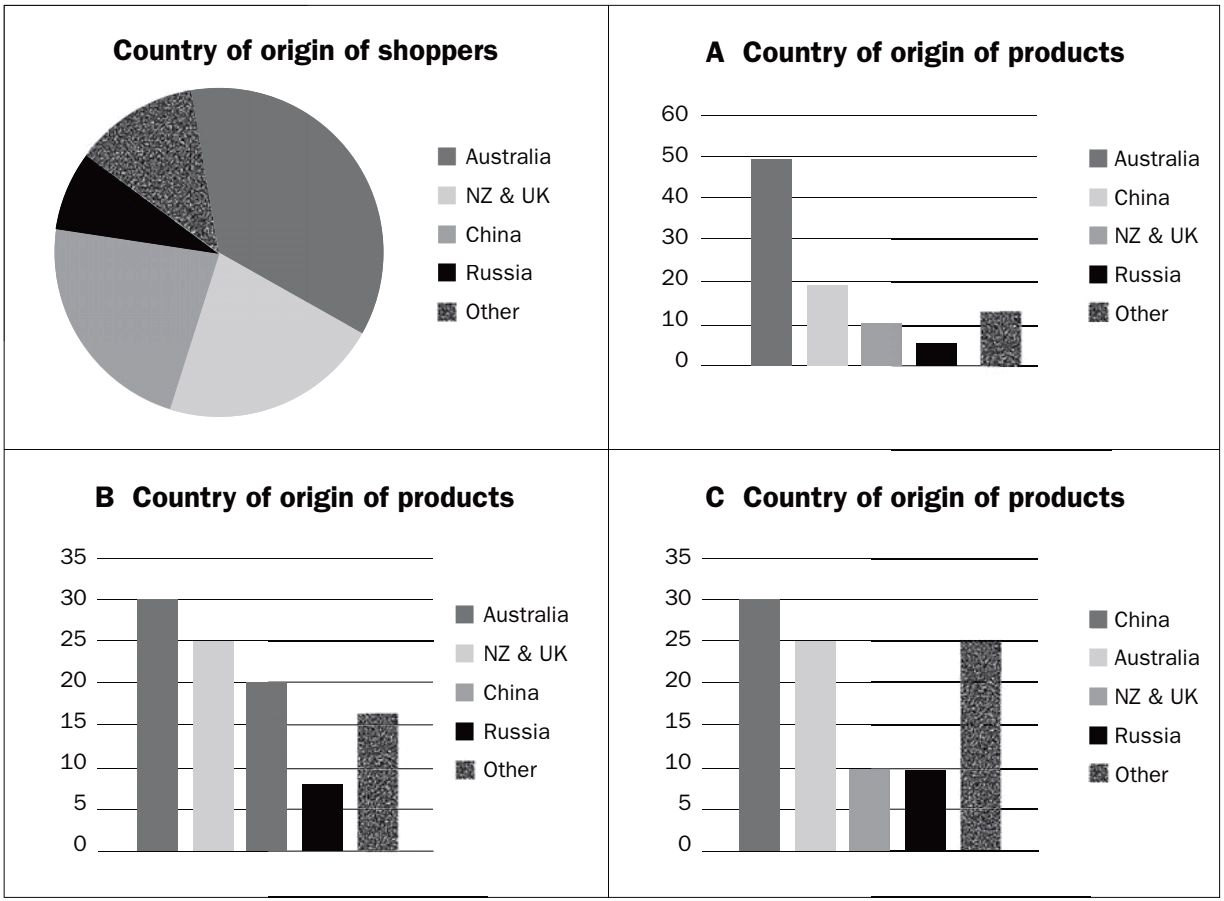
19.
Questions 20-26
Which study/studies do the following statements relate to?
In boxes 20-26 on your answer sheet, write
- A. if the information relates only to Atkin’s study
- B. if the information relates only to Bronnenberg’s study
- C. if the information relates to both Atkin’s and Bronnenberg’s studies
Điểm số của bạn là % - đúng / câu
Brand Loyalty Runs Deep Reading Answers
14 D | 19 B | 24 A |
15 A | 20 C | 25 C |
16 B | 21 C | 26 C |
17 D | 22 B | |
18 D | 23 A |
Giải chi tiết Brand Loyalty Runs Deep IELTS Reading
Questions 14-18: Dạng MCQ Cách làm: Bước 1: Đọc câu hỏi và gạch chân từ khóa Bước 2: Scan từ khóa trong đoạn văn Bước 3: Tìm ra hiện tượng paraphrase Bước 4: Chọn đáp án đúng, double check bằng cách chứng minh các đáp án còn lại sai Chứng minh các đáp án ĐÚNG/SAI bằng cách lần lượt trả lời 2 câu hỏi:
| |
14. In this article, the writer refers to food products that are sold | |
D. retail Nhận xét:
Cụ thể:
⇒ Đáp án D là chính xác | At almost any supermarket in Sydney, Australia, food from all over the world fills the shelves |
A. at markets Nhận xét:
Cụ thể:
⇒ Đáp án A là NOT GIVEN | At almost any supermarket in Sydney, Australia, food from all over the world fills the shelves |
B. Wholesale Nhận xét:
Cụ thể:
⇒ Đáp án B là NOT GIVEN | At almost any supermarket in Sydney, Australia, food from all over the world fills the shelves |
C. online Nhận xét:
Cụ thể:
⇒ Đáp án C là NOT GIVEN | At almost any supermarket in Sydney, Australia, food from all over the world fills the shelves |
15. In Sydney, shoppers can buy beer from | |
A. China and Indonesia Nhận xét:
Cụ thể:
⇒ Đáp án A là chính xác | Alongside local Foster’s beer, Chinese Tsingtao and Indonesian Bintang are both to be found. |
B. India and South Africa Nhận xét:
Cụ thể: Trong đoạn A, India và South Africa có xuất hiện nhưng là:
⇒ Đáp án B là FALSE | Perhaps you fancy some Tick Tock Rooibos tea made in South Africa or Maharaja’s Choice Rogan Josh sauce from India. |
C. Poland Nhận xét:
Cụ thể:
⇒ Đáp án C là FALSE | for pining Poles sweets manufactured by firms like Wawel or Solidarposc are available. |
D. Vietnam Nhận xét:
Cụ thể:
⇒ Đáp án D là NOT GIVEN | |
16. The greater variety of goods and brands now available is mainly due to | |
B. changes in migration and international trade Nhận xét:
Cụ thể:
⇒ Đáp án B là chính xác | All of this variety results from population movement and changes in global trade, and, to a lesser extent, reduced production and transportation costs |
A. cheaper production and more migration Nhận xét:
Cụ thể:
Nhưng:
⇒ Đáp án A là FALSE | All of this variety results from population movement and changes in global trade, and, to a lesser extent, reduced production and transportation costs |
C. cheaper production and transport Nhận xét:
Cụ thể:
⇒ Đáp án C là FALSE | All of this variety results from population movement and changes in global trade, and, to a lesser extent, reduced production and transportation costs |
D. changes in migration and transport Nhận xét:
Cụ thể:
⇒ Đáp án D là FALSE | All of this variety results from population movement and changes in global trade, and, to a lesser extent, reduced production and transportation costs |
17. The writer thinks supermarkets _____ should change their products slightly. | |
D. worldwide Nhận xét:
Cụ thể:
⇒ Đáp án D là chính xác | Even with this rise in the availability of non-local products, recent studies suggest that supermarkets should do more to increase their number to match more closely the proportion of shoppers from those countries or regions…Thus, if 10% of a supermarket’s customers originate in Vietnam, there ought to be 10% of Vietnamese products in the store. If Americans from southern states dominate in one northern neighborhood, southern brands should also be conspicuous |
A. in Australia Nhận xét:
Cụ thể:
⇒ Đáp án A là FALSE | Even with this rise in the availability of non-local products, recent studies suggest that supermarkets should do more to increase their number to match more closely the proportion of shoppers from those countries or regions |
B. in India and the US Nhận xét:
Cụ thể:
⇒ Đáp án B là FALSE | Even with this rise in the availability of non-local products, recent studies suggest that supermarkets should do more to increase their number to match more closely the proportion of shoppers from those countries or regions |
C. in Switzerland Nhận xét:
Cụ thể:
⇒ Đáp án C là NOT GIVEN | While Australia can claim around 40% of its population as the first generation, other countries, like Switzerland, may have fewer international migrants |
18. The writer suggests that | |
D. specialist shops already supply minority groups, yet supermarkets should compete with them Nhận xét:
Cụ thể:
→ Tác giả:
⇒ Đáp án D là chính xác | Even with this rise in the availability of non-local products, recent studies suggest that supermarkets should do more to increase their number…Admittedly, there are already specialist shops that cater to minority groups, but minorities do frequent supermarkets |
A. the quality of products at specialist shops will always be better than at supermarkets Nhận xét:
Cụ thể:
⇒ Đáp án A là NOT GIVEN | Even with this rise in the availability of non-local products, recent studies suggest that supermarkets should do more to increase their number…Admittedly, there are already specialist shops that cater to minority groups, but minorities do frequent supermarkets |
B. specialist shops will close down because supermarkets will be cheaper Nhận xét:
Cụ thể:
⇒ Đáp án B là NOT GIVEN | |
C. specialist shops already supply minority groups, so supermarkets shouldn’t bother Nhận xét:
Cụ thể: Bài không nói:
⇒ Đáp án C là NOT GIVEN | |
Questions 19: Dạng Diagram/ Table/ Flowchart Completion Cách làm:
| |
20 Which chart below A, B, or C, best describes the relationship between shoppers at one Sydney supermarket, and what research suggests that the same supermarket should sell? | |
Tỉ lệ sản phẩm của mỗi quốc gia nên xấp xỉ tỉ lệ khách hàng đến từ quốc gia đó. Biểu đồ khách hàng (pie chart):
→ Siêu thị nên bán sản phẩm với tỉ lệ xấp xỉ giống hệt các số trên. Chart B:
→ Đây là biểu đồ khớp nhất với nguyên tắc “tỉ lệ sản phẩm ≈ tỉ lệ khách hàng”. ⇒ Đáp án B là chính xác | If 10% of a supermarket’s customers originate in Vietnam, there ought to be 10% of Vietnamese products in the store |
Questions 20-26: Dạng Matching Phrases Cách làm:
Note:
| |
20. There was a correlation between brands a shopper used in childhood, and his or her preferences as an adult.
→ Câu hỏi nói: “Thương hiệu dùng lúc nhỏ ảnh hưởng đến sở thích khi trưởng thành” ⇒ Đáp án C là chính xác | Two separate studies by Bronnenberg and Atkin found that brand loyalty depends on a consumer’s past. |
21. One reason for the popularity of smaller brands was that many people surveyed came from another state where those brands were bigger.
⇒ Đáp án C là chính xác | … that Atkin discovered … In the US context, between 2006 and 2008, Bronnenberg analyzed data … In general, there were two leading brands… but there were smaller brands that assumed a greater proportion of consumers’ purchases than was statistically likely. One explanation for this is that 16% of people surveyed came from interstate, and these people preferred products from their home states …that Atkin discovered…. As in the US, internal migrants bought food from their native place even when it was considerably more expensive than local alternatives… |
22. Even living in a new state for a very long time did not mean that shoppers chose new brands. Giải nghĩa:
⇒ Đáp án B là chính xác | Bronnenberg analyzed data … Over time, they did buy more products from their adopted state, but, surprisingly, it took two decades for their brand loyalty to halve … Even people who had moved interstate 50 years previously maintained a preference for home-state brands. |
23. In general, food became more expensive during the time of the study. Despite this, families bought their favorite brands and ate less. Giải nghĩa dễ hiểu:
Giá đồ ăn tăng, ăn ít đi, nhưng vẫn mua thương hiệu quen → Điều này chỉ xuất hiện trong nghiên cứu của Atkin ở Ấn Độ ⇒ Đáp án A là chính xác | that Atkin discovered…. Firstly, during the period of his survey, the cost of all consumables rose considerably in India. As a result, families reduced their spending on food, and their calorific intake fell accordingly… |
24. Taxes on products from other states also increased the cost of food. This did not stop migrants from buying what they were used to. Ở Ấn Độ, mỗi bang đánh thuế lên hàng hóa từ bang khác, làm chúng đắt hơn. Nhưng người di cư vẫn ưu tiên mua sản phẩm từ quê mặc dù giá cao. Điều này chỉ được nêu trong nghiên cứu của Atkin ⇒ Đáp án A là chính xác | that Atkin discovered…Although India is one country, states impose tariffs or taxes on products from other Indian states, ensuring that locally-produced goods remain cheaper…As in the US, internal migrants bought food from their native place even when it was considerably more expensive than local alternatives. |
25. Children may be the target of more food advertising now.
⇒ Đáp án C là chính xác | Therefore, according to both researchers, more advertising may now be directed at minors, since brand loyalty is established in childhood and lasts a lifetime |
26. Advertising and price were once thought to be the main reasons for buying products. This theory has been modified now.
⇒ Đáp án C là chính xác | For supermarkets… advertising and price are not the sole motivating factors for purchase as was previously thought, in light of Atkin and Bronnenberg’s research… |
Trên đây là lời giải chi tiết cho Brand Loyalty Runs Deep IELTS Reading. Hy vọng bài viết này giúp ích cho bạn.
Xem thêm: Giải chi tiết Is Photography Art IELTS Reading