Giải thích đáp án chi tiết Communicating in colour IELTS Reading
Cùng thực hành giải bài đọc Communicating in colour IELTS Reading và tham khảo phần giải thích đáp án chi tiết từ IZONE trong bài viết này nhé!
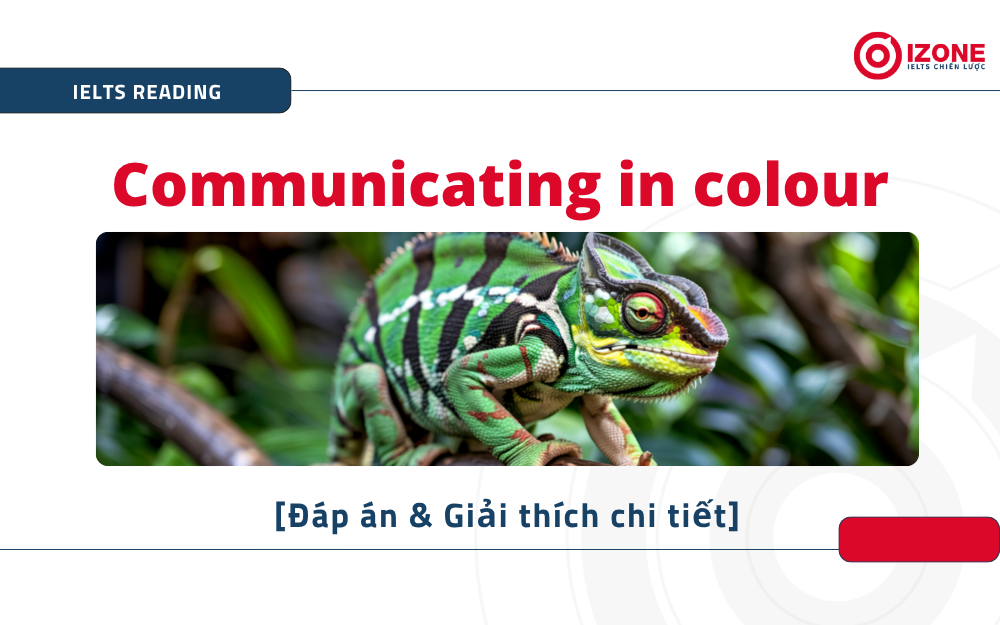
Bài đọc Communicating in colour IELTS Reading
Communicating in Colour
There are more than 160 known species of chameleons. The main distribution is in Africa and Madagascar, and other tropical regions, although some species are also found in parts of southern Europe and Asia. There are introduced populations in Hawaii and probably in California and Florida too.
New species are still discovered quite frequently. Dr Andrew Marshall, a conservationist from York University, was surveying monkeys in Tanzania, when he stumbled across a twig snake in the Magombera forest which, frightened, coughed up a chameleon and fled. Though a colleague persuaded him not to touch it because of the risk from the venom, Marshall suspected it might be a new species and took a photograph to send to colleagues, who confirmed his suspicions. Kinyongia magomherae, literally “the chameleon from Magombera”, is the result, and the fact it was not easy to identify is precisely what made it unique. The most remarkable feature of chameleons is their ability to change colour, an ability rivalled only by cuttlefish and octopi in the animal kingdom. Because of this, colour is not the best thing for telling chameleons apart and different species are usually identified based on the patterning and shape of the head, and the arrangement of scales. In this case, it was the bulge of scales on the chameleon’s nose.
Chameleons are able to use colour for both communication and camouflage by switching from bright, showy colours to the exact colour of a twig within seconds. They show an extraordinary range of colours, from nearly black to bright blues, oranges, pinks and greens, even several at once. A popular misconception is that chameleons can match whatever background they are placed on, whether a chequered red and yellow shirt or a Smartie box. But each species has a characteristic set of cells containing pigment distributed over their bodies in a specific pattern, which determines the range of colours and patterns they can show. To the great disappointment of many children, placing a chameleon on a Smartie box generally results in a stressed, confused, dark grey or mottled chameleon.
Chameleons are visual animals with excellent eyesight, and they communicate with colour. When two male dwarf chameleons encounter each other, each shows its brightest colours. They puff out their throats and present themselves side-on with their bodies flattened to appear as large as possible and to show off their colours. This enables them to assess each other from a distance. If one is clearly superior, the other quickly changes to submissive colouration, which is usually a dull combination of greys or browns.
If the opponents are closely matched and both maintain their bright colours, the contest can escalate to physical fighting and jaw-locking, each trying to push the other along the branch in a contest of strength. Eventually, the loser will signal his defeat with submissive colouration. Females also have aggressive displays used to repel male attempts at courtship. When courting a female, males display the same bright colours that they use during contests. Most of the time, females are unreceptive and aggressively reject males by displaying a contrasting light and dark colour pattern, with their mouths open and moving their bodies rapidly from side to side. If the male continues to court a female, she often chases and bites him until he retreats. The range of colour change during female displays, although impressive, is not as great as that shown by males.
Many people assume that colour change evolved to enable chameleons to match a greater variety of backgrounds in their environment. If this was the case, then the ability of chameleons to change colour should be associated with the range of background colours in the chameleon’s habitat, but there is no evidence for such a pattern. For example, forest habitats might have a greater range of brown and green background colours than grasslands, so forest-dwelling species might be expected to have greater powers of colour change. Instead, the males whose display colours are the most eye-catching show the greatest colour change. Their displays are composed of colours that contrast highly with each other as well as with the background vegetation. This suggests that the species that evolved the most impressive capacities for colour change did so to enable them to intimidate rivals or attract mates rather than to facilitate camouflage.
How do we know that chameleon display colours are eye-catching to another chameleon or, for that matter, to a predatory bird? Getting a view from the perspective of chameleons or their bird predators requires information on the chameleons or birds’ visual system and an understanding of how their brains might process visual information. This is because the perceived colour of an object depends as much on the brain’s wiring as on the physical properties of the object itself. Luckily, recent scientific advances have made it possible to obtain such measurements in the field, and information on the visual systems of a variety of animals is becoming increasingly available.
Questions 1-5: Answer the questions below.
Choose NO MORE THAN THREE WORDS from the passage for each answer. Write your answers in boxes 3-5 on your answer sheet
1. What kind of climate do most chameleons live in?
2. Which animal caught a chameleon that Dr. Andrew Marshall saw?
3. What was the new species named after?
4. Which part of the body is unique to the species Kinyongia magomberae?
Questions 5-13: Do the following statements agree with the information given in Reading Passage? In boxes 6-14 on your answer sheet, write
TRUE if the statement agrees with the information
FALSE if the statement contradicts the information
NOT GIVEN if there is no information on this
Điểm số của bạn là % - đúng / câu
Đáp án và giải thích đáp án chi tiết Communicating in colour IELTS Reading
| 1. tropical | 7. FALSE |
| 2. (a) (twig) snake | 8. FALSE |
| 3. (a/the) forest (of Magombera/ Magombera (forest) | 9. NOT GIVEN |
| 4. (the) nose | 10. TRUE |
| 5. TRUE | 11. TRUE |
| 6. FALSE | 12. NOT GIVEN |
| 13. FALSE |
Giải thích đáp án chi tiết Communicating in colour IELTS Reading
|
Question 1-4: Dạng Short Answer Questions Cách làm: Bước 1: Đọc câu hỏi, gạch chân từ khóa, xác định giới hạn đáp án được chọn Bước 2: Scan từ khóa trong đoạn văn Bước 3: Tìm ra hiện tượng paraphrase Bước 4: Chọn ra đáp án đúng |
|
|
1. What kind of climate do most chameleons live in? Hầu hết các loài tắc kè hoa sống ở khí hậu nhiệt đới. Đáp án: tropical |
There are more than 160 known species of chameleons. The main distribution is in Africa and Madagascar, and other tropical regions, although some species are also found in parts of southern Europe and Asia. |
|
2. Which animal caught a chameleon that Dr. Andrew Marshall saw? Một con rắn cành cây đã bắt và nôn ra tắc kè hoa. Đáp án: (twig) snake |
when he stumbled across a twig snake in the Magombera forest which, frightened, coughed up a chameleon and fled. |
|
3. What was the new species named after? Loài mới được đặt tên theo khu rừng Magombera, nơi nó được tìm thấy. Đáp án: (Magombera) forest |
when he stumbled across a twig snake in the Magombera forest which, frightened, coughed up a chameleon and fled. Though a colleague persuaded him not to touch it because of the risk from the venom, Marshall suspected it might be a new species and took a photograph to send to colleagues, who confirmed his suspicions. Kinyongia magomherae, literally “the chameleon from Magombera”, |
|
4. Which part of the body is unique to the species Kinyongia magomberae? Đặc điểm phân biệt là phần mũi – có vảy lồi. Đáp án: nose |
In this case, it was the bulge of scales on the chameleon’s nose. |
|
Questions 5 – 13: Dạng TRUE/FALSE/NOT GIVEN & YES/NO/NOT GIVEN Cách làm:
Chọn đáp án bằng cách lần lượt trả lời 2 câu hỏi: Câu 1: Các thông tin trong câu hỏi ĐỀU TÌM ĐƯỢC NỘI DUNG TƯƠNG ỨNG trong bài đọc hay không? (Nội dung tương ứng là những nội dung cùng chỉ về 1 điều, mang cùng 1 chức năng trong câu. Ví dụ: Anh ấy đến nơi lúc 8h vs. Sau 9h anh ấy mới tới => “lúc 8h” và “sau 9h” đều nêu thời điểm anh ta tới nơi => 2 thông tin này dù khác về nội dung những vẫn được coi là tương ứng với nhau) Nếu không (có thông tin trong câu hỏi mà không có phần tương ứng trong bài đọc): đáp án là NOT GIVEN. Nếu có: loại phương án NOT GIVEN và chuyển sang câu hỏi tiếp theo Câu 2: Có thông tin nào trong câu hỏi bị TRÁI NGƯỢC/SAI LỆCH với nội dung bài đọc hay không? Nếu không (mọi thông tin đều khớp)·: đáp án là TRUE. Nếu có: đáp án là FALSE. |
|
|
5. Few creatures can change colour as effectively as cuttlefish.
Tắc kè hoa có khả năng đổi màu “chỉ bị so sánh với mực nang và bạch tuộc”, tức là rất ít loài sánh được. Đáp án TRUE |
The most remarkable feature of chameleons is their ability to change colour, an ability rivalled only by cuttlefish and octopi in the animal kingdom. |
|
6. Chameleons can imitate a pattern provided there are more than two colours.
Sai, vì bài viết nói rõ đây là hiểu lầm phổ biến – chameleons không thể bắt chước mọi nền màu. Đáp án FALSE |
A popular misconception is that chameleons can match whatever background they are placed on, whether a chequered red and yellow shirt or a Smartie box. |
|
7. Chameleons appear to enjoy trying out new colours.
Không đúng, chúng có thể bị stress và bối rối khi đặt lên nền màu lạ. Đáp án FALSE |
To the great disappointment of many children, placing a chameleon on a Smartie box generally results in a stressed, confused, dark grey or mottled chameleon. |
|
8. Size matters more than colour when male chameleons compete.
Bài chỉ nói chúng phô diễn màu sắc và kích cỡ, không khẳng định yếu tố nào quan trọng hơn. Đáp án NOT GIVEN |
When two male dwarf chameleons encounter each other, each shows its brightest colours. They puff out their throats and present themselves side-on with their bodies flattened to appear as large as possible and to show off their colours. This enables them to assess each other from a distance. |
|
9. After a fight, the defeated male hides among the branches of a tree.
Sau khi thua, con đực chuyển sang màu phục tùng, tức là không tiếp tục chiến đấu nữa, ám chỉ hành vi rút lui. Đáp án TRUE |
Eventually, the loser will signal his defeat with submissive colouration. |
|
10. Females use colour and movement to discourage males.
Con cái dùng màu tương phản và chuyển động mạnh để đuổi con đực đi. Đáp án TRUE |
Most of the time, females are unreceptive and aggressively reject males by displaying a contrasting light and dark colour pattern, with their mouths open and moving their bodies rapidly from side to side. |
|
11. The popular explanation of why chameleons change colour has been proved wrong
Bài nói là “không có bằng chứng”, chứ không phải đã bị chứng minh sai. Đáp án FALSE |
If this was the case, then the ability of chameleons to change colour should be associated with the range of background colours in the chameleon’s habitat, but there is no evidence for such a pattern. |
|
12. There are more predators of chameleons in grassland habitats than in others. Không hề có thông tin so sánh về số lượng kẻ săn mồi ở các môi trường khác nhau. Đáp án NOT GIVEN |
Không được đề cập trong bài. |
|
13. Measuring animals’ visual systems necessitate removing them from their habitat
Hiện tại đã có thể đo lường hệ thống thị giác ngay tại hiện trường. Đáp án FALSE |
Luckily, recent scientific advances have made it possible to obtain such measurements in the field, and information on the visual systems of a variety of animals is becoming increasingly available. |
Bài viết trên IZONE đã cung cấp phần giải thích đáp án chi tiết cho bài đọc Communicating in colour IELTS Reading. Bạn có thể tiếp tục luyện tập tại chuyên mục IELTS Reading của IZONE.
Thử sức với: Giải chi tiết Alexander Henderson IELTS Reading