Giải đáp án chi tiết Jumping spider IELTS Reading
Luyện tập với bài đọc Jumping spider IELTS Reading và tham khảo phần giải thích đáp án chi tiết từ IZONE trong bài viết này nhé!
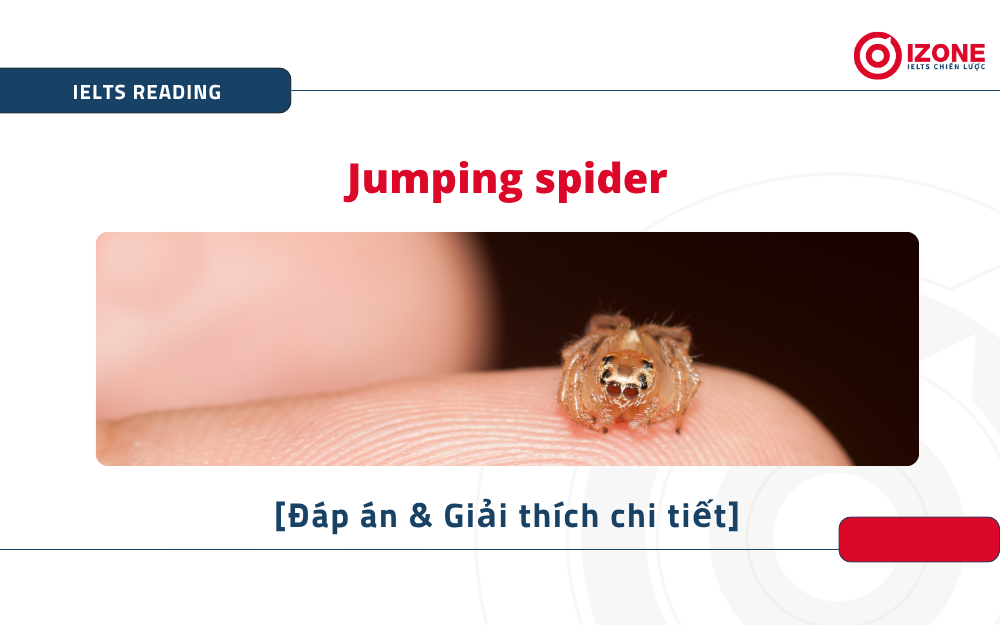
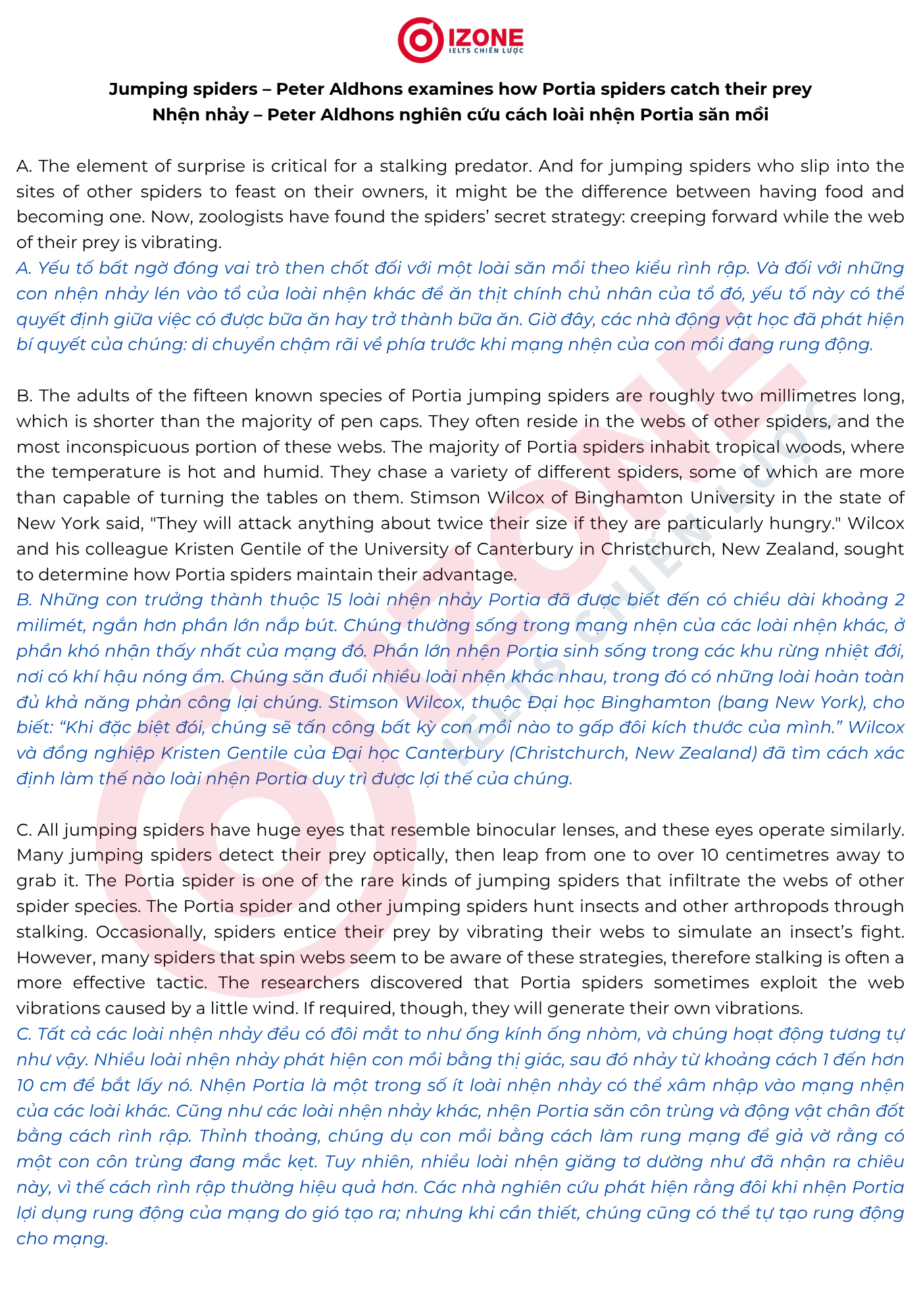
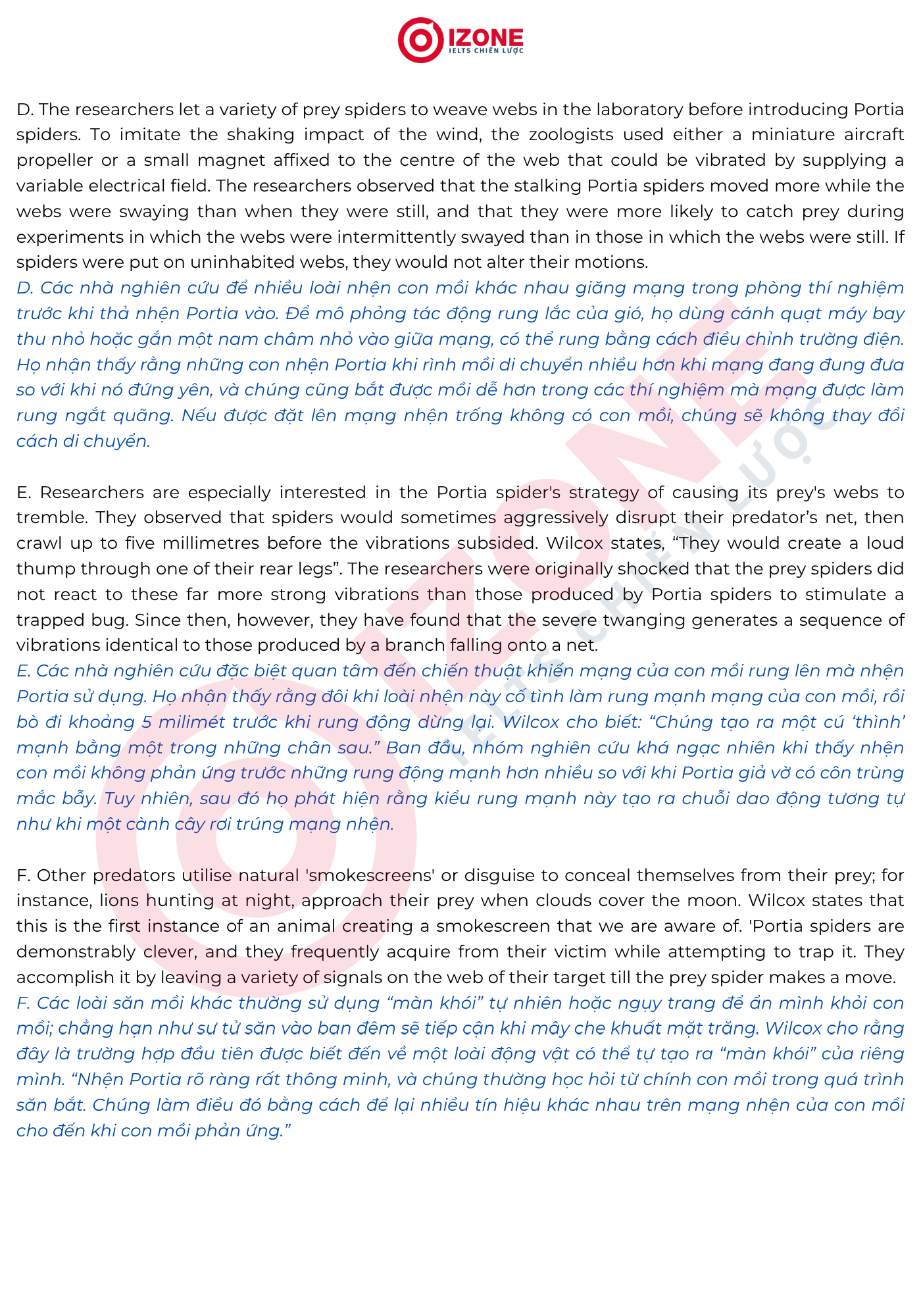
Bài đọc Jumping spider IELTS Reading

Questions 1-4: Multiple Choice Question
Select the appropriate letter, A, B, C, or D, and write it on your answer sheet.1. In experimental trials, researchers discovered that Portia spiders were most active when their web was
2. What discovery did scientists make about Portia spiders?
3. Portia spiders were the only recognized animal to
4. The Portia spider demonstrates ‘thinking ahead’ when it
Questions 5-7
Complete the notes.
Write NO MORE THAN TWO WORDS from the passage for each answer.
5. The zoologists used either a small aeroplane propeller or a small magnet to simulate the of the wind.
6. They do this by leaving a variety of on the web of their victim spider until it moves.
7. Portia spiders learn stalking abilities by and error.
Questions 8-14: Locate the information.
Write the correct letter A-F on your answer sheet.
NB You may use any letter more than once.
Điểm số của bạn là % - đúng / câu
Giải thích đáp án chi tiết Jumping spider IELTS Reading
| 1. C | 8. B |
| 2. D | 9. A |
| 3. A | 10. E |
| 4. D | 11. B |
| 5. Shaking impact | 12. D |
| 6. Signals | 13. F |
| 7. Experimenting | 14. D |
Giải thích đáp án chi tiết Jumping spider IELTS Reading
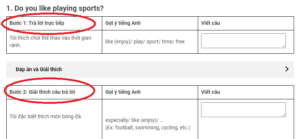
Questions 1-4: Dạng MCQ Cách làm:
Chứng minh các đáp án ĐÚNG/SAI bằng cách lần lượt trả lời 2 câu hỏi:
| |
1. In experimental trials, researchers discovered that Portia spiders were most active when their web was | |
C. vibrating. Nhận xét:
Cụ thể: Điều này rõ ràng nói rằng khi lưới rung, chúng di chuyển nhiều hơn — tức là hoạt động mạnh hơn so với khi lưới bất động. Đáp án C đúng. | Đoạn D: The researchers observed that the stalking Portia spiders moved more while the webs were swaying than when they were still, and that they were more likely to catch prey during experiments in which the webs were intermittently swayed than in those in which the webs were still. |
A. motionless. Nhận xét:
Cụ thể: Khi mạng “still” (bất động), Portia di chuyển ít hơn. Đáp án A sai. | Đoạn D: The researchers observed that the stalking Portia spiders moved more while the webs were swaying than when they were still, |
B. unoccupied. Nhận xét:
Cụ thể: Nếu mạng không có con mồi, Portia không thay đổi hành vi. Đáp án B sai. | Đoạn D: If spiders were put on uninhabited webs, they would not alter their motions. |
D. undisturbed. Nhận xét:
Cụ thể: Portia cần rung động (do gió hoặc tự tạo), không phải “web yên tĩnh”. Đáp án D sai. | Không được đề cập trong bài. |
2. What discovery did scientists make about Portia spiders? | |
D. They make very strong vibrations with one leg. Nhận xét:
Cụ thể: Portia dùng một chân sau để tạo ra rung động mạnh (loud thump), giúp che giấu hành vi di chuyển. Đáp án D đúng. | Đoạn E: Wilcox states, “They would create a loud thump through one of their rear legs”. |
A. They move slowly when vibrations stop. Nhận xét:
Cụ thể: Bài không nói chúng “di chuyển chậm” khi rung dừng; chỉ nói khi lưới rung thì chúng di chuyển nhiều hơn, không phải “chậm khi rung dừng”. Đáp án A sai. | Không đề cập trong bài. |
B. They move 5 mm at a time on a still web. Nhận xét:
Cụ thể: Bài có nói chúng có thể bò 5mm sau mỗi rung động mạnh, nhưng không phải trên lưới tĩnh mà là ngay sau khi tạo rung động mạnh. Đáp án B sai. | Đoạn E: They observed that spiders would sometimes aggressively disrupt their predator’s net, then crawl up to five millimetres before the vibrations subsided. |
C. They use energetic vibrations to mimic a trapped insect. Nhận xét:
Cụ thể: Portia có mô phỏng côn trùng bị mắc lưới bằng rung nhẹ, không phải “energetic”. “Energetic” rung được dùng để đánh lừa, chứ không để giả mồi. Đáp án C sai. | Đoạn E: Since then, however, they have found that the severe twanging generates a sequence of vibrations identical to those produced by a branch falling onto a net. |
3. Portia spiders were the only recognized animal to | |
A. create their smokescreen Nhận xét:
Cụ thể: Portia là loài đầu tiên được biết đến tự tạo “smokescreen” để ngụy trang, tạo rung động giả để đánh lừa con mồi. Đáp án A đúng. | Đoạn F: this is the first instance of an animal creating a smokescreen that we are aware of.” |
B. use the weather to disguise themselves Nhận xét:
Cụ thể: Loài khác (sư tử dùng mây che trăng), không phải Portia. Đáp án B sai. | Đoạn F: Other predators utilise natural ‘smokescreens’ or disguise to conceal themselves from their prey; for instance, lions hunting at night, approach their prey when clouds cover the moon. |
C. stalk using trial and error Nhận xét:
Cụ thể: Portia có học theo thử-sai, nhưng bài không nói chúng là loài duy nhất làm điều này. Đáp án C sai. | Đoạn G: Thus, Portia spiders acquire stalking skills by experimenting and failing. |
D. mimic other prey-eating animals Nhận xét:
Cụ thể: Portia không bắt chước các loài săn mồi khác, mà có chiến thuật riêng biệt. Không có chi tiết nào về việc mô phỏng động vật ăn thịt khác. Đáp án D sai. | Không được đề cập trong bài. |
4. The Portia spider demonstrates ‘thinking ahead’ when it | |
D. takes a longer route to reach its prey Nhận xét:
Cụ thể: Portia đôi khi đi đường vòng để tiếp cận con mồi đã phát hiện từ xa. Việc này mất tới 2 tiếng, chứng minh nó có chiến lược, suy nghĩ trước. Đáp án D đúng. | Đoạn G: Periodically, they may even follow a circuitous approach to catch a prey spider they have spotted from a distance. Following a predefined itinerary, this might sometimes take up to two hours. When it does this, the Portia spider is really resolving issues and planning its next move. |
A. reaches its prey in a short time Nhận xét:
Cụ thể: Portia có thể mất đến 2 tiếng để tiếp cận con mồi. Đáp án A sai. | Đoạn G: Periodically, they may even follow a circuitous approach to catch a prey spider they have spotted from a distance. Following a predefined itinerary, this might sometimes take up to two hours. When it does this, the Portia spider is really resolving issues and planning its next move. |
B. chooses prey that is a short distance away Nhận xét:
Cụ thể: Không có dữ kiện nói Portia chọn con mồi ở gần. Trái lại, nó có thể đi đường vòng dài. Đáp án B sai. | Không được đề cập trong bài. |
C. solves the problem of locating its prey Nhận xét:
Cụ thể: Bài không nói đến vấn đề tìm kiếm con mồi, mà là tiếp cận con mồi đã phát hiện bằng chiến lược. Đáp án C sai. | Đoạn G: Periodically, they may even follow a circuitous approach to catch a prey spider they have spotted from a distance. |
Questions 5- 7: Dạng Sentence Completion Cách làm
| |
5. The zoologists used either a small aeroplane propeller or a small magnet to simulate the ________ of the wind. Từ cần điền là danh từ. Các nhà khoa học mô phỏng tác động rung lắc của gió, bằng cách dùng quạt mini hoặc nam châm. Đáp án là shaking impact | Đoạn D: To imitate the shaking impact of the wind, the zoologists used either a miniature aircraft propeller or a small magnet affixed to the centre of the web that could be vibrated by supplying a variable electrical field. |
6. They do this by leaving a variety of _______ on the web of their victim spider until it moves. Từ cần điền là danh từ. Portia để lại tín hiệu (signals) trên mạng nhện để kích thích con mồi di chuyển. Đáp án là signals | Đoạn F: They accomplish it by leaving a variety of signals on the web of their target till the prey spider makes a move. |
7. Portia spiders learn stalking abilities by _______ and error. Nhện Portia học cách rình mồi bằng cách thử nghiệm và rút kinh nghiệm từ sai lầm. Đáp án là experimenting | Đoạn G: Thus, Portia spiders acquire stalking skills by experimenting and failing |
Questions 8 – 14: Dạng Matching Information Cách làm:
Note: Làm dạng bài này cuối cùng, sau khi đã hiểu được nội dung chính cả bài Một số đoạn văn có thể chứa 2 mẩu thông tin | |
8. a comparison between Portia spiders and their prey So sánh rõ ràng giữa Portia và con mồi về kích thước và khả năng săn mồi. Đáp án là B | Đoạn B: They will attack anything about twice their size if they are particularly hungry |
9. the reason why concealment is important to Portia spiders Bất ngờ (ẩn nấp, ngụy trang) rất quan trọng với Portia vì nó giúp tấn công hiệu quả hơn. Đáp án là A | Đoạn A: The element of surprise is critical for a stalking predator. |
10. the reaction of the Portia spider’s prey to strong web vibrations Con mồi không phản ứng như mong đợi, vì chúng nghĩ đó là rung do nhánh cây rơi. Đáp án là E | Đoạn E: The researchers were originally shocked that the prey spiders did not react to these far more strong vibrations. |
11. a description of the Portia spider’s habitat Đây là phần mô tả địa điểm, khí hậu sống Đáp án là B | Đoạn B: The majority of Portia spiders inhabit tropical woods, where the temperature is hot and humid. |
12. a description of how the researchers set up their experiment Dùng quạt mini hoặc nam châm rung động mô phỏng gió Đáp án là D | Đoạn D: To imitate the shaking impact of the wind, the zoologists used either a miniature aircraft propeller or a small magnet |
13. a comparison between Portia spiders and other animal species So sánh cách Portia tạo màn che rung với cách sư tử dùng bóng tối → là so sánh với động vật khác. Đáp án là F | Đoạn F: Other predators utilise natural ‘smokescreens’ or disguise to conceal themselves from their prey; for instance, lions hunting at night, approach their prey when clouds cover the moon. |
14. an explanation of how the researchers mimicked natural conditions Các nhà khoa học mô phỏng điều kiện tự nhiên (gió thổi) bằng thiết bị rung. Đáp án là D | Đoạn D: To imitate the shaking impact of the wind, the zoologists used either a miniature aircraft propeller or a small magnet affixed to the centre of the web that could be vibrated by supplying a variable electrical field. |
Thực hành với: Accidental scientists IELTS Reading – Giải thích đáp án chi tiết