IELTS Writing Task 2 là khó khăn với nhiều thí sinh không chỉ vì ý tưởng mà còn phải đảm bảo đúng structure để tối ưu điểm. Trong bài viết này, IZONE sẽ tổng hợp những IELTS Writing Task 2 structure theo các dạng đề thường gặp kèm dấu hiệu nhận biết, khung bài chuẩn 4 đoạn và bài mẫu tham khảo cho band 7.0+!
IELTS writing task 2 structure for Part 2 – Các dạng đề IELTS Writing task 2 trong IELTS
IELTS Writing Task 2 là phần yêu cầu thí sinh viết một bài luận (essay) về một chủ đề xã hội quen thuộc như giáo dục, công nghệ, môi trường, sức khỏe hoặc lối sống. Task 2 là phần chiếm 2/3 tổng điểm Writing. Để có band điểm cao trong IELTS Writing, việc nắm vững IELTS Writing task 2 Format sẽ đóng vai trò quan trọng.
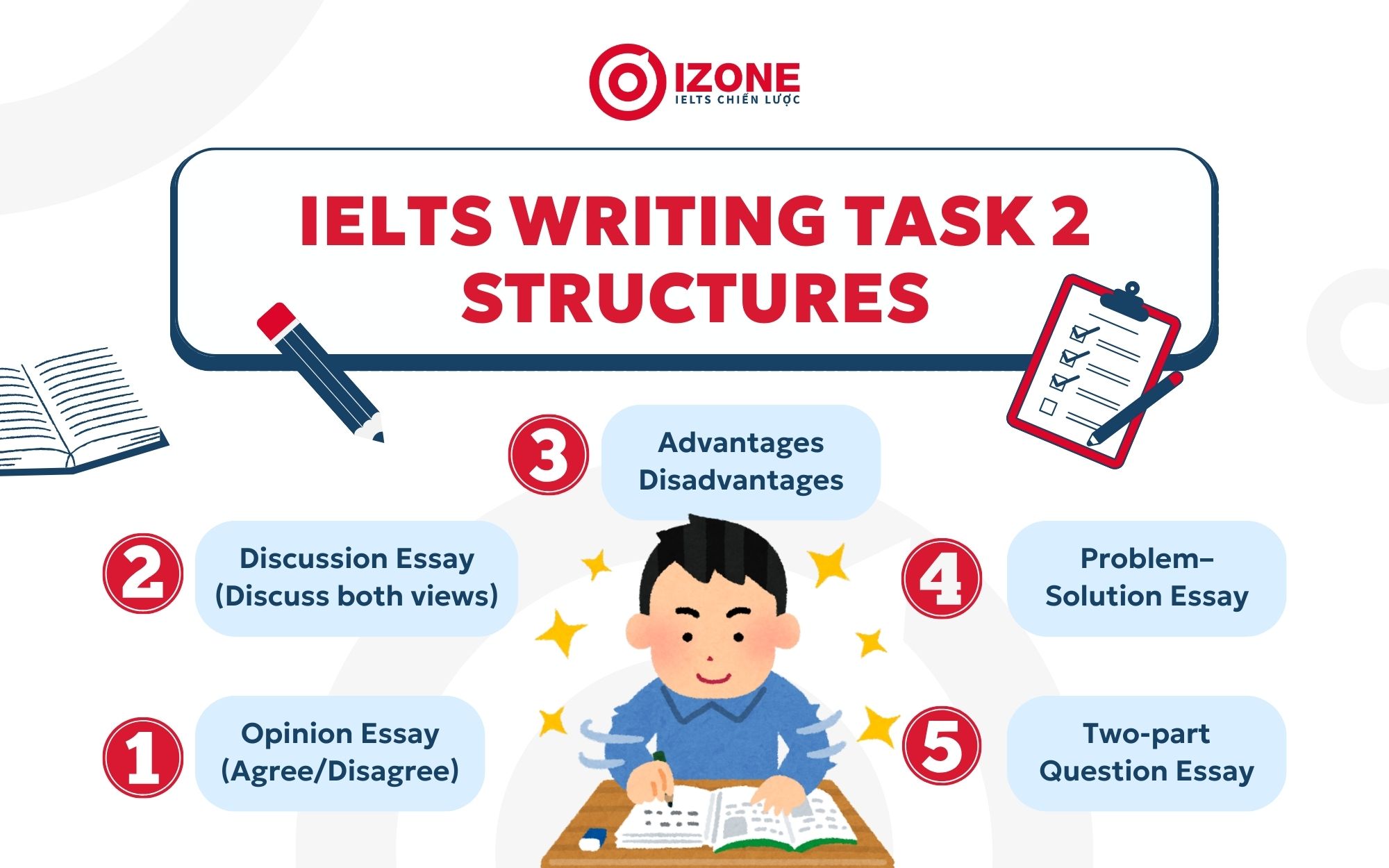
Dưới đây là các dạng đề IELTS Writing Task 2 thường gặp cùng cách nhận biết nhanh qua IELTS writing structure trong đề bài và cấu trúc triển khai chuẩn 4 đoạn (Introduction – Body 1 – Body 2 – Conclusion). Việc xác định đúng dạng ngay từ đầu sẽ giúp bạn sẽ tránh lạc đề, triển khai ý mạch lạc hơn và tối ưu điểm phần Task Response cũng như Coherence & Cohesion.
Writing task 2 IELTS writing structure- Cấu trúc chung cho mọi dạng bài
Ngoài ra, bạn cũng có thể tham khảo bài viết sau từ IZONE: Bộ từ vựng Writing Task 2 đầy đủ nhất kèm các cấu trúc “ăn điểm
1. Dạng Opinion Essay (Agree/Disagree)
Dấu hiệu nhận biết (keywords/đặc điểm)
Trong Đề bài có keywords: “Do you agree or disagree?”, “To what extent do you agree or disagree?” hoặc “What is your opinion?”
Yêu cầu: chọn 1 lập trường rõ ràng (agree hoặc disagree) và bảo vệ bằng lập luận hoặc bàn luận về cả hai quan điểm và đưa ra một góc nhìn cân bằng hơn.
Đề mẫu
Some people think governments should spend more money on public transport than on building new roads. Do you agree or disagree?
Cấu trúc mẫu
Với dạng opinion essay, bạn có thể tham khảo cấu trúc mẫu sau
Phần | Nội dung nên có |
Introduction | Paraphrase đề + nêu quan điểm rõ ràng (agree/disagree) + outline 2 ý chính |
Body 1 | Topic Sentence: Nêu lý do thứ nhất cho quan điểm của bạn. Explanation: Giải thích chi tiết tại sao bạn nghĩ như vậy. Example: Đưa ra ví dụ cụ thể để minh họa. |
Body 2 | Topic Sentence: Nêu lý do thứ hai cho quan điểm của bạn. Explanation: Giải thích sâu hơn. Example: Ví dụ thực tế hoặc giả định. |
Conclusion | Tóm tắt lại ý chính: Nhắc lại quan điểm và các lý do chính đã nêu ở thân bài (Bạn nên paraphrase và hạn chế copy lại những ý đã viết) |
Trong trường hợp bạn giữ lập trường cân bằng và đồng ý một phần với hai quan điểm, bạn có thể tham khảo cấu trúc sau
Phần | Nội dung nên có |
Introduction | Paraphrase đề bài: Viết lại đề bài bằng từ đồng nghĩa. Thesis Statement: Xác nhận bạn thấy vấn đề có cả mặt đúng và mặt chưa đúng (hoặc chỉ đúng trong một số điều kiện nhất định). Mẫu: “While I agree that [Opinion 1] is beneficial, I also believe that [Opinion 2] should be considered.” |
Body 1 | Topic Sentence: Thừa nhận tính đúng đắn/lợi ích của khía cạnh thứ nhất. Explanation: Tại sao khía cạnh này lại hợp lý? Example: Đưa ra ví dụ minh họa. Mục đích: Giải thích tại sao bạn “Agree” một phần. |
Body 2 | Topic Sentence: Đưa ra góc nhìn ngược lại hoặc những hạn chế của khía cạnh trên. Explanation: Tại sao khía cạnh thứ hai này cũng quan trọng không kém? Example: Ví dụ minh họa. Mục đích: Giải thích phần “Disagree” hoặc phần bổ sung của bạn. |
Conclusion | Restate Opinion: Khẳng định lại rằng cả hai yếu tố đều quan trọng và cần được cân bằng. Mẫu: “In conclusion, although [Opinion 1] is important for [Lý do], I maintain that [Opinion 2] is equally essential.” |
Bài viết mẫu (Band 7.0+)
Some people think governments should spend more money on public transport than on building new roads. Do you agree or disagree?
Many people believe that governments should prioritise public transport instead of constructing more roads. I agree with this opinion because public transport can reduce traffic problems more effectively and it is also better for the environment. To begin with, investing in public transport can ease congestion in a practical way. When a city builds more roads, more people may decide to drive, so the roads can quickly become crowded again. However, if the government improves buses, metro lines, and train services, a large number of commuters can travel at the same time. For example, if buses arrive frequently and are reliable, office workers are more likely to leave their cars at home, which helps reduce traffic on main streets. Another reason is that public transport can help cities become cleaner and healthier. Private cars produce a lot of pollution, especially in big cities with heavy traffic. In contrast, modern public transport systems, such as electric trains, can carry many passengers with less air pollution per person. As a result, investing in public transport can improve air quality and reduce health problems like asthma. In conclusion, I strongly agree that governments should spend more on public transport than new roads. This approach can reduce congestion in the long term and create a better living environment for citizens. (216 words) |
2. Dạng Discussion Essay (Discuss both views + your opinion)
Dấu hiệu nhận biết (keywords/đặc điểm)
Đề bài có cụm: “Discuss both views and give your own opinion hoặc: “Discuss both sides of this argument and then give your opinion”
Yêu cầu: trình bày 2 phía + quan điểm của bạn (thường nêu rõ ở phần mở bài và kết luận).
Đề mẫu
Some people think university education should be free for everyone, while others believe students should pay tuition fees. Discuss both views and give your own opinion.
Cấu trúc mẫu
Phần | Nội dung nên có |
Introduction | Câu 1 (Paraphrase): Dẫn dắt vấn đề và nêu rõ có hai luồng ý kiến trái chiều. Câu 2 (Thesis Statement): Nêu rõ quan điểm của bạn (Bạn nghiêng về phía nào hoặc chọn sự cân bằng). |
Body 1 (Thảo luận về Opinion 1) | Topic Sentence: Giới thiệu về quan điểm đầu tiên. Explanation: Tại sao bạn lại ủng hộ/không ủng hộ quan điểm này? Example: Ví dụ minh họa cho lợi ích hoặc tính đúng đắn của quan điểm A. |
Body 2 (Thảo luận về Opinion 2) | Topic Sentence: Chuyển sang quan điểm thứ hai Explanation: Tại sao quan điểm này cũng có lý hoặc vượt trội hơn quan điểm A. Your Opinion: Lồng ghép khéo léo ý kiến cá nhân (Ví dụ: In my view, this is a more sustainable approach because…). |
Conclusion | Tóm tắt 2 quan điểm và khẳng định lại quan điểm của bản thân về vấn đề |
Bài viết mẫu (Band 7.0+)
Some people think university education should be free for everyone, while others believe students should pay tuition fees. Discuss both views and give your own opinion.
It is often argued that higher education should be provided free of charge for all citizens, while others maintain that students ought to contribute through tuition fees. This essay will examine both perspectives before explaining why I believe a balanced approach is the most practical. On the one hand, making university education free can promote equal opportunity. In many countries, capable students from low-income families are discouraged from applying because of the high financial burden. If tuition were removed, admission would depend more on ability than on wealth, which could help societies develop a more skilled workforce. Moreover, public funding of universities may bring long-term economic benefits, as graduates tend to earn higher salaries, pay more taxes, and drive innovation. From this standpoint, free education is not merely a cost, but an investment in national development. On the other hand, opponents argue that fully free university education is neither fair nor sustainable. Governments operate under tight budgets and must also finance essential services such as healthcare, public transport, and welfare. If universities were entirely free, taxpayers—including those who never attend university—would subsidise degrees that often lead to private gains for graduates. In addition, charging at least part of the fees can encourage students to take their studies more seriously, reducing wasteful enrolment and improving completion rates. In my view, universities should not be completely free for everyone. Instead, a mixed system is preferable: tuition fees can remain, but governments should provide generous scholarships, grants, or income-contingent loans for disadvantaged students. This model protects access for those in need while ensuring higher education remains financially viable. 265 words |
Bạn có thể tìm hiểu thêm về dạng bài này qua bài đọc sau: Hướng dẫn làm dạng bài Discussion trong IELTS Writing Task 2 kèm bài mẫu
3. Dạng Advantages/Disadvantages (Outweigh)
Dấu hiệu nhận biết (keywords/đặc điểm)
Đề bài có cụm: “What are the advantages and disadvantages?” Hoặc cụm: “Do the advantages outweigh the disadvantages?”
Lưu ý: Nếu có “outweigh” → bạn phải kết luận ưu điểm hay nhược điểm có tác động lớn hơn(advantages > disadvantages hoặc ngược lại).
Đề mẫu
Many people now using modern technology to work from home. Do the advantages outweigh the disadvantages?
Cấu trúc mẫu
Với dạng bài này, bạn có thể tham khảo cấu trúc mẫu sau. Lưu ý, đây là cấu trúc mẫu cho quan điểm cho rằng những ưu điểm của vấn đề có tác động lớn hơn nhược điểm, bạn có thể linh hoạt áp dụng trong trường hợp ngược lại.
Phần | Nội dung nên có |
Introduction | Paraphrase + nêu rõ advantages outweigh hay disadvantages outweigh |
Body 1 (Bàn luận về nhược điểm) | Topic Sentence: Thừa nhận rằng có một số tác động tiêu cực nhất định. Mẫu: “On the one hand, [Disadvantages] can exert some negative effects on…” Explanation: Giải thích tại sao tác hại đó xảy ra. Example: Đưa ra ví dụ cụ thể để chứng minh |
Body 2 (Bàn luận về ưu điểm của vấn đề) | Topic Sentence: Khẳng định lợi ích là chủ đạo và quan trọng hơn. Mẫu: “On the other hand, I would argue that the advantages of this development are much more substantial.” Supporting sentence 1+ Expansion: Nêu lợi ích thứ nhất và giải thích. Supporting sentence 2 + Expansion: Nêu lợi ích thứ hai (thường là lợi ích mang tính lâu dài hoặc quy mô lớn). |
Conclusion | Khẳng định lại “outweigh” + tóm ý chính |
Bài viết mẫu (Band 7.0+)
Many people are now using modern technology to work from home. Do the advantages outweigh the disadvantages?
Many people now use modern technology to work from home, and this shift is becoming increasingly common. Although remote work can create problems such as weaker social connections and blurred boundaries between work and private life, I believe the advantages outweigh the disadvantages because the benefits are more dominant and have a greater impact on productivity and long-term flexibility. The main advantage is that working from home saves substantial time and money by eliminating commuting. This extra time can be redirected to rest, exercise, or focused working, which often leads to higher efficiency. In addition, many employees perform better in a personalised environment where they can control noise levels and interruptions, especially when completing tasks that require deep concentration, such as writing reports or analysing data. From an organisational perspective, remote work can reduce overhead costs, including office rent and utilities, and allows companies to hire capable staff beyond their local area, improving overall competitiveness. Nevertheless, there are several notable drawbacks. First, employees may feel isolated due to the lack of face-to-face interaction, which can reduce motivation over time. Second, teamwork may become less spontaneous because communication depends heavily on online meetings and messaging, where misunderstandings can occur more easily. Finally, some workers struggle to “switch off” after hours, potentially increasing stress and burnout. However, these disadvantages are largely manageable. Regular check-ins, occasional in-person meetings, and clear rules about working hours can maintain collaboration and protect wellbeing. In contrast, the core benefits-greater productivity, significant savings, and increased flexibility for both workers and employers-are more decisive and far-reaching. In conclusion, while working from home has limitations, the advantages are clearly stronger overall, and they play the leading role in shaping positive outcomes. 281 words |
4. Problem–Solution Essay (Causes + Solutions)
Dấu hiệu nhận biết (keywords/đặc điểm)
- Câu hỏi có chứa cụm: “What are the problems associated with this? What solutions can you suggest?” Hoặc: “What problems does this cause?”
- Yêu cầu đề bài: nêu vấn đề (problems) và đề xuất các giải pháp (solutions) tương ứng.
Đề mẫu
In many cities, traffic congestion is becoming worse. What problems does this cause, and what solutions can be implemented?
Cấu trúc mẫu
Phần | Nội dung |
Introduction | Paraphrase: Dẫn dắt vấn đề từ đề bài (Ví dụ: Sự gia tăng của rác thải nhựa, ô nhiễm không khí…). Thesis Statement: Xác nhận rằng vấn đề này do nhiều yếu tố gây ra và sẽ được giải quyết bằng một số biện pháp cụ thể. Mẫu: “This essay will look at the primary causes of this issue and propose some viable solutions.” |
Body 1 (Nêu nguyên nhân của vấn đề) | Topic Sentence: Nêu khái quát rằng có hai (hoặc một vài) nguyên nhân chính dẫn đến tình trạng này. Nguyên nhân 1 + Explain/Example: Nêu rõ lý do tại sao vấn đề xảy ra. Nguyên nhân 2 + Explain/Example: Trình bày thêm một nguyên nhân khác của vấn đề để tăng tính thuyết phục với người đọc. |
Body 2 (Đưa ra những biện pháp giải quyết vấn đề) | Topic Sentence: Đưa ra các biện pháp để đối phó với những nguyên nhân đã nêu ở Thân bài 1. Giải pháp 1: Phải giải quyết trực tiếp Nguyên nhân 1. (Ví dụ: Nếu nguyên nhân là thiếu kiến thức → Giải pháp là giáo dục). Giải pháp 2: Phải giải quyết trực tiếp Nguyên nhân 2. (Ví dụ: Nếu nguyên nhân là do luật lỏng lẻo → Giải pháp là thắt chặt quy định). Ngoài ra, bạn cũng có thể linh hoạt đưa ra thêm những giải pháp khác nếu thấy hợp lý Result (Kết quả mong đợi): Nêu ra viễn cảnh nếu các giải pháp này được thực hiện. |
Conclusion | Tóm tắt: Nhắc lại các nguyên nhân cốt lõi và khẳng định lại rằng nếu áp dụng các biện pháp trên, vấn đề sẽ được đẩy lùi. Lời khuyên/Dự đoán (Optional): Bạn có thể nêu thêm quan điểm của cá nhân mình cho vấn đề trên nếu được |
Bài viết mẫu (Band 7.0+)
In many cities, traffic congestion is becoming worse. What problems does this cause, and what solutions can be implemented?
Traffic congestion is worsening in many cities worldwide, largely due to rapid urbanisation and the growing number of private vehicles. This trend creates serious social and economic problems, but a combination of transport reform and smarter urban management can significantly reduce the issue. One major problem is the loss of productivity. When commuters spend hours stuck on roads, they arrive late, feel exhausted, and have less time for family or rest. This not only reduces individual wellbeing but also harms the economy, as businesses face delayed deliveries and lower efficiency. Another consequence is environmental and health damage. Heavy traffic increases fuel consumption and releases harmful emissions, contributing to poor air quality and respiratory illnesses. In addition, congestion often raises the risk of accidents because drivers become impatient, speed up in small gaps, or ignore traffic rules. To tackle these problems, governments should prioritise reliable public transport. Expanding metro systems, creating dedicated bus lanes, and improving service frequency can make buses and trains a more attractive option than private cars. At the same time, cities can discourage unnecessary car use through congestion charges, higher parking fees in central areas, or car-free zones during peak hours. These measures encourage people to switch to public transport or shared mobility. Finally, urban planning should promote “15-minute neighbourhoods,” where residents can access schools, shops, and workplaces nearby. If essential services are within walking or cycling distance, fewer people will need to drive daily. In conclusion, traffic congestion causes economic inefficiency, health risks, and environmental decline. However, by improving public transport, applying demand-control policies, and redesigning cities for shorter journeys, governments can effectively ease congestion and create healthier urban living. 274 words |
5. Two-part Question (Direct Questions)
Dấu hiệu nhận biết (keywords/đặc điểm)
- Với dạng Writing part 2 này, câu hỏi thường được chia ra làm hai phần bao gồm hai câu hỏi. Có thể là Cặp câu hỏi: “Nguyên nhân & Tác động” hay “Thực trạng & Giải pháp”, … Dựa vào đặc điểm trên mà bạn có thể nhận biết được dạng Two-part question.
- Yêu cầu: Với dạng này, bạn phải trả lời cả hai câu hỏi mà đề bài đưa ra, và đảm bảo tính liên kết giữa hai câu trả lời.
Đề mẫu
More young people choose to have children later. Why is this happening? And what effects might this have on society?
Cấu trúc mẫu
Phần | Nội dung gợi ý |
Introduction | Paraphrase: Viết lại tình huống/chủ đề mà đề bài đưa ra. Thesis Statement: Trả lời ngắn gọn cả hai câu hỏi (mỗi câu hỏi một ý). Mẫu: “This essay will argue that [Trả lời câu 1] and suggest that [Trả lời câu 2].” |
Body 1 (Question 1) | Topic Sentence: Trình bày ngắn gọn câu trả lời của bạn cho câu hỏi đầu tiên. Explanation: Giải thích tại sao bạn lại có quan điểm như vậy. Example: Đưa ra ví dụ để chứng minh cho lập luận của bạn. |
Body 2 (Question 2) | Topic Sentence: Chuyển ý và nêu câu trả lời cho câu hỏi thứ hai. Explanation: Giải thích tại sao bạn có quan điểm như vậy. Example: Ví dụ minh họa cụ thể để củng cố lập luận. |
Conclusion | Tóm tắt lại câu trả lời cho cả hai câu hỏi và khẳng định lại quan điểm của bản thân. |
Bài viết mẫu (Band 7.0+)
More young people choose to have children later. Why is this happening, and what effects might this have on society?
More young adults are choosing to have children later than previous generations. This trend is largely driven by financial pressures and changing priorities, and it may reshape societies in both beneficial and challenging ways. One key reason is economic insecurity. In many countries, housing prices, living costs, and childcare expenses have risen faster than wages, making parenthood feel unaffordable in one’s twenties. As a result, young people often delay having children until they have stable jobs and savings. Another factor is the growing emphasis on education and career development. Many graduates spend their early adult years pursuing higher qualifications, building professional experience, or relocating for better opportunities, which can push marriage and parenting into their thirties. Additionally, social values have changed: people increasingly view parenthood as a personal choice rather than a life “milestone,” so they take more time to find a suitable partner and prepare emotionally. This delay can have several effects on society. On the positive side, older parents may provide a more secure home environment. With greater financial stability and maturity, they may invest more in their children’s education and wellbeing, potentially improving outcomes for the next generation. However, the wider impact could be negative if the pattern becomes widespread. Lower birth rates can accelerate population ageing, leading to labour shortages and greater pressure on pension and healthcare systems. Furthermore, having children later may increase fertility-related health risks, which could raise demand for medical services and assisted reproductive technology. In conclusion, young people tend to postpone parenthood because of economic challenges and shifting life goals. While this can result in better-prepared parents, it may also contribute to demographic imbalance and place long-term strain on social support systems. 280 words |
Những lỗi thường gặp và cách cải thiện khi viết IELTS Writing Part 2
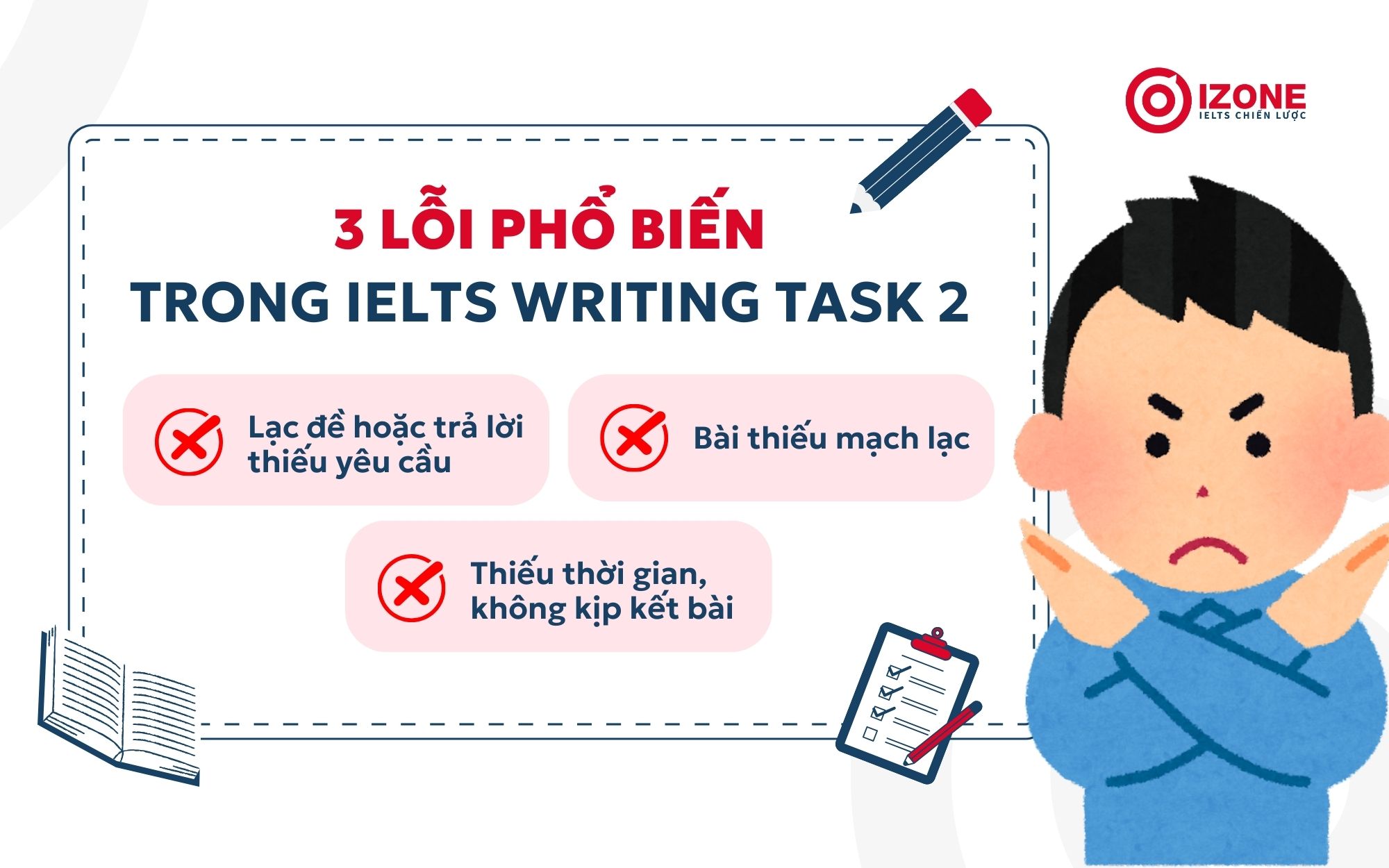
IELTS Writing Task 2 là phần khiến nhiều thí sinh mất điểm nhất vì không chỉ yêu cầu khả năng vận dụng ngôn ngữ tốt, mà còn phải có chiến lược làm bài rõ ràng: từ việc đọc đề, lên dàn ý, lập luận logic trong bài viết và kiểm soát lỗi. Dưới đây là những lỗi sai thường gặp và một vài lưu ý khi viết Task 2 hiệu quả giúp bạn cải thiện khả năng viết của mình.
- Lạc đề hoặc trả lời thiếu yêu cầu (Task Response thấp)
Đây là lỗi rất phổ biến: khi bạn viết dài nhưng không đúng trọng tâm, hoặc bỏ sót một phần yêu cầu của đề ra.
Lỗi thường gặp
Những lỗi này xảy ra khi bạn chưa đáp ứng được yêu cầu cơ bản của các dạng bài làm, một số lỗi sai mà trong quá trình viết có thể gặp phải như:
- Đề hỏi advantages outweigh disadvantages nhưng bạn chỉ liệt kê 2 mặt, không đưa ra quan điểm cụ thể rằng ưu điểm hay nhược điểm vượt trội hơn.
- Discussion essay nhưng chỉ nói 1 quan điểm.
- Problem–Solution nhưng body lại chỉ nói nguyên nhân.
Tips viết đúng IELTS Writing Task 2
Để có band điểm cao hơn khi viết IELTS Writing Task 2, bạn có thể tham khảo một số lưu ý sau đây:
- Định hướng khi đọc đề: bạn hãy gạch chân 3 thứ: topic + yêu cầu + từ khóa dạng bài (agree/disagree, discuss both views, causes, solutions, effects, outweigh…).
- Đưa ra quan điểm chính của bài viết đầu bài một cách rõ ràng: I agree that… because… / The advantages outweigh because…
- Trong phần thân bài, nên viết theo hướng Diễn giải và nêu rõ luận điểm trong từng đoạn, Ví dụ: Body 1 = luận điểm 1, Body 2 = luận điểm 2(đặc biệt với Two-part Question).
2. Bài thiếu mạch lạc (Coherence & Cohesion thấp)
Biểu hiện dễ thấy nhất của lỗi này là khi bài viết của bạn có ý nhưng người đọc cảm thấy không mạch lạc, không có sự kết nối giữa các luận điểm bạn đưa ra trong bài.
Lỗi thường thường gặp
- Đoạn văn dài nhưng thiếu câu chủ đề (topic sentence).
- Dùng quá nhiều linking words nhưng không đảm bảo tính logic.
Tips khắc phục
- Mỗi body theo khung đơn giản, rõ ràng: Topic sentence → Explain → Example → Result.
- Mỗi đoạn chỉ 1 tập trung đưa ra quan điểm về 1 ý lớn (đừng nhồi 3–4 ý nhỏ).
- Sử dụng linking word vừa đủ, đúng chỗ & ưu tiên sử dụng những từ dễ dùng: First, However, As a result, Therefore…
3. Thiếu thời gian, không kịp kết bài
Nhiều thí sinh bị hết ý ở Body 2 hoặc không kịp viết phần Conclusion dẫn tới mất điểm Task 2. Lỗi này thường xảy ra khi bạn không có định hướng tốt cho những đề bài khó hoặc chưa phân bổ thời gian viết hợp lý dẫn tới không kịp kết thúc bài.
- Phân chia thời gian hợp lý, Ví dụ: 5 phút dàn ý → 25 phút viết → 5 phút soát lỗi.
- Introduction + Conclusion ngắn gọn nhưng đảm bảo yêu cầu mỗi phần (ngắn, rõ, đúng hướng).
- Nếu gần hết giờ, bạn vẫn nên viết 1 câu conclusion vẫn tốt hơn bỏ trống.
Để có thêm những kinh nghiệm khi làm IELTS Writing part 2, bạn có thể tham khảo bài viết:Tổng hợp từ A đến Z các kinh nghiệm khi làm IELTS Writing Task 2
Tổng kết
Tóm lại, để viết IELTS Writing Task 2 hiệu quả và cải thiện điểm nhanh, Điều quan trọng nhất là đọc đề đúng dạng, trả lời đủ yêu cầu, và xây dựng bài viết theo một cấu trúc rõ ràng. Qua bài viết trên IZONE mong bạn đọc đã có thêm những kiến thức bổ ích để tránh sai sót trong phần Writing Task 2.