Tham khảo Speaking sample cho đề bài IELTS Speaking Part 2 & 3: Describe something you do regularly to help you work or study effectively do IZONE biên soạn và bỏ túi bộ từ vựng hữu ích cho chủ đề trên trong bài viết này nhé!
Cue Card Describe something you do regularly to help you work or study effectively
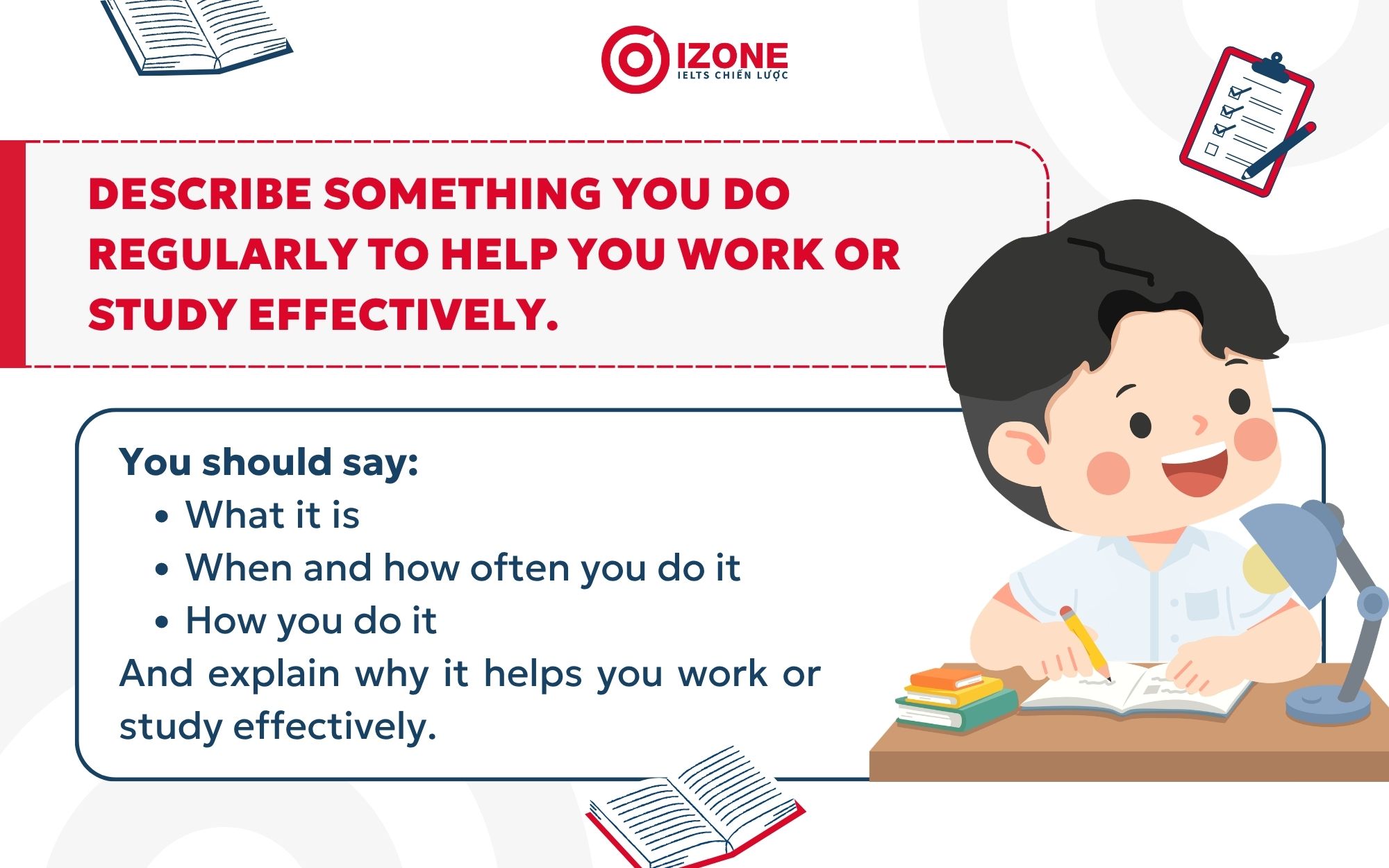
Để hiểu thêm về Cue card, bạn hãy tham khảo bài viết: Hướng dẫn sử dụng Cue card trong IELTS Speaking Part 2.
Hướng dẫn cách triển khai Describe something you do regularly to help you work or study effectively – IELTS Speaking Part 2
1 – What it is (Bạn làm điều gì?)
Ở phần này chỉ nên nói 1-2 câu và nói trong khoảng 10-15 giây. Mục tiêu là giới thiệu nhanh thói quen/hoạt động, chưa cần giải thích sâu. Các nội dung mà bạn nên đề cập:
- Hoạt động đó là gì
- Nó liên quan đến học/làm việc như thế nào
Mẫu câu gợi ý:
- One thing I do regularly to help me [work/study] effectively is [V-ing / activity].
- A habit that really helps me [stay productive / stay focused] is [V-ing / activity].
- A habit that really helps me [stay productive / stay focused] is [V-ing / activity].
- I would like to talk about [activity], which is something I do [frequency].
2 – When and how often you do it (Khi nào và bao lâu làm một lần?)
Bạn nên đề cập trong khoảng 2-3 câu với thời lượng 15-20 giây, mục tiêu là làm rõ tần suất + thời điểm + hoàn cảnh bạn thường làm việc đó. Dựa trên mục tiêu đó, bạn có thể chia thành 3 ý nhỏ sau:
- Bạn làm việc đó bao lâu một lần
- Bạn thường làm vào thời điểm nào
- Bạn làm thường xuyên hơn trong hoàn cảnh nào
Mẫu câu gợi ý:
- I usually do this [frequency], especially when I have [situation].
- I normally do it [time], and it usually takes me around [amount of time].
- I tend to do this [frequency], mostly [before/after] [activity], because it helps me prepare myself for [work/study].
- I’ve been doing this for [period of time], and over time, it has become an essential part of my [daily/weekly] routine.
- Depending on how busy I am, I usually do this [frequency], but during [exam periods/heavy workloads], I make it a point to do it more consistently.
3 – How you do it (Bạn thực hiện nó như thế nào?)
Phần này nên được trình bày từ 3-4 câu, tương đương 25-35 giây. Bạn nên nói được quy trình thực hiện một cách cụ thể, logic và có hệ thống, thay vì chỉ mô tả hoạt động một cách chung chung. Để triển khai được như vậy bạn nên trả lời được các ý:
- Bạn dùng công cụ gì
- Bạn làm theo những bước nào
- Bạn có cách duy trì/kiểm tra kết quả ra sao
Mẫu câu gợi ý:
- First, I [do something], and then I [do another thing].
- I usually start by [V-ing], before [V-ing] to make sure everything is clear.
- I tend to use [tool/app/method] to [purpose], which makes the whole process much easier and more organized.
- What I normally do is [step 1], then I [step 2], and finally I [step 3].
- Instead of doing it randomly, I follow a clear system: I first [step 1], then [step 2], and after that, I [step 3] so that I can [benefit].
4 – And explain why it helps you work or study effectively (Và giải thích vì sao việc đó giúp bạn học/làm việc hiệu quả)
Phần này nên nói 4-5 câu, khoảng 35-45 giây. Mục tiêu là làm rõ tác động thực tế của thói quen đó, ví dụ: giúp tập trung hơn, quản lý thời gian tốt hơn, giảm căng thẳng, tăng động lực hoặc cải thiện kết quả học tập/công việc.
Mẫu câu gợi ý:
- It helps me [benefit] because I can [result].
- This habit makes me feel more [adjective], so I can [do something] more effectively.
- One major benefit is that it helps me [benefit], especially when I have [situation].
- It allows me to [benefit] instead of [negative habit/problem], which used to affect my productivity.
- More importantly, it has a long-term impact on my [discipline/productivity/concentration], as it trains me to [positive habit] on a regular basis.
Bài mẫu Describe something you do regularly to help you work or study effectively – IELTS Speaking Part 2 band 7.0
One thing I do regularly to help me study effectively is making a daily to-do list. It may sound quite simple, but I find it extremely useful because it helps me stay organized and focused.
I usually do this every evening before going to bed. It normally takes me about 10 minutes, but when I have a busy schedule or an important exam coming up, I spend a bit more time planning everything carefully.
The way I do it is quite systematic. First, I write down all the tasks I need to complete the next day. Then, I arrange them based on priority, starting with the most important or urgent ones. I also try to break large tasks into smaller steps, so they feel less overwhelming and easier to manage.
This habit helps me work and study more effectively for several reasons. Firstly, it gives me a clear direction, so I do not waste time wondering what to do next. Secondly, it helps me manage my workload better and avoid procrastination. I also feel more motivated whenever I tick off a completed task, because it gives me a sense of achievement.
Before developing this habit, I often left things until the last minute, especially when I had many assignments to finish. However, over time, making a to-do list has helped me become more disciplined and productive. So overall, I would say this is a simple but powerful habit that has had a positive impact on my study routine.
Dịch nghĩa:
Một điều tôi thường xuyên làm để giúp bản thân học tập hiệu quả hơn là lập danh sách công việc hằng ngày. Nghe thì có vẻ khá đơn giản, nhưng tôi thấy nó cực kỳ hữu ích vì nó giúp tôi duy trì sự ngăn nắp và tập trung.
Tôi thường làm việc này vào mỗi buổi tối trước khi đi ngủ. Thông thường, nó chỉ mất khoảng 10 phút, nhưng khi tôi có lịch trình bận rộn hoặc sắp có một kỳ thi quan trọng, tôi sẽ dành nhiều thời gian hơn để lên kế hoạch một cách cẩn thận.
Cách tôi thực hiện việc này khá có hệ thống. Đầu tiên, tôi viết ra tất cả những công việc cần hoàn thành vào ngày hôm sau. Sau đó, tôi sắp xếp chúng theo mức độ ưu tiên, bắt đầu từ những việc quan trọng hoặc cấp bách nhất. Tôi cũng cố gắng chia những nhiệm vụ lớn thành các bước nhỏ hơn để chúng bớt gây cảm giác quá tải và dễ xử lý hơn.
Thói quen này giúp tôi học tập và làm việc hiệu quả hơn vì nhiều lý do. Thứ nhất, nó giúp tôi có định hướng rõ ràng nên tôi không lãng phí thời gian để suy nghĩ xem nên làm gì tiếp theo. Thứ hai, nó giúp tôi quản lý khối lượng công việc tốt hơn và tránh trì hoãn. Tôi cũng cảm thấy có động lực hơn mỗi khi đánh dấu hoàn thành một nhiệm vụ, bởi vì điều đó mang lại cho tôi cảm giác thành tựu.
Trước khi hình thành thói quen này, tôi thường để mọi việc đến phút chót, đặc biệt là khi có quá nhiều bài tập cần hoàn thành. Tuy nhiên, theo thời gian, việc lập danh sách công việc đã giúp tôi trở nên kỷ luật và năng suất hơn. Vì vậy, nhìn chung, tôi nghĩ đây là một thói quen đơn giản nhưng rất hiệu quả và đã tạo ra ảnh hưởng tích cực đến việc học của tôi.
Từ vựng quan trọng:
- making a daily to-do list: lập danh sách việc cần làm hằng ngày
- stay organized: giữ mọi thứ có tổ chức
- focused: tập trung
- a busy schedule: lịch trình bận rộn
- an important exam coming up: một kỳ thi quan trọng sắp tới
- systematic: có hệ thống
- arrange them based on priority: sắp xếp chúng theo mức độ ưu tiên
- break large tasks into smaller steps: chia việc lớn thành các bước nhỏ hơn
- overwhelming: quá tải
- a clear direction: định hướng rõ ràng
- manage my workload: quản lý khối lượng công việc
- avoid procrastination: tránh trì hoãn
- tick off a completed task: đánh dấu một việc đã hoàn thành
- a sense of achievement: cảm giác thành tựu
- left things until the last minute: để mọi việc đến phút chót
- disciplined: có kỷ luật
- productive: năng suất
Câu trả lời mẫu IELTS Speaking Part 3
| 1, What habits can help people study or work more effectively? |
I think habits such as planning tasks in advance, setting clear priorities, and taking regular breaks can help people study or work more effectively. These habits allow people to manage their workload better instead of feeling overwhelmed. For example, if students make a study plan before an exam, they are more likely to stay focused and avoid last-minute pressure.
| Từ vựng/ Cụm từ | Nghĩa |
| habits | thói quen |
| study or work more effectively | học tập hoặc làm việc hiệu quả hơn |
| planning tasks in advance | lên kế hoạch công việc trước |
| setting clear priorities | đặt thứ tự ưu tiên rõ ràng |
| taking regular breaks | nghỉ giải lao đều đặn |
| manage their workload | quản lý khối lượng công việc |
| overwhelmed | quá tải |
| stay focused | giữ tập trung |
| last-minute pressure | áp lực sát hạn |
| 2, Why do some people find it difficult to stay focused? |
There are several reasons why people struggle to stay focused. One major reason is that they are often surrounded by digital distractions, such as social media notifications or online entertainment. Another reason is that some people do not have a clear goal, so they easily lose motivation. In my opinion, focus is not just about willpower; it also depends on having the right environment and a realistic plan.
| Từ vựng / Cụm từ | Nghĩa |
| stay focused | duy trì sự tập trung |
| digital distractions | sự xao nhãng từ thiết bị/công nghệ |
| a clear goal | mục tiêu rõ ràng |
| lose motivation | mất động lực |
| willpower | ý chí |
| 3, Should schools teach students how to manage their time? |
Yes, definitely. Time management is an important life skill, but many students are never taught how to plan their study schedule or deal with deadlines. If schools included this skill in the curriculum, students would become more independent and less stressed. It could also help them prepare better for university and future jobs, where self-discipline is extremely important.
| Từ vựng / Cụm từ | Nghĩa |
| manage their time | quản lý thời gian |
| time management | kỹ năng quản lý thời gian |
| study schedule | lịch học |
| deal with deadlines | xử lý hạn nộp bài/công việc |
| self-discipline | tính tự kỷ luật |
Hy vọng với bài hướng dẫn chi tiết này, bạn đã tự tin hơn để đối đầu với chủ đề Describe something you do regularly to help you work or study effectively. Chúc các bạn ôn luyện tốt và sớm đạt được band điểm mục tiêu và đừng quên tham khảo thêm những bài viết trong series IELTS Speaking để học thêm những kiến thức mới về IELTS nhé.
Xem thêm: Bài Mẫu IELTS Speaking Part 2 & 3: Describe a special occasion in your life