Giải thích đáp án chi tiết A remarkable beetle mini IELTS Reading
Cùng thực hành giải bài đọc A Remarkable Beetle mini IELTS Reading và tham khảo phần giải thích đáp án chi tiết từ IZONE trong bài viết này nhé!
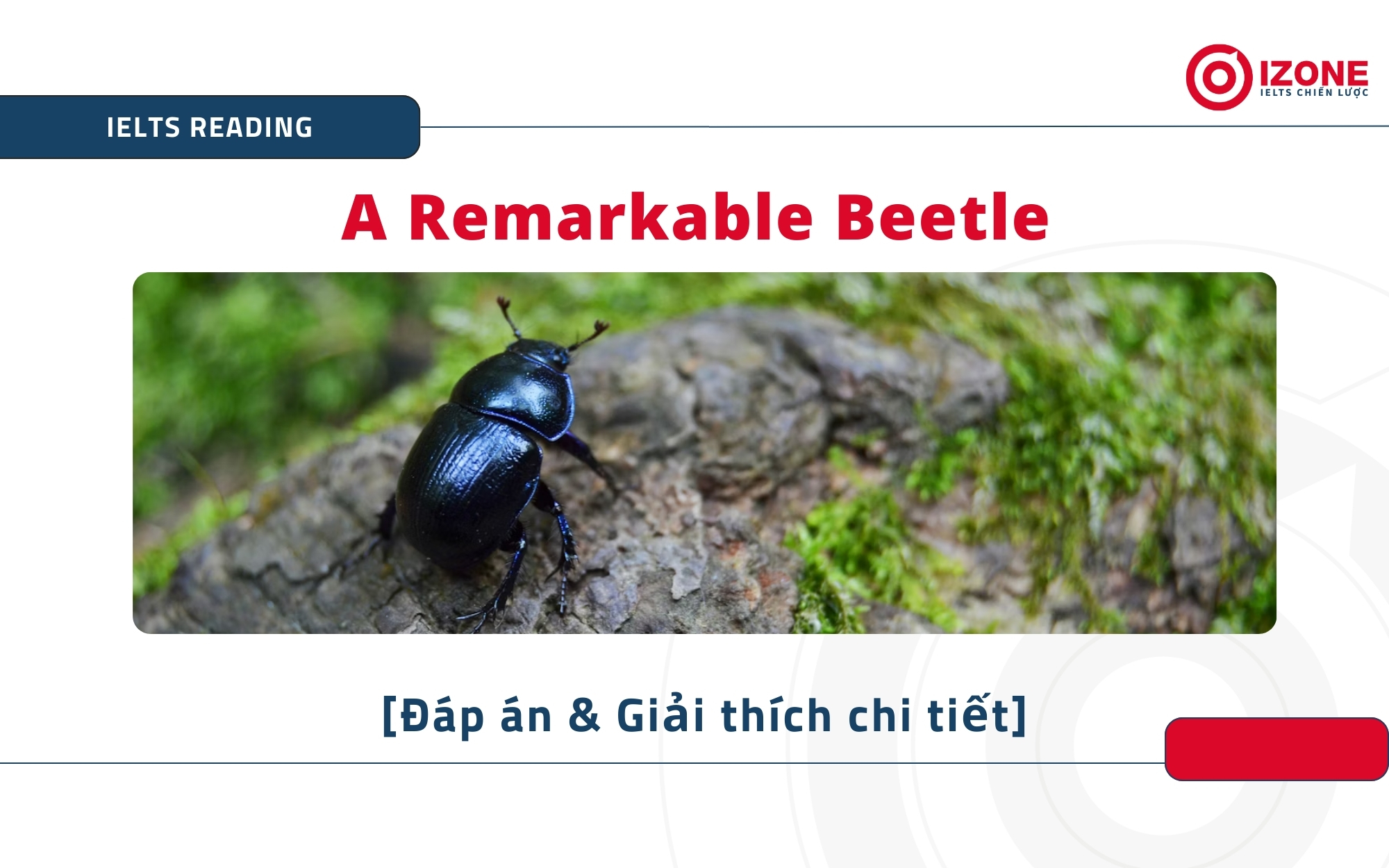
Bài đọc A Remarkable Beetle IELTS Reading answers
More than 4,000 species of these remarkable creatures have evolved and adapted to the world’s different climates and the dung of its many animals. Australia’s native dung beetles are scrub and woodland dwellers, specialising in coarse marsupial droppings and avoiding the soft cattle dung in which bush flies and buffalo flies breed.Some of the most remarkable beetles are the dung beetles, which spend almost their whole lives eating and breeding in dung’.
In the early 1960s George Bornemissza, then a scientist at the Australian Government’s premier research organisation, the Commonwealth Scientific and Industrial Research Organisation (CSIRO), suggested that dung beetles should be introduced to Australia to control dung-breeding flies. Between 1968 and 1982, the CSIRO imported insects from about 50 different species of dung beetle, from Asia, Europe and Africa, aiming to match them to different climatic zones in Australia. Of the 26 species that are known to have become successfully integrated into the local environment, only one, an African species released in northern Australia, has reached its natural boundary.
Introducing dung beetles into a pasture is a simple process: approximately 1,500 beetles are released, a handful at a time, into fresh cow pats2 in the cow pasture.
The beetles immediately disappear beneath the pats digging and tunnelling and, if they successfully adapt to their new environment, soon become a permanent, self sustaining part of the local ecology. In time they multiply and within three or four years the benefits to the pasture are obvious.
Dung beetles work from the inside of the pat so they are sheltered from predators such as birds and foxes. Most species burrow into the soil and bury dung in tunnels directly underneath the pats, which are hollowed out from within. Some large species originating from France excavate tunnels to a depth of approximately 30 cm below the dung pat. These beetles make sausage-shaped brood chambers along the tunnels. The shallowest tunnels belong to a much smaller Spanish species that buries dung in chambers that hang like fruit from the branches of a pear tree. South African beetles dig narrow tunnels of approximately 20 cm below the surface of the pat. Some surface-dwelling beetles, including a South African species, cut perfectly-shaped balls from the pat, which are rolled away and attached to the bases of plants.
For maximum dung burial in spring, summer and autumn, farmers require a variety of species with overlapping periods of activity. In the cooler environments of the state of Victoria, the large French species (2.5 cms long) is matched with smaller (half this size), temperate-climate Spanish species. The former are slow to recover from the winter cold and produce only one or two generations of offspring from late spring until autumn. The latter, which multiply rapidly in early spring, produce two to five generations annually. The South African ball-rolling species, being a subtropical beetle, prefers the climate of northern and coastal New South Wales where it commonly works with the South African tunnelling species. In warmer climates, many species are active for longer periods of the year.
Dung beetles were initially introduced in the late 1960s with a view to controlling buffalo flies by removing the dung within a day or two and so preventing flies from breeding. However, other benefits have become evident. Once the beetle larvae have finished pupation, the residue is a first-rate source of fertiliser. The tunnels abandoned by the beetles provide excellent aeration and water channels for root systems. In addition, when the new generation of beetles has left the nest the abandoned burrows are an attractive habitat for soil-enriching earthworms. The digested dung in these burrows is an excellent food supply for the earthworms, which decompose it further to provide essential soil nutrients. If it were not for the dung beetle, chemical fertiliser and dung would be washed by rain into streams and rivers before it could be absorbed into the hard earth, polluting water courses and causing blooms of blue-green algae. Without the beetles to dispose of the dung, cow pats would litter pastures making grass inedible to cattle and depriving the soil of sunlight. Australia’s 30 million cattle each produce 10-12 cow pats a day. This amounts to 1.7 billion tonnes a year, enough to smother about 110,000 sq km of pasture, half the area of Victoria.
Dung beetles have become an integral part of the successful management of dairy farms in Australia over the past few decades. A number of species are available from the CSIRO or through a small number of private breeders, most of whom were entomologists with the CSIRO’s dung beetle unit who have taken their specialised knowledge of the insect and opened small businesses in direct competition with their former employer.
Glossary
- dung: the droppings or excreta of animals
- cow pats: droppings of cows
Questions 5-7
Do the following statements agree with the information given in Reading Passage?
In boxes 7-14 on your answer sheet, write
YES if the statement agrees with the information
NO if the statement contradicts the information
NOT GIVEN if these is no information on this
Questions 6-8
Label the tunnels on the diagram below. Choose your labels from the box below the diagram.
Write your answers in boxes 6-8 on your answer sheet.
Diagram
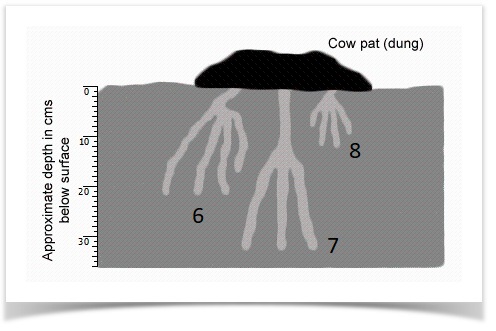
Dung Beetle Types
6.
7.
8.
Question 9-13
Complete the table below.
Choose NO MORE THAN THREE WORDS OR A NUMBER from Reading Passage 1 for each answer.
Write your answers in boxes 9-13 on your answer sheet.
|
Species |
Size |
Preferred climate |
Complementary species |
Start of active period |
Number of generations per year |
|
French |
2.5 cm |
cool |
Spanish |
late spring |
1-2 |
|
Spanish |
1.25 cm |
9 |
10 |
11 |
|
|
South African ball roller |
12 |
13 |
Điểm số của bạn là % - đúng / câu
Đáp án và giải thích đáp án chi tiết A Remarkable Beetle IELTS Reading answers
1. Answer: NOT GIVEN | 8. Answer: Spanish |
2. Answer: FALSE | 9. Answer: temperate |
3. Answer: TRUE | 10. Answer: early spring |
4. Answer: TRUE | 11. Answer: 2-5 |
5. Answer: FALSE | 12. Answer: sub-tropical |
6. Answer: South African | 13. Answer: South African tunneling |
7. Answer: French |
Giải thích đáp án chi tiết A Remarkable Beetle mini IELTS Reading
Questions 1 – 5: Dạng TRUE/FALSE/NOT GIVENCách làm: Bước 1: Đọc kĩ câu hỏi và gạch chân từ khóa Bước 2: Scan từ khóa đã gạch trong bài đọc Bước 3: Chú ý tới controlling words (not, only, the majority etc.) Bước 4: Chọn đáp án phù hợp Chọn đáp án bằng cách lần lượt trả lời 2 câu hỏi: Câu 1: Các thông tin trong câu hỏi ĐỀU TÌM ĐƯỢC NỘI DUNG TƯƠNG ỨNG trong bài đọc hay không? Nội dung tương ứng là những nội dung cùng chỉ về 1 điều, mang cùng 1 chức năng trong câu.
Câu 2: Có thông tin nào trong câu hỏi bị TRÁI NGƯỢC/SAI LỆCH với nội dung bài đọc hay không?
|
|
|
1. Bush flies are easier to control than buffalo flies. => Không có thông tin so sánh mức độ dễ kiểm soát giữa ruồi bụi và ruồi trâu trong bài. Chỉ nói rằng cả hai loại ruồi sinh sản trong phân bò mềm, và phân bò được xử lý để ngăn ruồi sinh sản, nhưng không có so sánh trực tiếp. Đáp án: NOT GIVEN |
Australia’s native dung beetles are scrub and woodland dwellers, specialising in coarse marsupial droppings and avoiding the soft cattle dung in which bush flies and buffalo flies breed (Đoạn 1) |
|
2. Four thousand species of dung beetle were initially brought to Australia by the CSIRO. => Trong bài nói có 4000 loài trên thế giới, nhưng chỉ có khoảng 50 loài được mang tới Aus bởi CSIRO, không phải 4000. Đáp án: FALSE |
Between 1968 and 1982, the CSIRO imported insects from about 50 different species of dung beetle, from Asia, Europe and Africa, aiming to match them to different climatic zones in Australia (Đoạn 2) |
|
3. Dung beetles were brought to Australia by the CSIRO over a fourteen-year period. => Bài nói rõ là từ năm 1968 đến 1982, đúng 14 năm. Đáp án: TRUE |
Between 1968 and 1982, the CSIRO imported insects from about 50 different species of dung beetle, from Asia, Europe and Africa, aiming to match them to different climatic zones in Australia (Đoạn 2) |
|
4. At least twenty-six of the introduced species have become established in Australia. => Bài đọc nói rõ đã có 26 loài đã thích nghi thành công và tồn tại lâu dài. Đáp án: TRUE |
Of the 26 species that are known to have become successfully integrated into the local environment, only one, an African species released in northern Australia, has reached its natural boundary. (Đoạn 2) |
|
5. The dung beetles cause an immediate improvement to the quality of a cow pasture. => Bài đọc cho biết phải mất 3–4 năm mới thấy hiệu quả rõ rệt. Đáp án: FALSE |
In time they multiply and within three or four years the benefits to the pasture are obvious. (Đoạn 4) |
Questions 6-8: Dạng Diagram CompletionCách làm: Bước 1: Khoanh tròn giới hạn từ được điền Bước 2: Nghiên cứu Diagram và xác định loại từ cho mỗi chỗ trống Bước 3: Skim bài text để tìm ra những đoạn liên quan chứa đáp án Bước 4: Scan đoạn văn và điền đáp án đúng, chú ý giới hạn từ |
|
|
6. Đáp án: South African => Đường hầm sâu khoảng 20 cm thuộc về loài bọ cánh cứng Nam Phi (không phải loài lăn bóng). Vì bài có nêu rõ “South African beetles dig narrow tunnels of approximately 20 cm”. |
South African beetles dig narrow tunnels of approximately 20 cm below the surface of the pat |
|
7. Đáp án: French => Bọ Pháp đào đường hầm sâu nhất (khoảng 30 cm), tạo ra các khoang sinh sản hình xúc xích. |
Some large species originating from France excavate tunnels to a depth of approximately 30 cm below the dung pat |
|
8. Đáp án: Spanish => Bọ Tây Ban Nha nhỏ hơn, tạo ra khoang sinh sản nông giống như quả treo từ cành cây — biểu thị đường hầm nông nhất. |
The shallowest tunnels belong to a much smaller Spanish species that buries dung in chambers that hang like fruit from the branches of a pear tree. |
Questions 9-13: Dạng Table CompletionCách làm: Bước 1: Khoanh tròn giới hạn từ được điền Bước 2: Nghiên cứu Diagram/ Table/ Flowchart và xác định loại từ cho mỗi chỗ trống Bước 3: Skim bài text để tìm ra những đoạn liên quan chứa đáp án Bước 4: Scan đoạn văn và điền đáp án đúng, chú ý giới hạn từ |
|
|
9. Preferred climate of Spanish Species => Ở đoạn này chỉ rõ loài Tây Ban Nha phù hợp với khí hậu ôn đới (“temperate-climate”). Từ “matched with” ám chỉ rằng hai loài này tương thích với khí hậu ở Victoria, nơi có khí hậu ôn đới. Đáp án là: temperate |
In the cooler environments of the state of Victoria, the large French species (2.5 cms long) is matched with smaller (half this size), temperate-climate Spanish species. |
|
10. Start of active period of Spanish Species => “The latter” ở đây là loài Spanish. Việc nhân giống nhanh vào đầu mùa xuân cho thấy chúng bắt đầu hoạt động từ early spring. |
The latter, which multiply rapidly in early spring, produce two to five generations annually. |
|
11. Number of generations per year of Spanish Species => Bài đọc đã cho biết mỗi năm loài này sinh ra từ 2 đến 5 thế hệ |
The latter, which multiply rapidly in early spring, produce two to five generations annually. |
|
12. Preferred climate of South African ball roller => Bài đọc cho biết loài này thích hợp với khí hậu cận nhiệt đới (subtropical) Đáp án là : sub-tropical |
The South African ball-rolling species, being a subtropical beetle, prefers the climate of northern and coastal New South Wales where it commonly works with the South African tunnelling species. |
|
13. Complementary species of South African ball roller => “It” ở đây chính là South African ball roller. Cụm “works with” là cách nói khác của complementary species – hai loài này cùng hoạt động tại cùng vùng. Đáp án là :South African tunneling. |
The South African ball-rolling species, being a subtropical beetle, prefers the climate of northern and coastal New South Wales where it commonly works with the South African tunnelling species. |
Tổng kết
Bài viết trên IZONE đã cung cấp phần giải thích đáp án chi tiết cho bài đọc A Remarkable Beetle mini IELTS Reading. Mời bạn tiếp tục luyện tập kỹ năng Reading tại chuyên mục IELTS Reading của IZONE.
Luyện tập với: Giải chi tiết Environmental Management IELTS Reading