Trong bài viết này, hãy cùng IZONE phân tích chủ đề IELTS Speaking Part 2: Describe an important old thing that your family has kept for a long time nhằm luyện tập nâng cao kỹ năng nói.
Đề thi IELTS Speaking part 2 mẫu cho chủ đề: Describe an important old thing that your family has kept for a long time
Trước hết, với phần thi IELTS Speaking Part 2, giám khảo sẽ cho bạn một Cue card bao gồm chủ đề cần nói và các câu hỏi gợi ý. Phần thi này yêu cầu thí sinh trình bày chủ đề trong vòng 2 phút với thời gian là 1 phút chuẩn bị.
Bạn có thể tham khảo cue card sau đây:
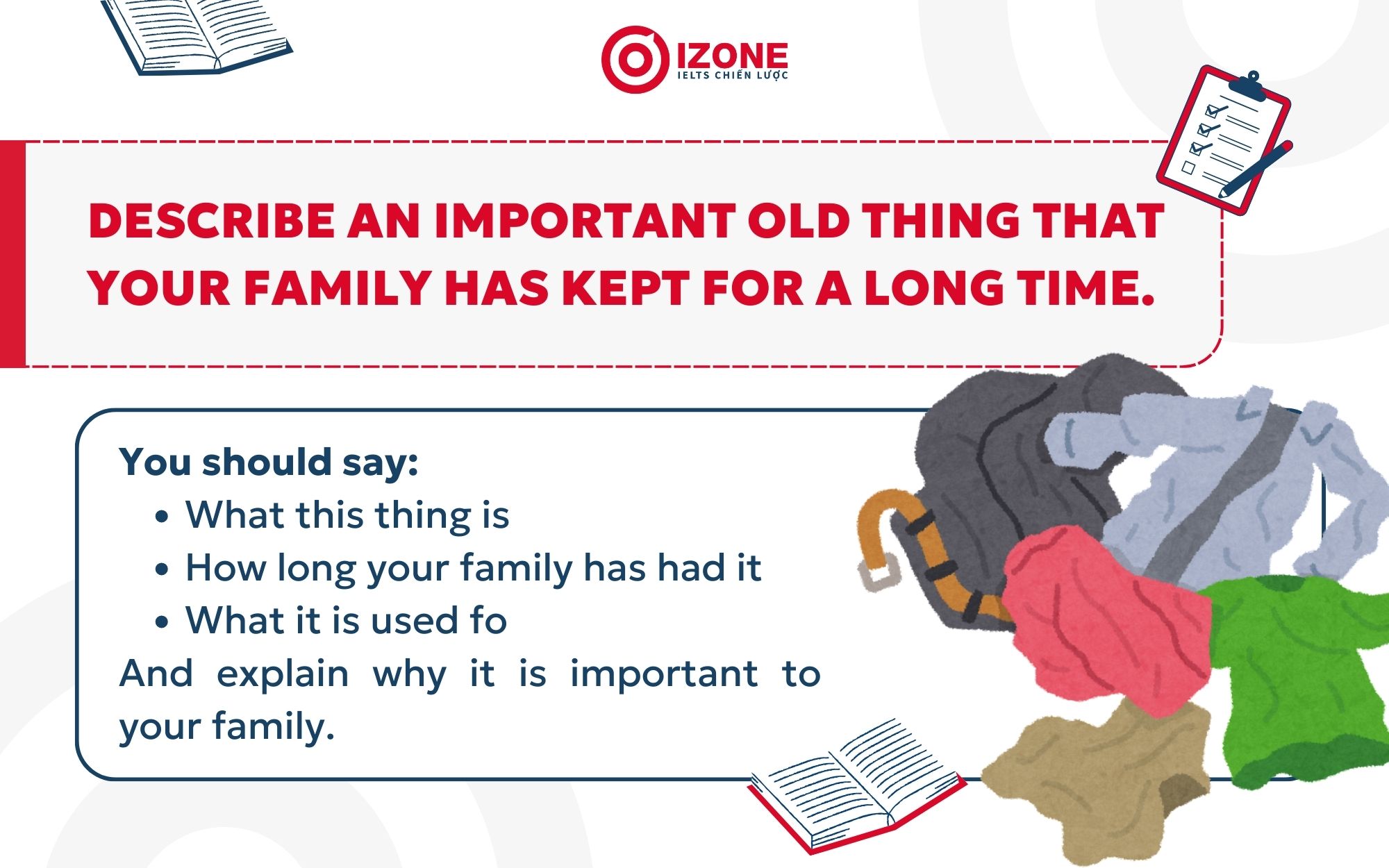
Describe an important old thing that your family has kept for a long time.
You should say:
- What this thing is
- How long your family has had it
- What it is used for
- And explain why it is important to your family.
Xem thêm: Cue card là gì? Hướng dẫn sử dụng Cue card trong IELTS Speaking Part 2
Hướng dẫn trả lời IELTS Speaking Part 2: Describe an important old thing that your family has kept for a long time
Với cue card như trên, bạn có thể tham khảo cách trả lời sau tới từ IZONE
What this thing is | Name a specific object (antique furniture, piece of jewelry, old photo album, musical instrument, vehicle, household appliance…). Ví dụ (Example): “It’s a string of pearl necklaces passed down from my great-grandmother.” (Chuỗi ngọc trai từ cố của tôi) Mô tả thêm về món đồ:
|
How long your family has had it | This depends on the history of the object. You can mention specific years, generations, or historical events associated with it. Gợi ý diễn đạt:
|
What it is used for | Tell about the function of the object. Compare its past use vs. present use (This is a great way to expand your answer).
|
And explain why it is important to your family. | Ở câu hỏi này, bạn có thể trả lời theo nhiều hướng khác nhau thay vì chỉ đề cập tới giá trị vật chất của đồ vật (Đắt hay rẻ).
|
Ngoài ra, IZONE còn có một số từ vựng mà bạn có thể tham khảo để áp dụng vào bài nói như sau:
| Từ vựng | Phiên âm | Nghĩa |
| Heirloom (n) | /ˈer.luːm/ | Vật gia bảo, đồ truyền đời |
| Antique (n/adj) | /ænˈtiːk/ | Đồ cổ, cổ xưa (thường có giá trị cao) |
| Vintage (adj) | /vɪn.tɪdʒ/ | Cổ điển (thường chỉ phong cách thời xưa) |
| Sentimental (adj) | /sen.tɪˈmen.təl/ | Thuộc về tình cảm (thường đi với value) |
| Priceless (adj) | /praɪs.ləs/ | Vô giá (quý đến mức không định giá được) |
| Irreplaceable (adj) | /ˌɪr.ɪˈpleɪ.sə.bəl/ | Không thể thay thế được |
| Nostalgia (n) | /nɒsˈtæl.dʒə/ | Sự hoài niệm, nỗi nhớ quá khứ |
| Intricate (adj) | /ˈɪn.trɪ.kət/ | Tinh xảo, cầu kỳ (chi tiết thiết kế) |
| Delicate (adj) | /ˈdel.ɪ.kət/ | Mong manh, dễ vỡ (cần nâng niu) |
| Durable (adj) | /ˈdʒʊə.rə.bəl/ | Bền, lâu hỏng |
| Weathered (adj) | /ˈweð.əd/ | Dãi dầu mưa nắng, sờn màu theo thời gian |
| Rusty (adj) | /ˈrʌs.ti/ | Bị gỉ sét (thường dùng cho kim loại) |
| Pristine (adj) | /ˈprɪs.tiːn/ | Nguyên vẹn, như mới (từ trong ảnh mẫu của bạn) |
| Timeless (adj) | /ˈtaɪm.ləs/ | Vượt thời gian, không bao giờ lỗi mốt |
| Exquisite (adj) | /ɪkˈskwɪz.ɪt/ | Tuyệt mỹ, cực kỳ tinh tế |
| Handcrafted (adj) | /ˈhænd.krɑːf.tɪd/ | Được làm thủ công (bằng tay) |
| Fragile (adj) | /ˈfrædʒ.aɪl/ | Dễ vỡ, mỏng manh |
| Keepsake (n) | /ˈkiːp.seɪk/ | Vật kỷ niệm |
| Resilience (n) | /rɪˈzɪl.i.əns/ | Sự kiên cường, bền bỉ (nghĩa bóng) |
| Inherit (v) | /ɪnˈher.ɪt/ | Thừa kế, được để lại |
| Pass down (v) | /pɑːs daʊn/ | Truyền lại (cho thế hệ sau) |
| Preserve (v) | /prɪˈzɜːv/ | Gìn giữ, bảo quản |
| Cherish (v) | /ˈtʃer.ɪʃ/ | Trân trọng, yêu thương |
| Utilitarian (adj) | /juːˌtɪl.ɪˈteə.ri.ən/ | Mang tính thực dụng/công năng (hơn là trang trí) |
| Reminisce (v) | /ˌrem.ɪˈnɪs/ | Hồi tưởng lại (chuyện cũ) |
Bài nói mẫu IELTS Speaking Part 2: Describe an important old thing that your family has kept for a long time (band 7.0+)
I’m going to talk about a string of pearl necklaces that has been in my family for four generations. It is, without a doubt, the most precious family heirloom we possess, originally belonging to my great-grandmother. Unlike the perfectly round pearls you see in modern jewelry shops, these are natural pearls. This means each bead has a slightly irregular shape and a unique iridescent luster. Over the decades, they have acquired a beautiful creamy, ivory tint, which I think gives them a lot of character. The necklace also features a vintage gold clasp with exquisite craftsmanship that is incredibly hard to find nowadays. It is usually kept in a velvet-lined wooden box that still smells faintly of my grandmother’s old perfume. In terms of its usage, there has been a significant shift. Back in the day, my great-grandmother used to wear this necklace on a regular basis, especially when she wore her traditional Ao Dai for weddings or during the Tet holiday. It was her signature accessory that symbolized elegance. However, nowadays, we treat it very differently. Because it is so fragile and valuable, my mother keeps it securely in a safe. We rarely take it out, and it is only worn on extremely special occasions, like my sister’s wedding last year. This necklace is irreplaceable to my family for two main reasons. First and foremost, it acts as a tangible connection to my ancestors. Even though I never met my great-grandmother, holding the heavy, cool pearls makes me feel connected to her roots. Secondly, it holds immense sentimental value. It’s not just a piece of jewelry; it’s a symbol of our family’s tradition and resilience. We plan to preserve it carefully so it can be passed down to the next generation. |
Useful vocabulary:
| Từ vựng | Phiên âm | Nghĩa |
| Heirloom (n) | /ˈer.luːm/ | Vật gia bảo, đồ truyền đời |
| Iridescent (adj) | /ˌɪr.ɪˈdes.ənt/ | Óng ánh, đổi màu (như xà cừ) |
| Luster (n) | /ˈlʌs.tər/ | Ánh sáng rực rỡ, độ bóng (của ngọc) |
| Exquisite (adj) | /ɪkˈskwɪz.ɪt/ | Tinh xảo, tuyệt mỹ |
| Craftsmanship (n) | /ˈkrɑːfts.mən.ʃɪp/ | Tay nghề thủ công, sự khéo léo |
| Signature accessory (n phrase) | /ˈsɪɡ.nə.tʃər/ | Phụ kiện đặc trưng (tạo nên thương hiệu cá nhân) |
| Fragile (adj) | /ˈfrædʒ.aɪl/ | Mong manh, dễ vỡ |
| Tangible (adj) | /ˈtæn.dʒə.bəl/ | Hữu hình, có thể sờ thấy được |
| Resilience (n) | /rɪˈzɪl.i.əns/ | Sự kiên cường, bền bỉ (nghĩa bóng) |
| Preserve (v) | /prɪˈzɜːv/ | Gìn giữ, bảo quản |
| Irreplaceable (adj) | /ˌɪr.ɪˈpleɪ.sə.bəl/ | Không thể thay thế được |
Các câu hỏi IELTS Speaking Part 3 chủ đề Describe an important old thing that your family has kept for a long time
- You mentioned that in the past, your great-grandmother wore the necklace daily, but now your family keeps it locked in a safe to preserve it. Do you think it’s better to use old objects or to keep them stored away for safety?
Câu trả lời
I think it really depends on the condition of the object. If the item is durable, like an old wooden chair, we should use it because that is its purpose. However, for delicate things like my pearl necklace, it is better to store them away. If we use them too much, they might get damaged, and we would lose a valuable memory.
- You described the necklace as having ‘exquisite craftsmanship’ which is hard to find in today’s ‘mass-produced’ world. Why do you think modern society values speed and quantity over such traditional craftsmanship?
Câu trả lời
I believe the main reason is price and convenience. Making things by hand is extremely time-consuming, which makes them expensive. On the other hand, machines can produce thousands of items quickly and cheaply. Most people today want affordable products that they can buy easily, so they choose factory-made goods instead of handmade ones.
- You said that holding the pearls gives you a ‘tangible connection’ to an ancestor you never met. In what ways can historical objects teach us about the past better than books or videos?
Câu trả lời
Well, books can give us facts, but real objects give us a physical connection. When I hold the necklace, I can feel its weight and see the details with my own eyes. This helps bring history to life. It makes me imagine the lifestyle of my ancestors much better than just reading a description on a page.
Useful vocabulary
| Từ vựng | Phiên âm | Nghĩa |
| Durable (adj) | /ˈdʒʊə.rə.bəl/ | Bền (dùng thay cho strong) |
| Delicate (adj) | /ˈdel.ɪ.kət/ | Mong manh, cần nhẹ tay (dễ hơn từ fragile) |
| Damaged (adj) | /ˈdæm.ɪdʒd/ | Bị hỏng hóc |
| Time-consuming (adj) | /ˈtaɪm.kənˌsjuː.mɪŋ/ | Tốn thời gian |
| Affordable (adj) | /əˈfɔː.də.bəl/ | Giá cả phải chăng (dễ mua) |
| Factory-made (adj) | /ˈfæk.tər.i meɪd/ | Sản xuất tại nhà máy (đối lập với handmade) |
| Physical connection (n) | /ˈfɪz.ɪ.kəl/ | Sự kết nối về mặt vật lý (chạm vào được) |
| Bring history to life (idiom) | Làm lịch sử trở nên sống động | |
| Lifestyle (n) | /ˈlaɪf.staɪl/ | Lối sống |
Bạn có thể tham khảo thêm về IELTS Speaking Part 3 với bài viết: IELTS Speaking Part 3: Tổng hợp câu hỏi và câu trả lời
Tổng kết
Trên đây là tổng hợp gợi ý trả lời và bài mẫu của chủ đề IELTS Speaking Part 2 chủ đề Describe an important old thing that your family has kept for a long time. Hy vọng bài viết này giúp ích cho bạn, đừng quên tham khảo thêm những bài viết trong series Giải đề thi thật – IELTS Speaking để học thêm những kiến thức mới về IELTS nhé.